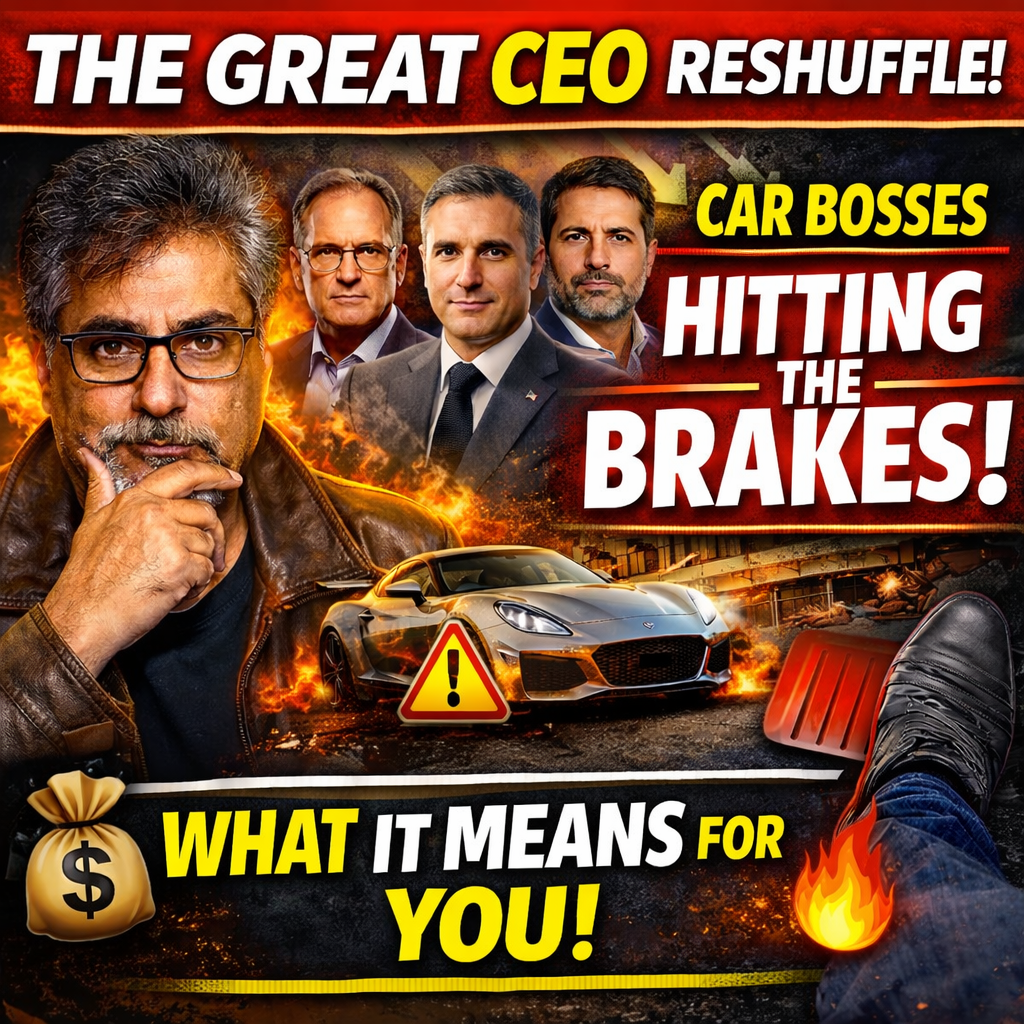
Car CEOs were replaced in 2025 – and it wasn’t because the industry is winning
Something significant is happening at the very top of the global car industry, and it isn’t loud, dramatic or accompanied by the usual marketing fanfare. There are no slick launch events, no bold vision statements, no glossy videos promising to reinvent mobility as we know it. Instead, there is a quiet but unmistakable pattern emerging: car company bosses are leaving, being replaced, or stepping aside, and the people taking their seats look nothing like the rockstar executives of just a few years ago.
CAR Magazine recently dubbed it “The great CEO reshuffle”, and the phrase is apt. In a remarkably short space of time, the industry has watched the departure or sidelining of some of its most recognisable, outspoken and, in many cases, polarising leaders. What has replaced them is something far more sober, far less flamboyant, and far more revealing about the true state of the car business in 2025.
This is not a story about individual personalities. It is a story about fear, realism, and an industry coming to terms with the fact that the future it so confidently sold to itself in 2021 has not quite materialised.
From rockstars to risk managers
Not long ago, car CEOs were encouraged to behave like disruptors. They were meant to break things, challenge norms, rip up old business models and chase the kind of transformational change that looked great on investor decks and conference stages. Software would unlock vast new revenue streams. Electric vehicles would sell themselves. Direct sales would cut out the middleman. China would remain an endless growth engine. Tesla, we were told, had shown everyone the way.
Fast forward to 2025 and that optimism has curdled into caution.
Across the industry, boards are no longer looking for visionaries. They are looking for insiders. People who know the organisation intimately, understand where the costs hide, appreciate how fragile supply chains really are, and have enough institutional memory to avoid repeating expensive mistakes. As CAR Magazine neatly put it, the new breed of CEO is there to prevent disruption, not create it.
That single sentence explains almost everything.
At Stellantis, Carlos Tavares is gone, replaced by Antonio Filosa. At Renault, Luca de Meo has exited, with François Provost stepping up from within. Volvo has turned back to a familiar face in Håkan Samuelsson. Nissan has handed the reins to Ivan Espinosa. JLR is preparing for PB Balaji to take over from Adrian Mardell. Porsche, meanwhile, has separated its leadership more clearly after Oliver Blume’s dual role overseeing both Porsche and the wider Volkswagen Group came under increasing scrutiny.
Different companies, different challenges, same instinctive response. Close ranks. Reduce risk. Steady the ship.
Why the mood changed so quickly
To understand why this is happening now, you have to rewind just a few years. In the early 2020s, the car industry convinced itself that it was on the brink of a golden age. Electric vehicles were going to be cleaner, simpler and more profitable. Software-defined cars would generate recurring income. New business models would offset shrinking margins on hardware. Governments were aligned. Investors were enthusiastic. Consumers, it was assumed, would follow.
What actually happened was messier.
Electric vehicle demand proved far more price sensitive than expected. Software revenues remained largely theoretical. Direct sales alienated dealers without delivering the promised efficiency gains. China, once the industry’s growth saviour, became brutally competitive, hostile even, to European premium brands. Europe stagnated. The United States became politically unpredictable again, with tariffs and trade tensions firmly back on the agenda.
As one industry consultant quoted by CAR put it, no CEO today is comfortable. They are dealing with multiple fires at once, and those fires are burning in different places depending on where you do business. That is not an environment that rewards grand, risky bets.
Perhaps the most damning reassessment of all concerns Tesla. For years, legacy manufacturers were told to copy its playbook. In hindsight, as CAR Magazine bluntly observed, Tesla turned out to be a terrible role model in many ways. Its success was built on circumstances that could not be easily replicated by century-old manufacturers carrying legacy costs, dealer networks and regulatory baggage.
One world became three
One of the most quietly astonishing admissions in the article comes from Volvo. The company now openly accepts that the global car market has fragmented to such an extent that it must effectively build three different Volvos: one for the United States, one for Europe, and one for China. The idea of a single global product strategy, once the cornerstone of automotive efficiency, has fractured under the weight of geopolitics, regulation and divergent consumer behaviour.
When a premium manufacturer admits it can no longer build one car for the world, you know the old assumptions are broken.
This fragmentation alone explains much of the CEO reshuffle. Managing a single global strategy is one thing. Juggling three semi-independent regional businesses, each facing different regulations, tariffs, competitors and consumer expectations, is quite another. That requires operational discipline, not visionary rhetoric.
The EV climb-down, quietly underway
Nowhere is this shift more evident than in how companies are recalibrating their electric vehicle strategies. At Stellantis, the new leadership has begun quietly rolling back some of the more ambitious projections laid out under the previous regime, reviving delayed or cancelled US launches and softening earlier claims about software-led revenue windfalls. At Nissan, the problem is almost the inverse: too much capacity chasing too little demand, resulting in plant closures and job cuts justified by a stark admission that fixed costs no longer match reality.
Even Porsche, long regarded as immune to industry turbulence, has acknowledged that its traditional business model no longer works in its current form, with China’s sudden cooling towards European premium brands playing a significant role.
At JLR, the appointment of a Tata Group finance heavyweight is telling. It signals a period of tighter financial control at a time when EV investment costs are soaring, demand is unpredictable, political risk is rising and the company is still dealing with the fallout from a damaging cyber attack. This is not the language of expansion. It is the language of caution, balance sheets and survival.
It also raises an intriguing question about the future of Jaguar’s much-publicised reinvention. Bold rebrands and radical repositioning look very different when the priority shifts from ambition to discipline.
What this means for buyers in 2026
For consumers, this reset is not necessarily bad news. In fact, it may be the most positive development the industry has seen in years.
When car companies stop chasing fantasies and start responding to reality, products tend to improve. Fewer half-baked models are rushed to market simply to satisfy regulators or impress investors. Powertrain diversity persists because it has to. Discounts become more common as manufacturers focus on volume as well as margins. The tone of communication shifts from lecturing to listening.
Development cycles may still shorten, but with clearer purpose. EVs will arrive when they make sense, not when spreadsheets demand it. Hybrids and combustion engines will stick around longer than many predicted, not out of stubbornness, but because that is where real demand still exists.
The great irony is that boring CEOs might turn out to be exactly what the car industry needs right now.
As Nick Gibbs wryly concluded in CAR Magazine, it is a good job they are paid well, because the new automotive CEO rulebook is full of contradictions. Increase profits while discounting to push volume. Cut costs while offering EVs, hybrids and combustion cars. Match Chinese development speeds without sacrificing quality. Prepare for a future that may be rewritten by politics at any moment.
For buyers watching from the sidelines, the message is clear. The industry has stopped pretending everything is fine. And that honesty, however unglamorous, is often the first step towards better cars.
azon. Every bit helps me keep creating independent automotive content that actually helps people.
Support independent car journalism 🙏🏽☺️ grab my books on Amazon, take up membership to BrownCarGuy on YouTube, or join me on Ko-Fi or Patreon.

👉🏽 Channel membership: https://www.youtube.com/browncarguy/join
👉🏽 Buy me a Coffee! https://ko-fi.com/browncarguy
👉🏽 Patreon – https://www.patreon.com/BrownCarGuy

MY BOOKS ON AMAZON!
📖 Want to become an automotive journalist, content creator, or car influencer? Check out my book: How to be an Automotive Content Creator 👉🏽 https://amzn.eu/d/7VTs0ii
📖 Quantum Races – A collection of my best automotive sci-fi short stories! 👉🏽 https://amzn.eu/d/0Y93s9g
📖 The ULEZ Files – Debut novel – all-action thriller! 👉🏽 https://amzn.eu/d/d1GXZkO
Discover more from Brown Car Guy
Subscribe to get the latest posts sent to your email.
