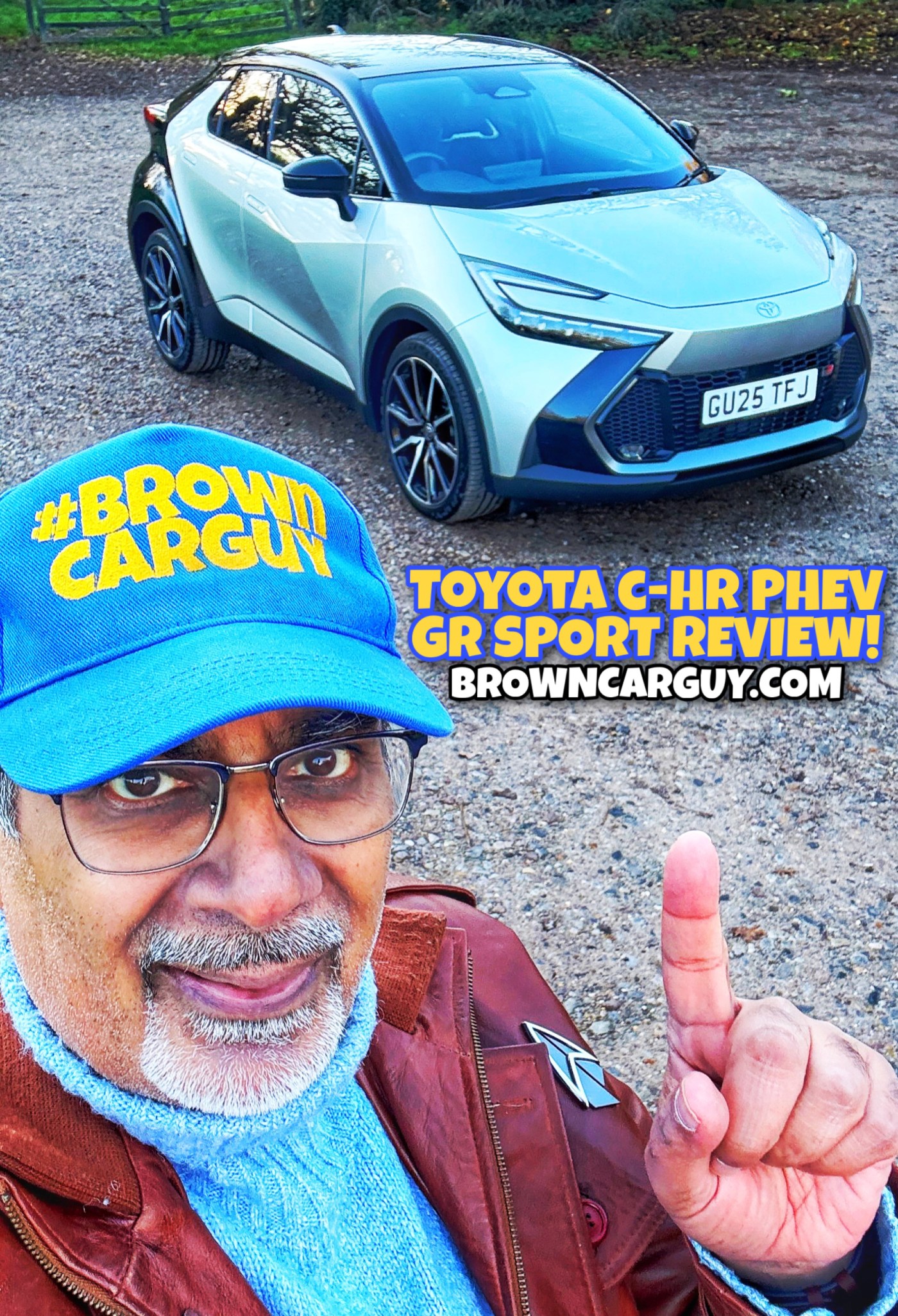
The Toyota C-HR has grown up, plugged in and gone premium – but does the range-topper still have the spark that made the original so memorable?
I’ve always had a soft spot for the Toyota C-HR. When the original arrived, it felt like a small act of rebellion from a brand better known for playing things safe. It was sharp, angular, unapologetically different, and crucially, it didn’t try to hide its personality. Better still, in its early years you could even buy one with a petrol engine and a manual gearbox, complete with rev-matching. A crossover that actually wanted to be driven. That alone made it stand out.
This new C-HR feels like the same character several years on. More mature, more polished, far more premium, and inevitably, more expensive. The car tested here is the very top of the range: the Toyota C-HR GR Sport Plug-in Hybrid, producing 223bhp and carrying a price tag that pushes well into the mid-£40,000 bracket. It’s not just the most powerful C-HR you can buy, it’s also the clearest statement yet of how Toyota sees the future of its compact SUV lineup.
Where the Plug-In Hybrid Sits in the C-HR Range
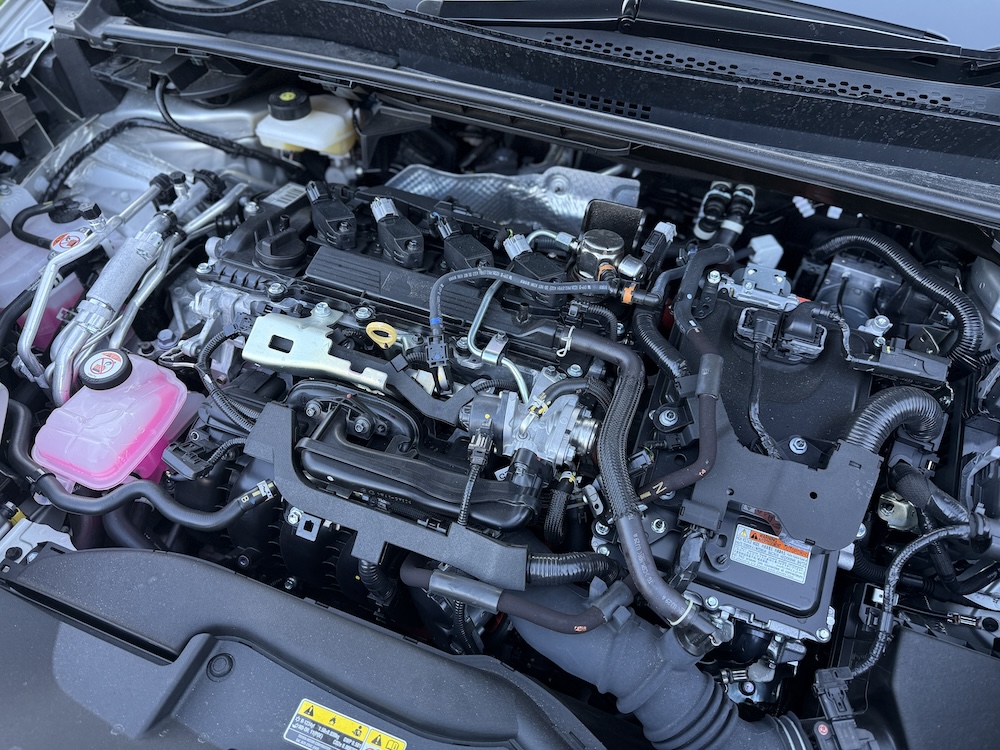
To understand this car properly, you need to see it in context. The current C-HR lineup is entirely electrified. There are no diesel engines, no pure petrol options, and certainly no manuals anymore. The entry point is the 1.8-litre hybrid, offering 140bhp and focusing on efficiency and smoothness rather than performance. Above that sits the 2.0-litre hybrid, which increases output to 193bhp and brings a noticeable jump in pace and confidence. Sitting above both is this plug-in hybrid, pairing a 2.0-litre petrol engine with a larger battery and a more powerful electric motor to deliver a combined output of 223bhp.
That extra power places the PHEV in a very different league to the rest of the range. With a 0–62mph time of 7.4 seconds, it’s around seven-tenths quicker than the 2.0 hybrid and nearly three seconds faster than the 1.8. In real-world driving, the difference is immediately apparent, largely thanks to the stronger electric assistance at low speeds. It’s still front-wheel drive, still uses Toyota’s familiar e-CVT gearbox, and still prioritises refinement over aggression, but there’s no escaping the fact that this is the quickest and most muscular C-HR Toyota has ever built.
It’s also the most expensive. Prices for the plug-in hybrid start at around £44,000, and a GR Sport like this one, fitted with optional packs, nudges even higher. That places it firmly above the standard hybrids and means it has to justify itself not just within the C-HR range, but against a broader field of plug-in hybrid rivals.
GR Sport: Style and Specification, Not a Hot Hatch in Disguise
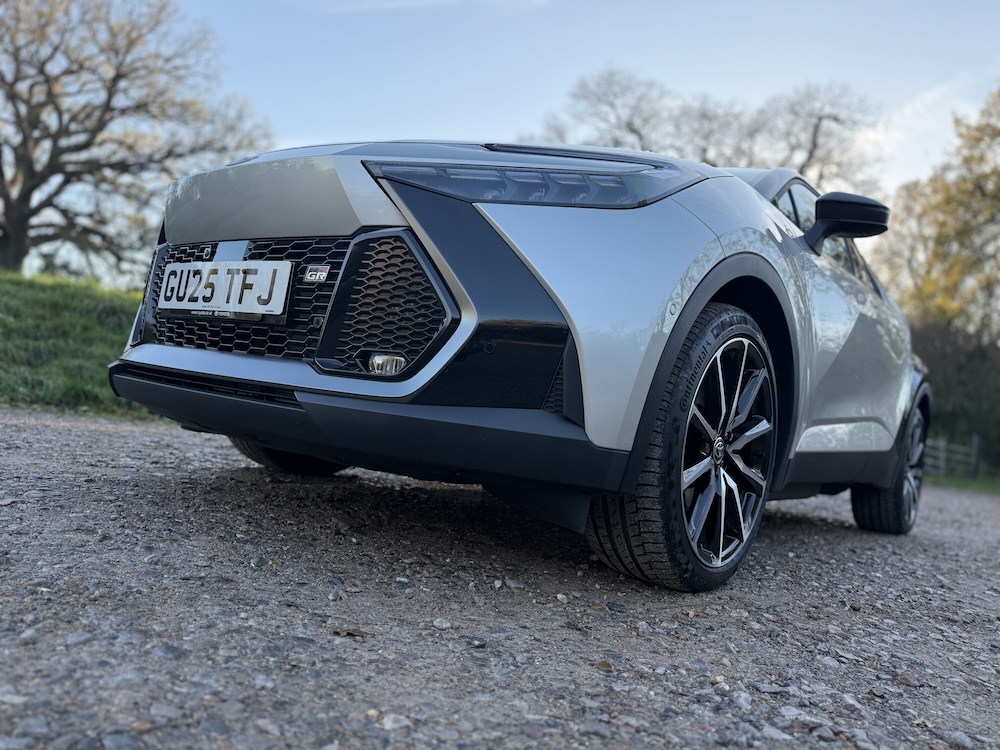
The GR Sport badge needs a bit of context. Despite the name, this is not a Gazoo Racing performance model. There are no mechanical upgrades, no suspension changes, no uprated brakes and no extra power beyond what the plug-in hybrid already provides. What GR Sport delivers is visual drama and equipment.
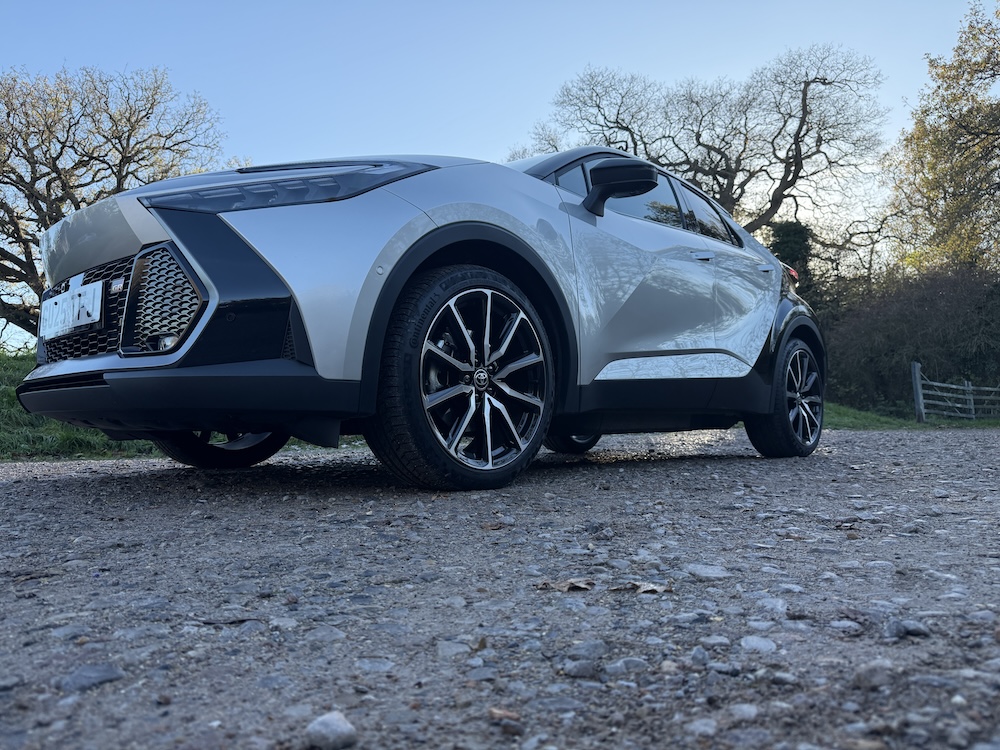
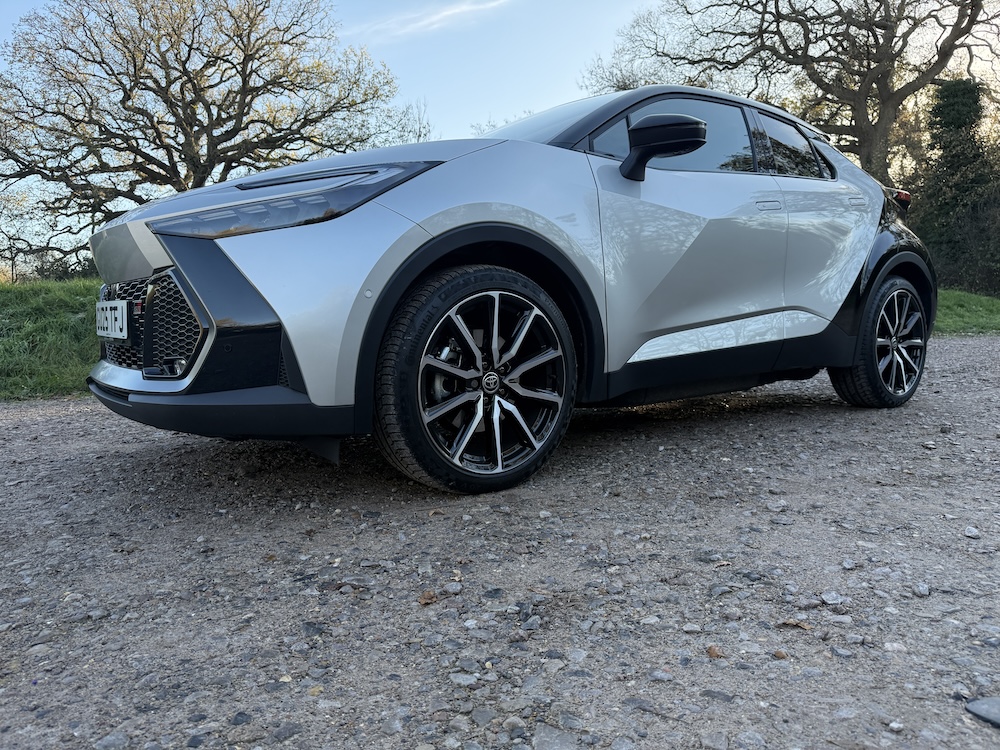
This is the most assertive-looking C-HR you can buy, and it’s also the most comprehensively equipped. The larger wheels, darker exterior detailing, Alcantara-trimmed seats, head-up display and JBL sound system all come as part of the package. It’s best thought of as the fully-loaded, design-led flagship rather than a performance variant. Once you approach it with that mindset, the GR Sport badge makes much more sense.
Exterior Design: Still Outlandish, Now More Polished
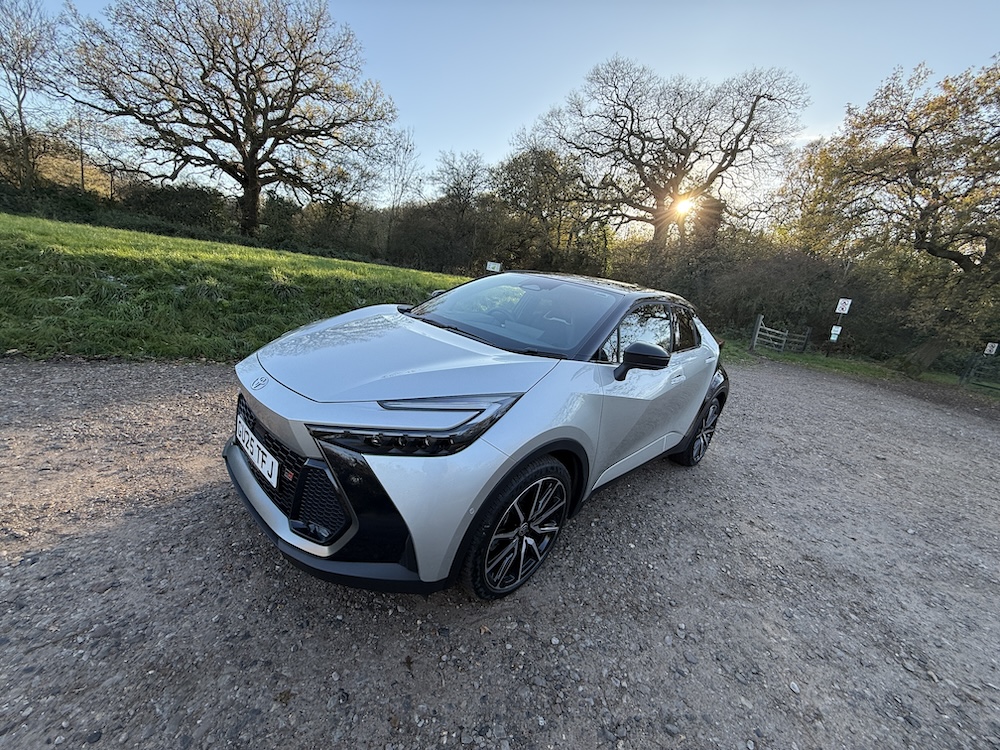
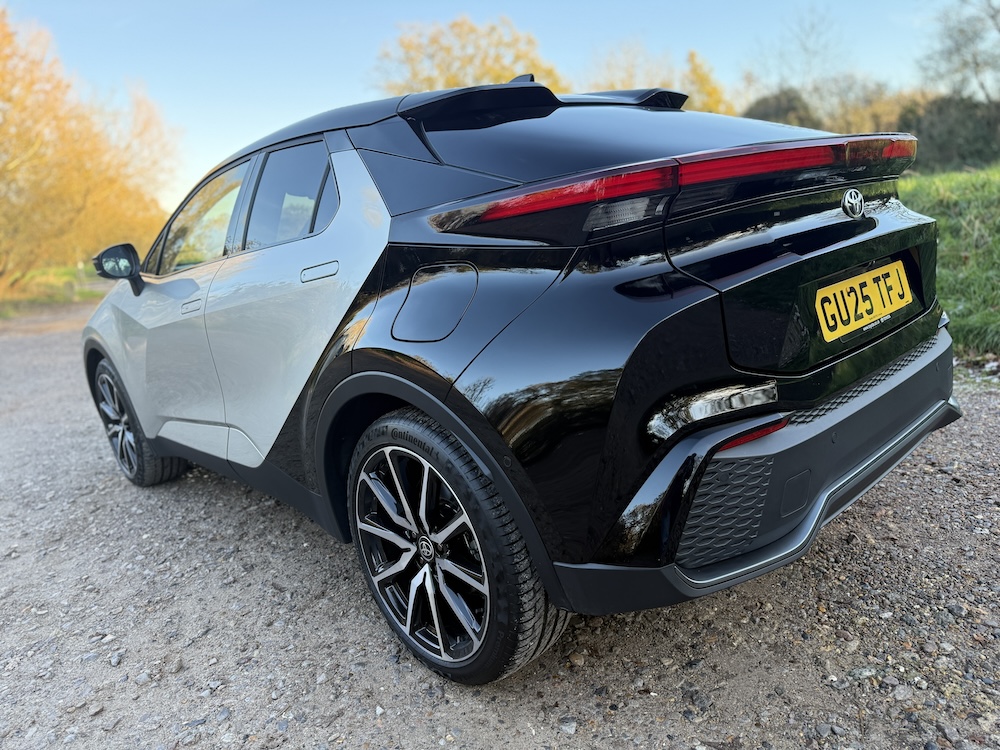
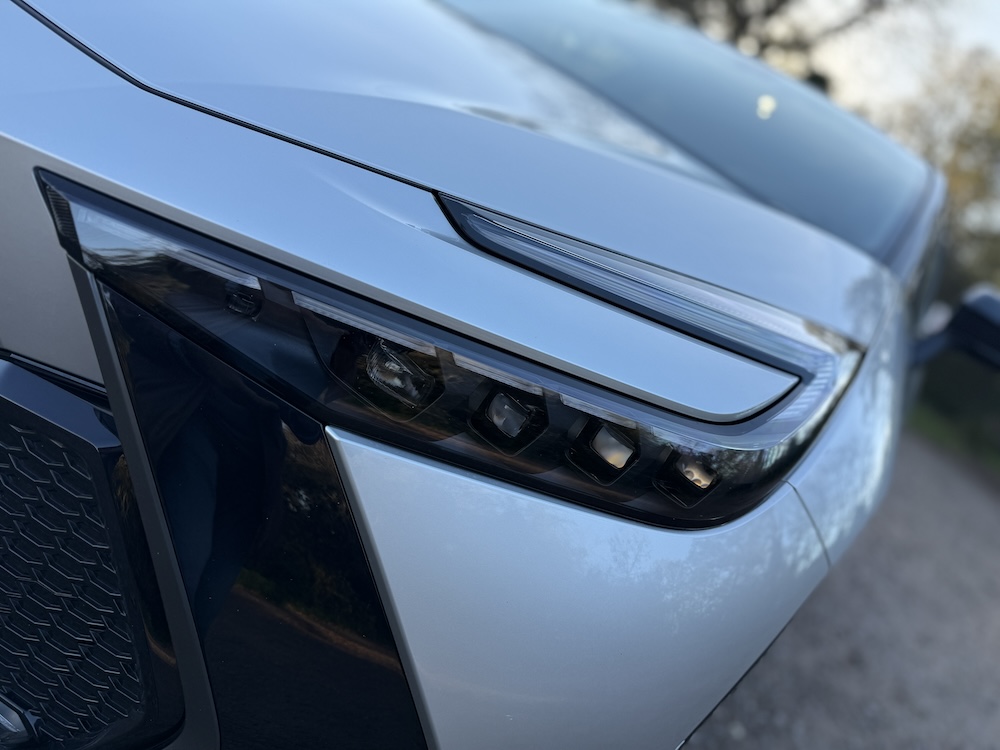
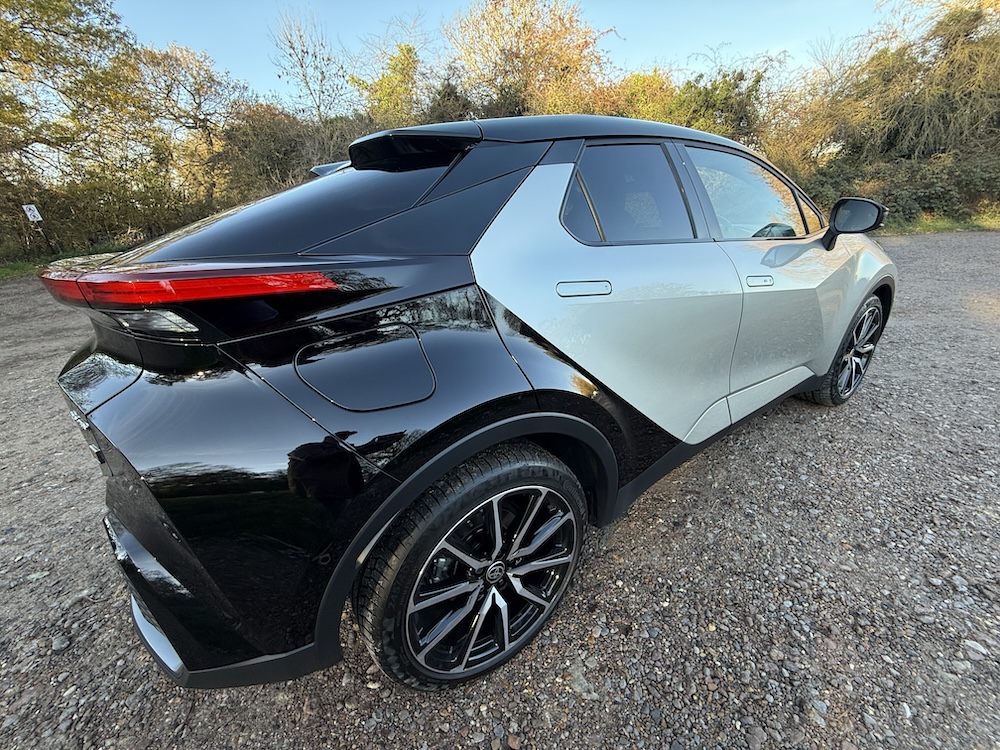
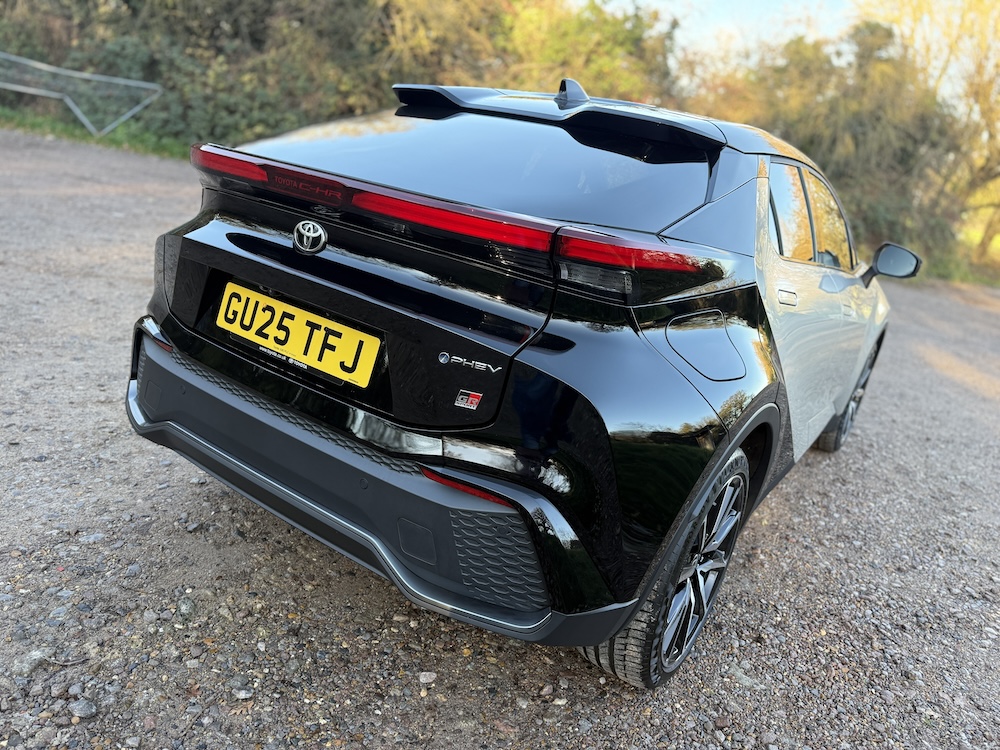
The C-HR has always leaned heavily into the idea of being a concept car you can actually buy, and this latest version doubles down on that philosophy. The bodywork is a mass of sharp creases, dramatic surfaces and sculpted angles, with very little restraint on display. The front end adopts Toyota’s latest design language, with slim headlights and a wide, planted stance that gives the car real presence on the road.
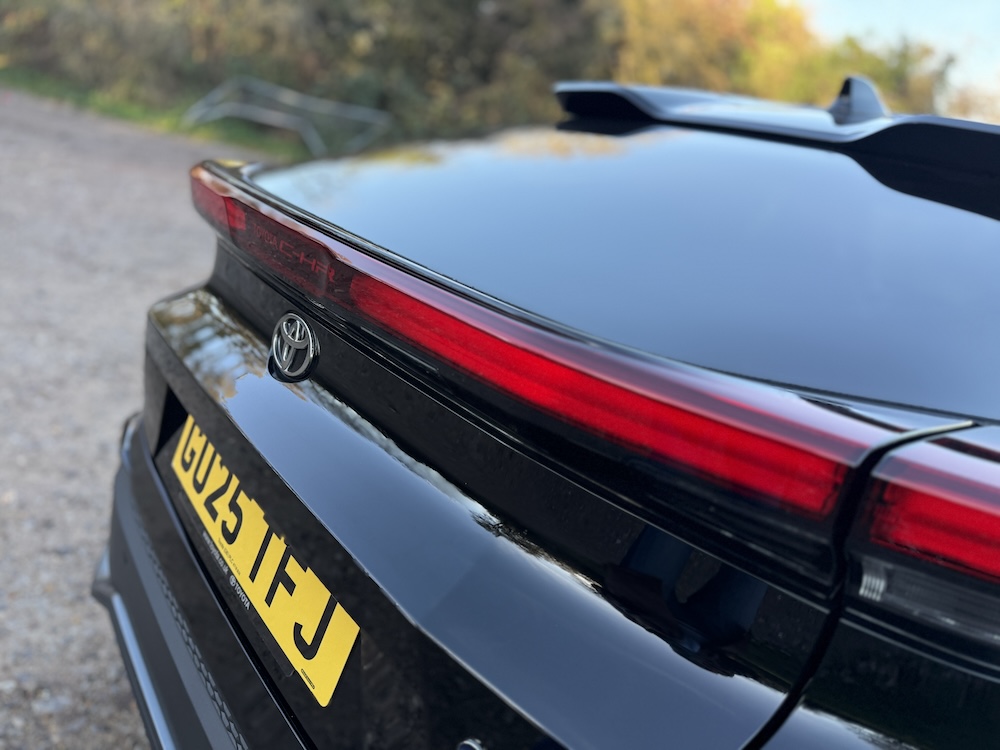
Along the sides, the flush door handles are a small but important detail. They help clean up the profile and add a layer of modernity that the previous model lacked. At the rear, the full-width light bar with the illuminated C-HR script is pure theatre, complete with a welcome animation when you approach the car. There’s no rear wiper, which Toyota attributes to clever aerodynamics. In theory it works, though British winter conditions may have their own opinion on that.
Compared to the original, the new C-HR feels more resolved and more premium. It hasn’t lost its boldness, but it does feel better judged and less raw.
Boot Space and Practicality
For a car with such dramatic styling, the C-HR remains reasonably usable. Boot capacity in the plug-in hybrid stands at 364 litres, broadly in line with the standard hybrid models. Toyota has packaged the larger battery cleverly, avoiding the major space penalties that often come with plug-in systems.
The boot opening is wide, the load floor is fairly flat, and the rear seats fold to extend the space when needed. It won’t trouble class leaders for outright capacity, but it’s perfectly adequate for everyday use, weekend trips and family duties.
Rear Seat Space: Better, But Not Tall-Adult Friendly
This is the bit where the C-HR’s dramatic styling comes with a small penalty. I set the front seat to my driving position and I’m six foot one and a bit with long legs, and that immediately tells you what you need to know. In the back, I’m honestly a bit scrunched up. My knees are high, my shins are hard up against the seatback, and while there’s still wiggle room for your feet, I’m not convinced I could do a proper long distance in here without grumbling about it like an old man who’s misplaced his reading glasses.
The panoramic roof helps because it adds a bit of airiness, but the rear still feels quite closed off. The windows are on the small side and, crucially, you feel like you’re sitting lower than the front seats, rather than getting that “theatre-style” seating you get in some better family SUVs where rear passengers feel perched slightly higher. If you regularly carry tall adults, or anyone who’s even mildly claustrophobic, it’s the sort of thing you should check before buying. For regular-sized adults it’ll be fine, and for children it’s absolutely fine, especially as child seats lift them up a bit anyway. You’ve got USB-C ports down there, bottle holders, pockets and a useful rear shelf for kid-stuff, even though there’s no centre armrest. It’s not a disaster, it’s just one of those honest, real-world caveats that gets lost when people only look at brochure photos.



Front Cabin: Features Galore, and Everything Just Works
Climb into the front and the whole vibe changes. This is where the new C-HR feels properly sorted, because it’s straightforward, intuitive, and everything is where you want it to be. The best compliment I can give it is that nothing surprises you. You get in, it goes, it stops, it turns, and the controls feel natural, which sounds obvious until you drive something that requires a PhD in menu-diving just to turn on the heated seats.
The car does that slightly theatrical thing where, when you turn it off, the seat slides back for easier exit, and when you start up it returns to your driving position. Then those two big 12.3-inch screens come to life, one in front of you and one as the main touchscreen, and because it’s a plug-in hybrid it can feel eerily silent when it’s running on electric.
There’s the EV Auto button, the EV button, and crucially the option to hold to charge, which kicks the engine in and starts charging the battery while you drive. Plug-in hybrids only properly make sense if you can charge at home. If you’re relying on public charging, especially slower chargers and expensive rates, the maths can get a bit daft, and you’ll probably just end up driving it like a normal hybrid, which is I found yourself doing.
The steering wheel is loaded with controls, the mirrors and window switches are where you expect, you can pop the boot and fuel flap from buttons, and there’s a pleasingly “aeronautical” design theme to the dashboard, including those little illuminated accents that come alive at night. There’s a mix of materials too, including sections that are soft-touch.
Infotainment, Controls and Day-to-Day Usability
Toyota has finally got the balance right between technology and usability, and it shows the moment you start interacting with the cabin. The infotainment system goes deep if you want it to, with layers of vehicle customisation that allow you to tailor illumination, ambient lighting themes and cabin moods to your liking. There are plenty of colour options to play with, and the way the car subtly links visual ambience to different drive modes adds a sense of occasion without tipping into gimmickry.
Crucially, all of this cleverness sits alongside proper physical controls where they matter. Climate functions are easy to access, demisters are clearly labelled including mirror demist, and everyday features like heated seats and a heated steering wheel are exactly where you expect them to be. Parking assistance, driver aids and convenience features are logically grouped and intuitive to use. The overriding impression is that nothing is trying to show off. Everything works, everything makes sense, and the car never makes you feel like you are fighting it just to get comfortable. That alone puts it ahead of a worrying number of modern rivals.
On the Road: Smooth and Unfussy, Until the Road Fights Back
In normal driving, the C-HR PHEV is an easy car to live with. It takes care of itself. You can delve into EV modes, charging strategies and energy management if you feel inclined, but you do not have to. Left to its own devices, the car quietly manages the transition between electric and petrol power with very little drama. Most of the time the switching is unobtrusive enough that you simply stop thinking about what is powering the wheels at any given moment.
The character changes once the road surface deteriorates. On smoother tarmac and around town, the ride is perfectly acceptable, even on the GR Sport’s large 20-inch wheels. However, on broken British roads, over potholes, ridges and poorly repaired surfaces, the suspension begins to feel brittle. Sharp impacts send noticeable jolts through the cabin, and there are moments where the car feels unsettled in a way you do not expect at this price point. It raises a genuine question about whether the GR Sport’s wheel and tyre combination is worth the compromise if your daily driving involves anything more rugged than well maintained A-roads. The car is fine when the surface behaves, but when it does not, the wheels start to dictate the experience.
Performance: Brisk, Confident and Entirely On Message
With 223bhp, the plug-in hybrid C-HR is the quickest version Toyota has ever offered, and in real terms it feels usefully quick rather than theatrically fast. Select Sport mode, press on, and the car responds cleanly and confidently. The power delivery is smooth, the acceleration is progressive, and it gathers speed without fuss. It does not pin you into the seat, and it is not trying to. That suits the car’s personality perfectly.
At motorway speeds, refinement is good. The car feels stable and precise, wind noise is present but not intrusive, and long distances are dispatched with little effort. Push harder and the petrol engine reveals a surprisingly vocal side, with a slightly roarty note that adds character rather than annoyance. In slippery conditions, you can even provoke a hint of front wheel scrabble under strong acceleration, which serves as a reminder that all 223bhp is going through the front tyres. It never feels unruly, just honest about its layout.
Handling and Steering: More Composed Than Expected
For a front-wheel-drive crossover, the C-HR handles itself well. Even on uneven, undulating roads, the body remains reasonably composed, with only a small amount of float. Grip levels are better than expected, and turn-in is sharper than you might assume, particularly given the conditions. It resists understeer more effectively than anticipated and holds its line with confidence.
Steering feel improves noticeably in Sport mode, gaining weight and a sense of resistance that suits more enthusiastic driving. There is enough feedback to build trust, and while it never pretends to be a hot hatch, it does encourage you to enjoy a well judged road. There are moments where the car feels as though it is actively pulling itself around corners, giving the impression of clever traction management working quietly in the background. Whether that is software, calibration or simply good chassis tuning, the result is reassuring and confidence-inspiring.
Braking: Strong Performance, Slightly Inconsistent Feel
Braking performance itself is not in question. The car stops strongly and predictably, and there is never any sense of insecurity. What does let it down slightly is the feel. The transition between regenerative braking and conventional braking is not always seamless, and there are moments where the response is either stronger or weaker than expected. That inconsistency forces you to recalibrate your pedal input more often than you should have to.
It is a sensation rather than a safety issue, but it is noticeable, particularly to passengers, who may interpret it as clumsy braking when in reality it is the system deciding how much energy to recover. Given Toyota’s long history with hybrid systems, it is mildly surprising that this aspect is not more polished.
Closing Thoughts: A Different Kind of C-HR, But Still a Good One
There is no escaping the fact that something has been lost along the way. The old C-HR’s wilder edge, and especially the availability of that petrol manual with rev-matching, gave it a sense of playfulness that this fully electrified generation does not attempt to replicate. That chapter is clearly closed.
What replaces it is a more mature, more refined and more capable car. The new C-HR PHEV GR Sport feels premium, well engineered and thoughtfully designed. It is not perfect, and the ride on big wheels and brake feel are worth considering carefully, but it is undeniably a strong and coherent package.
If you approach it on its own terms rather than longing for what came before, this is a very good modern crossover. And if nothing else, it proves that even as the market moves towards electrification, personality has not been completely engineered out of the equation.
If you found this useful, interesting or fun, consider supporting me via Patreon, Ko-Fi, or even grabbing a copy of one of my books on Amazon. Every bit helps me keep creating independent automotive content that actually helps people.
Support independent car journalism 🙏🏽☺️ grab my books on Amazon, take up membership to BrownCarGuy on YouTube, or join me on Ko-Fi or Patreon.

👉🏽 Channel membership: https://www.youtube.com/browncarguy/join
👉🏽 Buy me a Coffee! https://ko-fi.com/browncarguy
👉🏽 Patreon – https://www.patreon.com/BrownCarGuy

MY BOOKS ON AMAZON!
📖 Want to become an automotive journalist, content creator, or car influencer? Check out my book: How to be an Automotive Content Creator 👉🏽 https://amzn.eu/d/7VTs0ii
📖 Quantum Races – A collection of my best automotive sci-fi short stories! 👉🏽 https://amzn.eu/d/0Y93s9g
📖 The ULEZ Files – Debut novel – all-action thriller! 👉🏽 https://amzn.eu/d/d1GXZkO
Discover more from Brown Car Guy
Subscribe to get the latest posts sent to your email.
