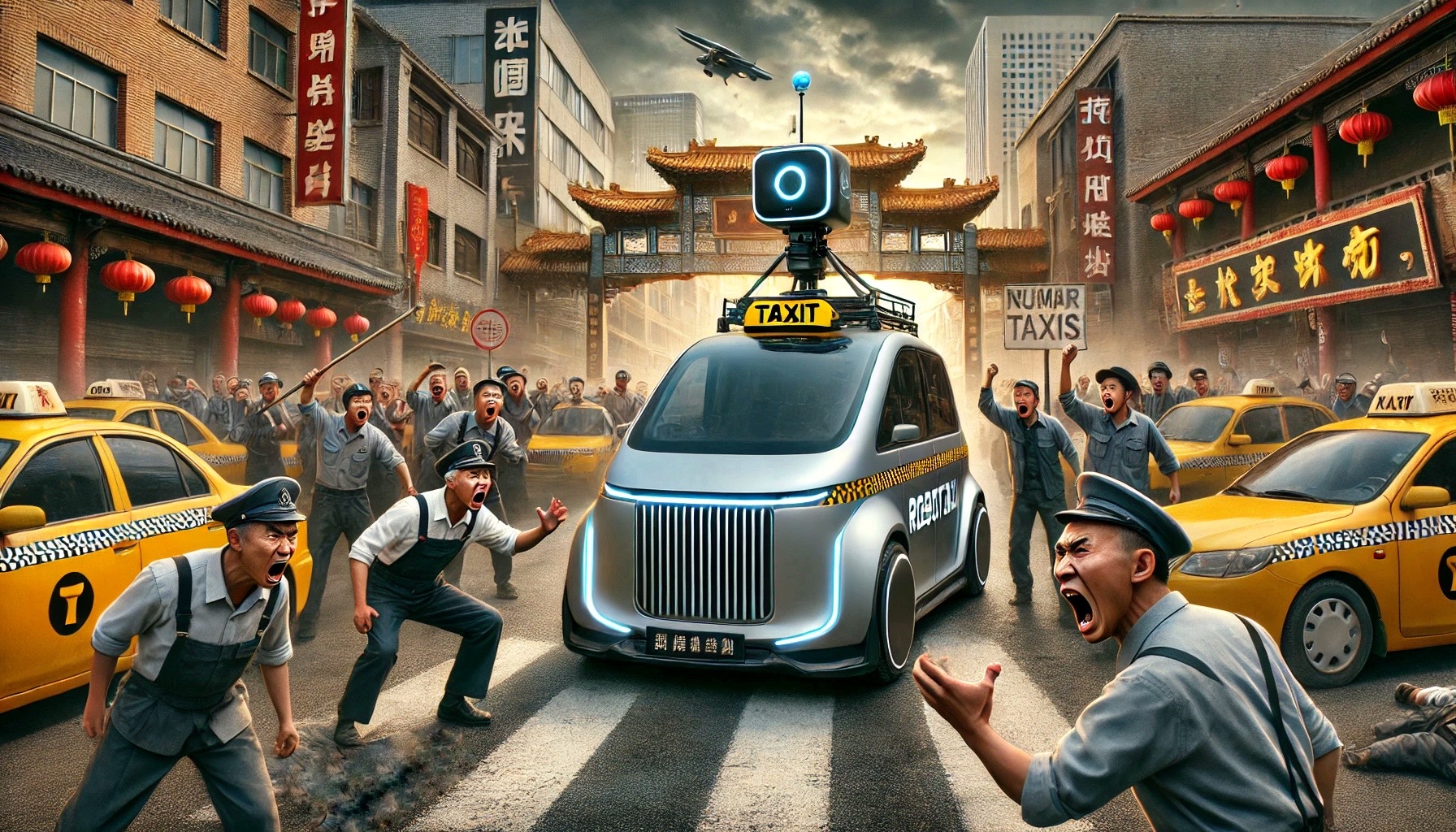
Taxi drivers in Wuhan, China are already raising their voices against robotaxis and AI taking over their jobs
Hold on to your steering wheels, keeping looking straight and don’t turn around because the future is pulling up right alongside you, and it’s got no driver! It’s the rise of the Robotaxis. Driverless cabs ensconced in sleek futuristic EV shapes, and they are threatening to revolutionise transportation in ways that not everyone will want. Because as the world shifts gears towards automation, there’s a pressing question: will AI steal our jobs, and more urgently, driving jobs? Let’s take a closer look at what’s happening on the streets of China, where this technological transformation is speeding ahead, leaving many human drivers demonstrating in the dust.
China’s Rapid Robotaxi Revolution
In China, the race towards automation is on, and the finish line is closer than you might think. With the likes of Baidu’s Apollo Go, Pony.ai, WeRide, and AutoX leading the charge, the streets of major cities like Wuhan are quickly becoming the testing grounds for the future of transportation. These companies are rolling out robotaxis at an impressive pace, and by the end of this year, Apollo Go alone plans to deploy 1,000 of these autonomous vehicles in Wuhan.
“Will AI steal driving jobs? It’s already happening, and the impact could be far-reaching.”
But while this might sound like something out of a sci-fi novel, the reality for China’s 7 million ride-hailing drivers is far from futuristic fantasy. Many of these drivers, like Liu Yi, a 36-year-old part-timer in Wuhan, are watching in dismay as their neighbours opt for driverless taxis over human-driven ones. Liu, who started driving after construction work dried up due to an oversupply of unsold apartments, now fears that robotaxis will leave him and his fellow drivers with no work at all. “Everyone will go hungry,” he says, staring at a future that seems increasingly uncertain.
Robotaxis vs. Human Drivers: A Battle for Survival
Let’s face it, the idea of a car driving itself sounds like something straight out of Total Recall – except this time, it’s real, and there’s no Arnie won’t be back to save the day. In China, the situation is serious. Robotaxis, dubbed “stupid radishes” by local drivers, are making their presence felt. These AI-driven vehicles might not be completely autonomous just yet, but they’re close enough to have human drivers worried sick. And the fares are undercutting human drivers by a considerable margin.
“In China, the race towards automation is on, and the finish line is closer than you might think.”
Now, I’ve mentioned before (and if you’re a regular reader or viewer, you’ll know) that truly autonomous vehicles – what the industry calls Level 5 autonomy – aren’t quite here. The tech is still in its infancy, with a few hiccups along the way. These taxis usually have roof-mounted pods with additional cameras and radars. In China, the government has thrown open the floodgates, allowing trials and tests to proceed at breakneck speed, unlike the U.S., where regulations are tighter, and safety concerns have prompted a more cautious approach.
This rapid adoption has led to a flurry of activity across 19 Chinese cities, with robotaxis zipping around with minimal human oversight. In fact, seven of these cities have already approved trials without human driver monitors – a move that has traditional drivers shaking in rage.
The Economic Impact: Job Creation or Destruction?
But it’s not just about the technology—it’s about the people. With ride-hailing providing a last-resort job for many during tough economic times, the introduction of robotaxis could be a double-edged sword. On one hand, companies like Apollo Go argue that their robotaxi fleets “complement rather than replace” existing transport options. They even claim that the rollout of autonomous vehicles will create new jobs in monitoring, testing, and data analysis.
“Progress shouldn’t come at the expense of the very people it’s meant to serve.”
But let’s be real here. You’re talking about deploying a thousand taxis, theoretically denying a thousand drivers’ jobs but you don’t need a thousand people to monitor the taxis, do you? More like five people and a supercomputer. So, while some new jobs may be created, the number of traditional driving jobs lost could be staggering. And when you consider that many of these drivers are already living on the edge, the potential for widespread unemployment is a serious concern.
In Wuhan, for example, the number of registered ride-hailing drivers has nearly doubled in just two years. These are people who have turned to driving as a means of survival during an economic slowdown. If robotaxis take over, what’s left for these workers? As one driver, Wang Guoqiang, put it, “Ride-hailing is work for the lowest class. If you kill off this industry, what is left for them to do?”
AI and the Future of Work: A Balancing Act
Now, before you start thinking this is all doom and gloom, it’s worth noting that some economists believe that automating jobs could benefit China in the long run, especially given the country’s shrinking population. But as Tang Yao, an associate professor of applied economics at Peking University, wisely points out, “In the short run, there must be a balance in speed between the creation of new jobs and the destruction of old jobs.”
“For the millions of drivers who rely on their jobs to make ends meet, the future looks uncertain.”
In other words, just because we can introduce robotaxis at warp speed doesn’t mean we should. There needs to be a thoughtful approach to how this technology is rolled out, with consideration given to the real people who will be affected. After all, it’s not just about getting from point A to point B – it’s about ensuring that the journey doesn’t leave millions of drivers stranded.
Conclusion: What Does the Future Hold?
So, where does this leave us? Well, the rise of robotaxis is certainly exciting, and the potential for AI to revolutionise transport is enormous. But as with any technological leap, it comes with challenges. For the millions of drivers who rely on their jobs to make ends meet, the future looks uncertain. Will AI steal driving jobs? It’s already happening, and the impact could be far-reaching.
But let’s not forget that we still have a say in how this plays out. Governments, companies, and society as a whole must carefully consider the balance between embracing new technologies and protecting livelihoods. After all, progress shouldn’t come at the expense of the very people it’s meant to serve.
“Governments, companies, and society must carefully consider the balance between embracing new technologies and protecting livelihoods.”
In the meantime, I’ll be keeping a close eye on how this all unfolds—so stay tuned, and don’t forget to check out my latest video on this very topic. And while you’re at it, why not have a read of my novel The Quantum Races? It’s got plenty of futuristic scenarios involving AI, and it might just give you a glimpse of what’s to come.
Follow all my channels https://linktr.ee/browncarguy
Get my book! https://amzn.eu/d/adFimgB
If you enjoyed this review sponsor my content from as little as £3 at
https://ko-fi.com/browncarguy
Big Thanks to my Supporters!
CraftLab (https://www.CraftLab.my)
Collecting Motors (https://collectingmotors.com)
Design5IT
Tom Conway-Gordon (https://www.instagram.com/anycoloursolongasits_black/)
And others! 🙏🏽☺️
Discover more from Brown Car Guy
Subscribe to get the latest posts sent to your email.
