
When Sir Jim Ratcliffe talks immigration, unemployment and “colonisation”, it exposes the hypocrisy at the heart of the modern global elite
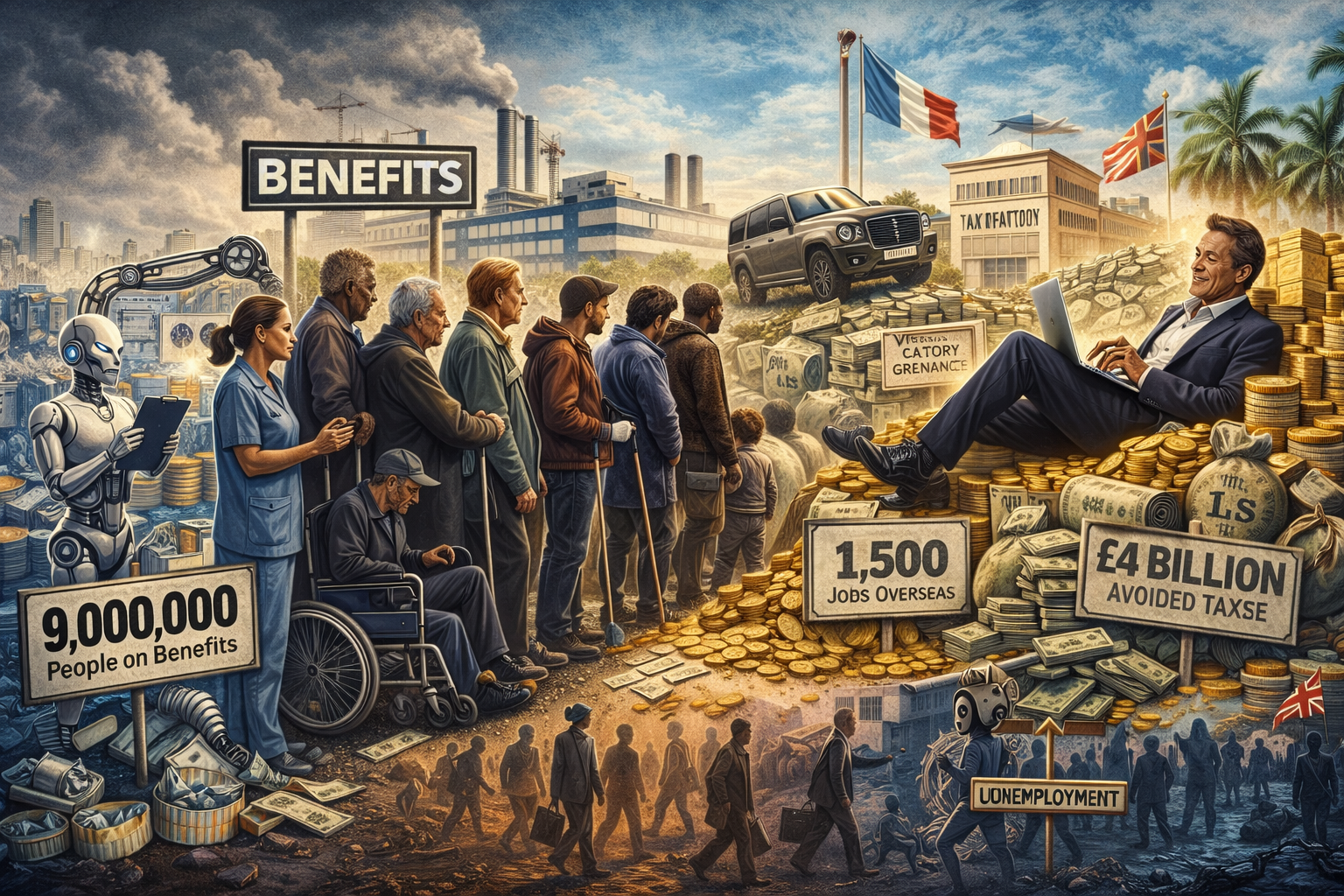
A few days ago, headlines were dominated by Sir Jim Ratcliffe, co-owner of Manchester United. Founder and driving force behind the INEOS Grenadier, the same INEOS that is also part-owner of the Mercedes F1 team, and, oh, by the way, he is one of the richest men in Britain. His estimated net worth hovers around £17 billion, according to recent Rich Lists. This Knight of the Realm made remarks suggesting the UK was being “colonised” by immigrants. He referenced unemployment, claimed nine million people were on benefits, and linked immigration levels to economic strain.
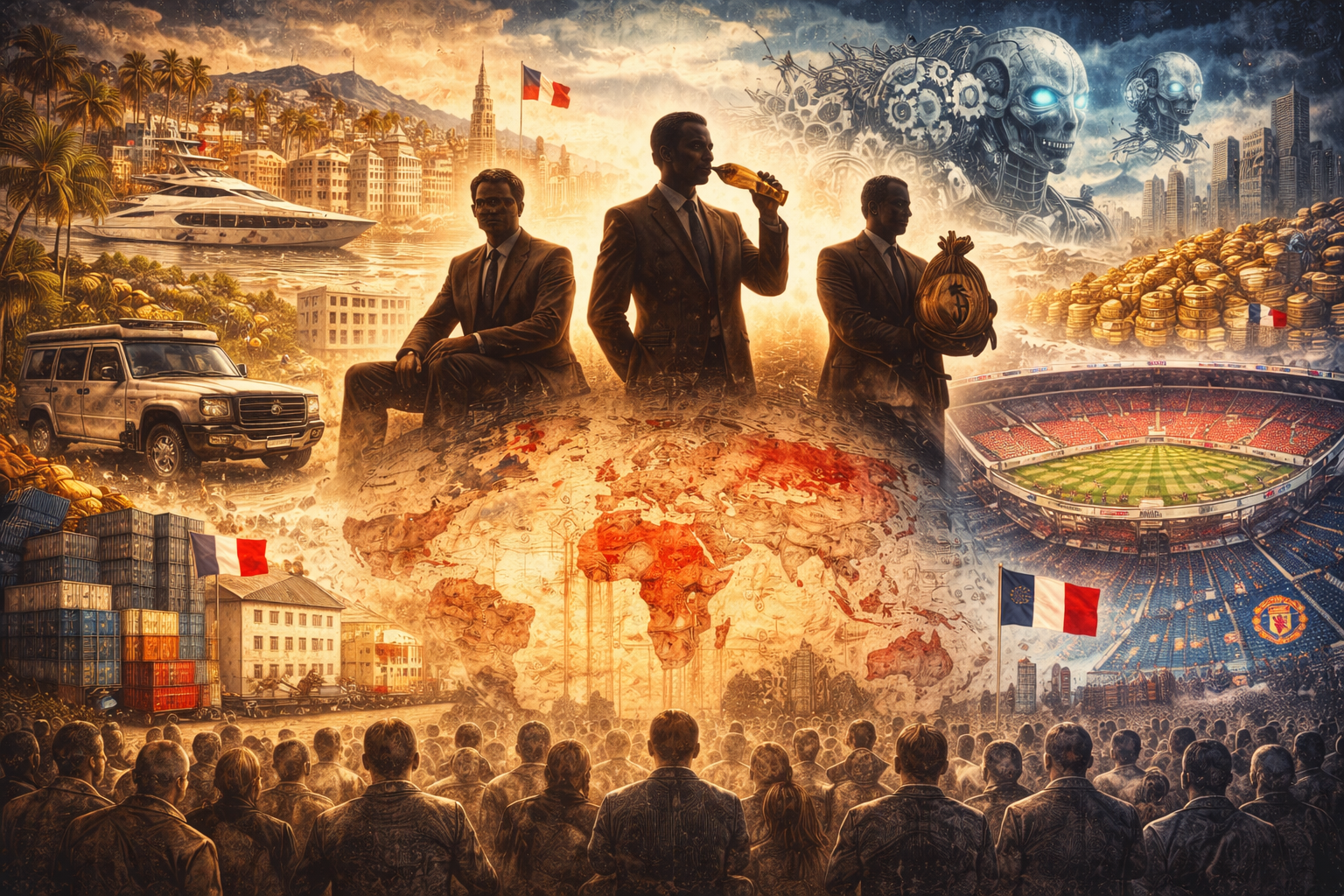
Cue political backlash, discontent from MU fans and a social media meltdown. But that’s not the most interesting part of this. It’s the contradiction. You see, Ratcliffe is not just a commentator; he is a global industrialist whose empire is built on international markets, multinational labour, cross-border supply chains and the relentless logic of globalisation.
Oh, and he left the UK to live in the tax haven of Monaco. Yup, he’s managed to avoid paying approximately £4 billion in taxes to the Treasury. So he’s actually not putting any of his own cash into the coffers that hand out the benefits he’s complaining about.
Benefits, Unemployment and Reality
Let’s start with the nine million figure – the number of people he said were claiming benefits and, by implication, unemployed parasites.
Indeed, roughly nine million people in the UK receive some form of benefit. But that does not mean nine million people are unemployed. Many recipients are working. Many are carers. Many are disabled. Many are pensioners. Universal Credit alone often tops up low wages rather than replacing them. And they receive the money because they need it – because they don’t have billions in the bank and the tax man kept at arm’s length.
Shall we also just mention at this point that this particular billionaire had the opportunity to create the new factory for his Grenadier, an imagined successor to the original Land Rover Defender, right here in Wales, but instead located it in Hambach, Moselle, in France near the German border. Handy, of course, when you’re getting the engines for said vehicle from Bavaria – yes, they’re BMW units.
So at least around 1,500 jobs went across the Channel rather than staying here. You see, unemployment isn’t a malaise; it’s a symptom of capitalist greed – plus the relentless advance of 21st-century technology and innovation.
Because if the concern is truly about unemployment, then the looming structural shock is not immigration. It is automation. C’mon, anyone who’s been monitoring the advent of AI and the speed with which it’s evolving will know jobs are evaporating before our very eyes.
The International Monetary Fund has warned that up to 40% of jobs globally could be affected by AI in the coming years. In advanced economies, that figure rises towards 60%. Advanced economies – yes, that’s us. In fact, UK-focused studies suggest as many as three million jobs could disappear here alone by 2035 due to automation and AI displacement.
Three million. Let that sink in. And add that to your nine million… Okay, sorry, before you have to get your AI to do that, I’ll just tell you – it’s 12 million (says my AI!).
Robotics replacing warehouse labour. AI handling administrative functions. Software writing copy. Algorithms reviewing contracts. The future of work is shifting far faster than migration flows. If we are serious about employment, the real debate should be about reskilling, productivity, education reform, technological governance and creating entirely new spheres of work altogether.
Blaming migrants does not slow down neural networks.
A Word Heavy With Bloodied History
Then there is that word: “Colonised.” Immigrants have apparently colonised the UK, according to Ratcliffe. When given the opportunity to back away from a word he was called out for – and later forced to apologise and admit it was a poor choice (without actually expressing any regret for using it) – he doubled down on it during the interview.
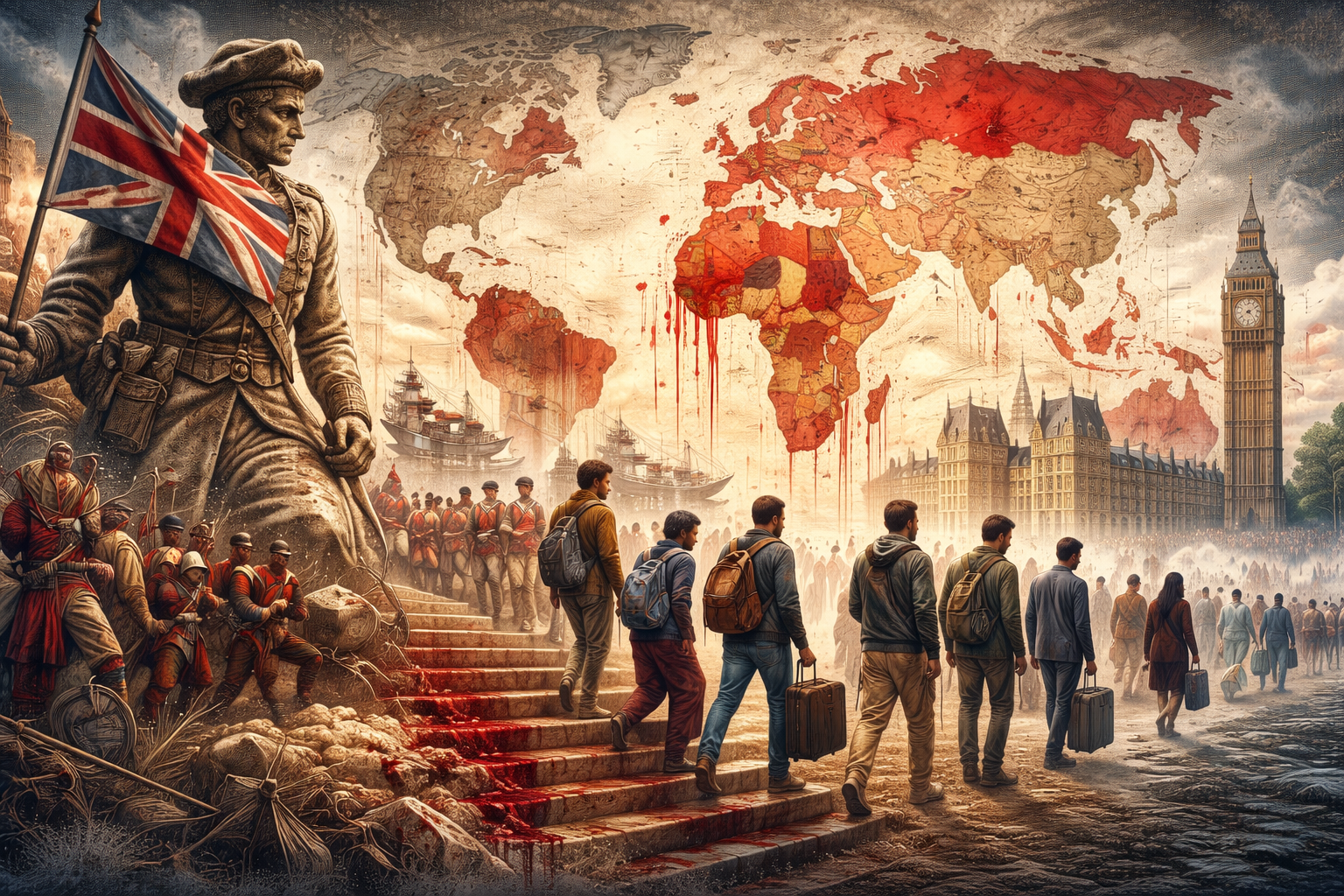
Colonise: to occupy, take over, seize, capture, take possession of, annexe, subjugate, hegemonise. Which is what Britain once did when, at the peak of its empire, it governed roughly 23% of the world’s population. British legal systems, railways, civil services and, crucially, the English language were exported across continents. English became the lingua franca of global commerce, so to speak.
The British Empire left in its wake a legacy of exploitation, extraction, subjugation, engineered famines, violent suppression, racial hierarchy, cultural erasure, countless deaths, systemic injustice and arbitrarily drawn borders, the consequences of which remain unresolved to this day.
Of course, history is complex, and with the bad occasionally came some good. But the scale of the bad is simply undeniable. Just because it’s not taught in school doesn’t mean it didn’t happen. Just take off the rose-tinted spectacles and look past the vainglorious statues.
So when “colonised” is used to describe inward migration into a former imperial centre, the irony is difficult to ignore – irony dripping in the blood of hollowed-out innocents lost in armageddons inflicted upon them. This is not a conspiracy or vaguely estimated theory – historians estimate that British imperial rule was associated with millions, and possibly tens of millions, of deaths through famine, war, forced labour and colonial conflict.
The Culture Wars
And yet now, in 2025, the descendants of empire speak of being “colonised”. The inversion would be laughable if it were not so historically illiterate.
Because the reality is this: Britain has not been taken over. It has been transformed, as it has always been transformed. British culture is not some sealed Victorian specimen jar that has suddenly been contaminated. It is a living organism, and like all living organisms, it adapts and evolves.
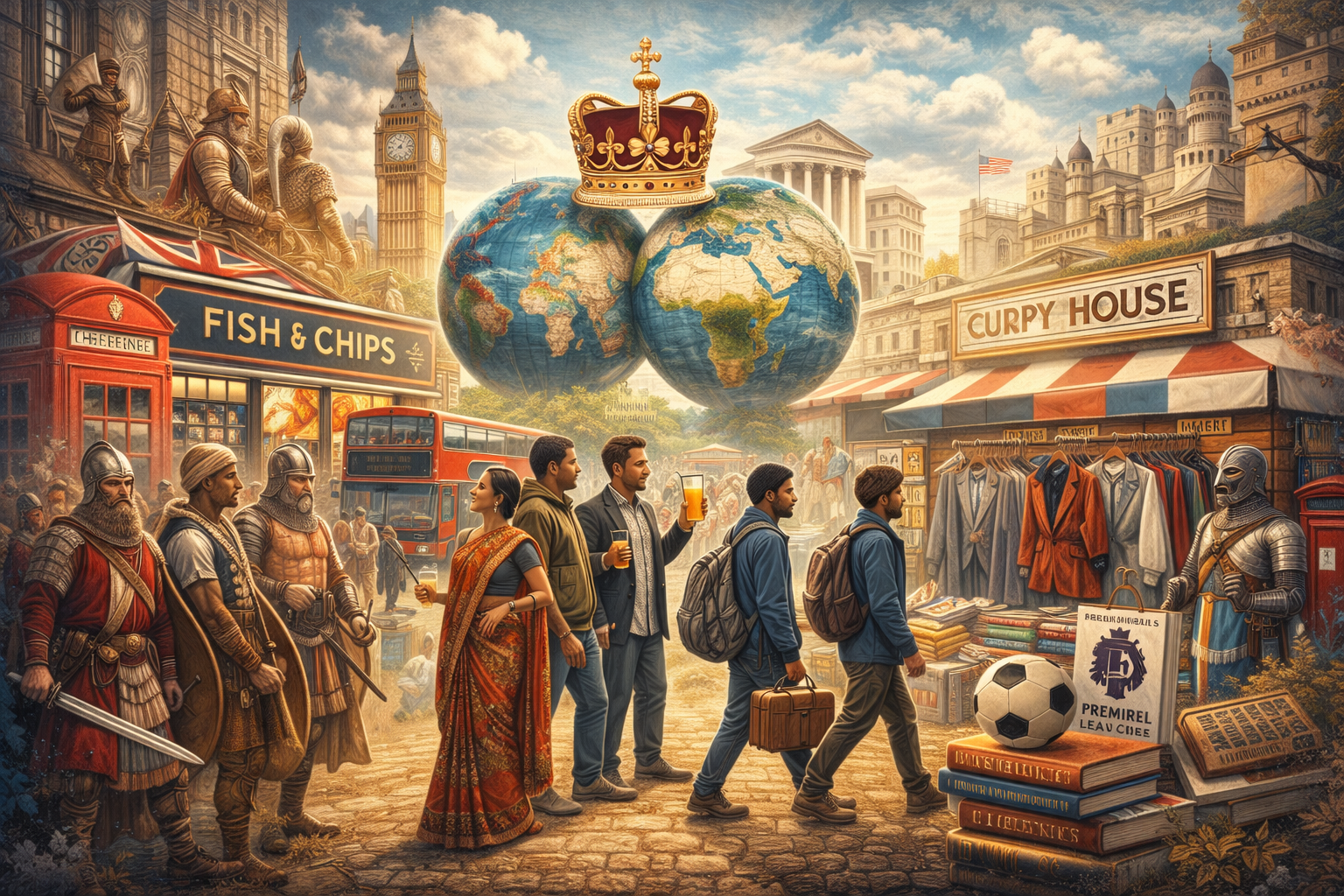
Take a walk through any British high street. The curry house is as British as fish and chips. The Premier League is a global spectacle. London is a financial capital precisely because it is international. Our music, fashion, literature and sport are hybrid creations. Even the monarchy itself is stitched together through European bloodlines.
British culture has always absorbed influence. The Romans influenced it; the Saxons reshaped it; the Vikings raided and settled it; the Normans transformed its language and ruling class; and the Empire imported everything else.
English itself is a mongrel tongue – Germanic roots infused with Norman French, Latin, Greek, colonial borrowings and global slang, including South Asian and Arabic words. Don’t believe me? Thug, loot, shampoo, bungalow and khaki, for example, are all from Hindi and Urdu. Meanwhile, algebra, coffee, and even algorithm and alcohol are from Arabic, among many others.
Britain never lost its culture; it accumulated it. It hasn’t become weaker; it has become layered. So the idea that modern migration is somehow erasing British identity misunderstands what British identity has always been.
Culture is not being taken over. It is being added to. It is enriched. It is complicated. It is sometimes uncomfortable. But discomfort is not extinction.
What Are the Elite Playing At?
Ratcliffe’s rhetoric does not exist in isolation, of course. Elon Musk has made similar interventions, predicting social collapse, hinting at civil conflict, amplifying fears of demographic replacement and institutional decay – sowing the seeds of fear of the “other”. Meanwhile, millionaire Nigel Farage has long argued that immigration levels are eroding British identity and overwhelming public services.
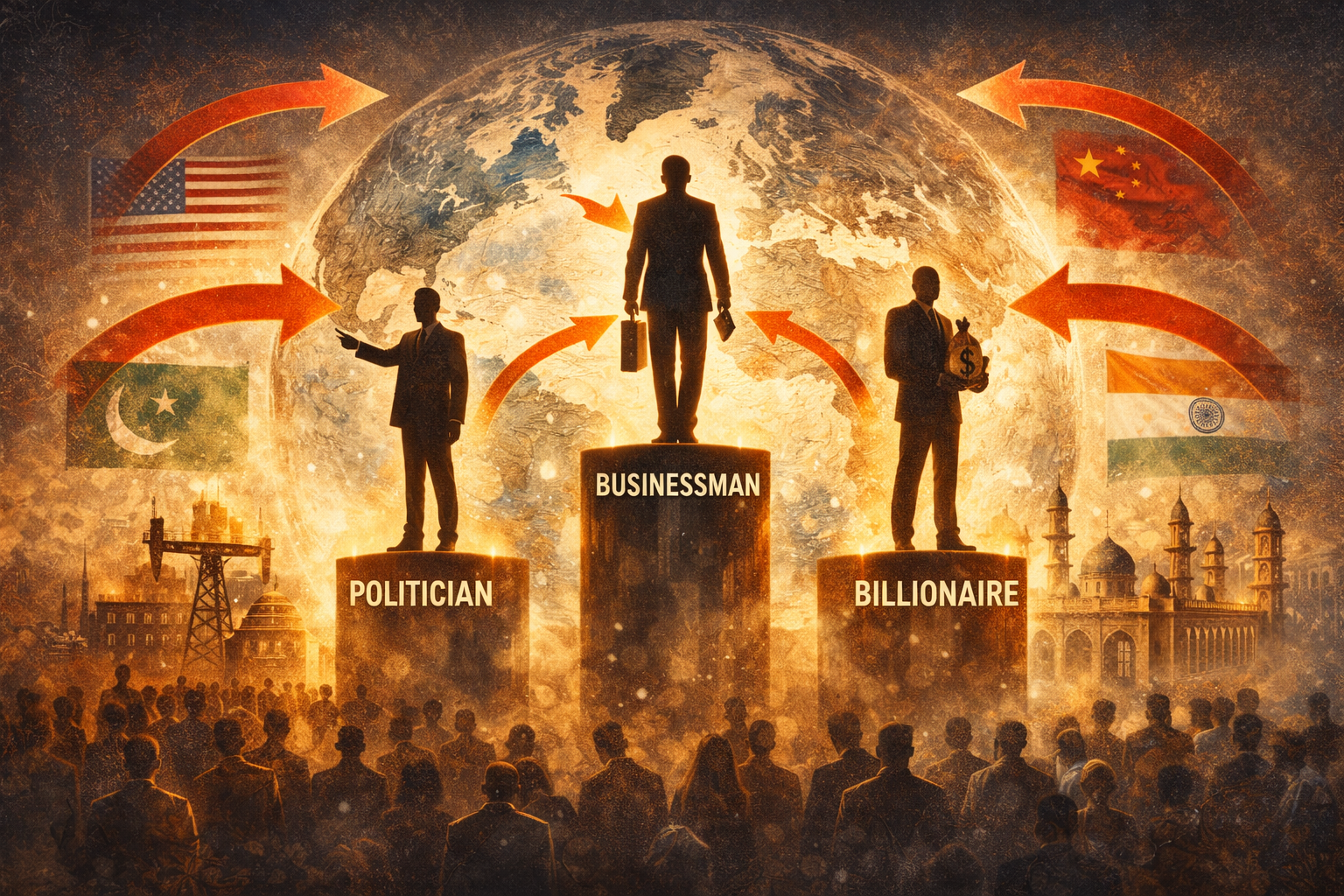
And yet the same elite – and let’s include Trump in this (president and businessman) – will court markets in India, take investment from the Gulf, manufacture in China and sell everywhere. Capital is borderless when it comes to profit. Yet domestic political rhetoric often treats people from those same regions as cultural threats. It’s hypocrisy, gold-plated, placed on a pedestal and lit with spotlights, with a constant fanfare playing in the background.
The Problem With Immigration
When it comes to Europe, the UK and the US, the claim is always the same: too many migrants, too much strain, culture under threat. But here’s the thing: migration often follows economic necessity. People move where opportunity exists. Businesses recruit where skills exist. Capital flows where markets exist. Britain remains attractive precisely because it is open, connected and globally relevant.
If public services are strained, the issue is funding, planning and management – basically successive governments failing to manage socio-economic activity and growth effectively. If wages are stagnant, the issue is productivity and capital allocation. If housing is scarce, the issue is supply constraints and decades of underbuilding.
Blaming migrants for structural policy failures is politically convenient, emotionally provocative and entirely illogical.
Illegal migration, however, is a different conversation. A sovereign state has every right to control its borders. Illegal entry is a matter of law and administration. It requires competent processing systems, functional asylum pathways and political courage to implement clear policy. Basically, it is again utterly and totally down to the incompetence of successive governments, which have filed this issue into the ‘to do’ tray, allowing it to fester and eventually blow up in their faces.
Let’s be absolutely clear, though: legal migration is not synonymous with societal, economic and cultural degradation. If anything, it is often a net-positive contributor. Conflating the two feeds anxiety without clarifying solutions.

Rhetoric but No Answers – Why?
You may be wondering why we care what Ratcliffe, Musk, Farage or even Trump say. Why did I feel the need to write this extended essay on the subject? What does it all matter?
Well, it matters for the simple reason that, in lieu of any alternative structure of economic and governmental leadership, people like these are shaping the world right now. And it’s deeply disappointing when billionaires and political entrepreneurs lean into rhetoric that simplifies economic complexity into cultural alarmism instead of channelling a more constructive and positive narrative.
Especially as they are hardly suffering any personal burden whatsoever… oh, the strain of balancing and bolstering my billions in the bank – woe is me. Not!
There is now, more than ever, a need for solid and visionary leadership from genuinely insightful people not driven by personal greed and corruption, and whose names and pictures aren’t in the Epstein Files – that cesspit of elite depravity that is becoming apparent to the world, a world that knows we’ve barely scratched the surface.
Meanwhile, for the rest of us struggling to make ends meet, automation is accelerating, AI is restructuring labour markets, energy demands are reshaping industry, and global supply chains and consumer demand are being redrawn dramatically. These are epoch-defining changes.
Instead of leading serious conversations about reskilling, technological governance, industrial strategy and equitable growth, some of the loudest voices pivot to migration – and fear-mongering, and hate, and conflict, and ultimately… distraction.
Ratcliffe’s INEOS operates globally. Musk’s Tesla depends on international supply chains and markets. Nigel Farage courts voters in a country whose prosperity depends on exports and services traded worldwide.
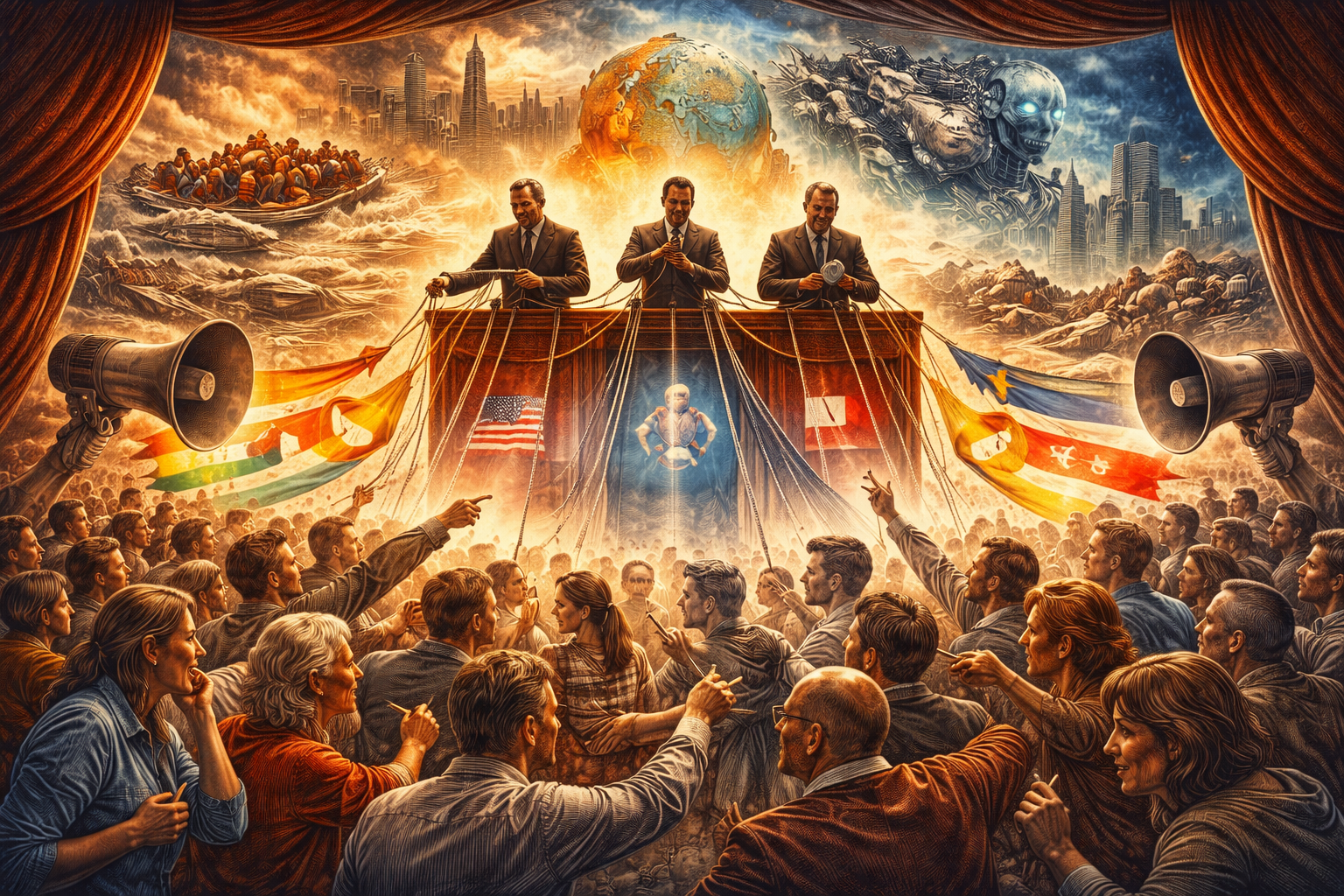
We’re Being Played, Aren’t We?
When leaders stoke narratives of cultural siege while operating transnational empires, the contradiction becomes difficult to ignore. It’s almost impossible not to conclude that it’s all just a ginormous switch-and-bait trick at play. They are drawing mass conversation away from the issues that really matter: automation, inequality, taxation structures, job losses, impending poverty, climate catastrophes – the multiple avalanches of epic, potentially civilisation-altering scenarios facing the future of humanity.
But no, let’s just talk about Turkish barbers (fighting back with comical Farage haircut pictures); Asian grooming gangs (National Police Chiefs’ Council 2023–24 data stated that in group-based child abuse and exploitation offences, around 83–85% of suspects were white, with smaller percentages recorded as Pakistani heritage or other backgrounds – and let’s not even mention Epstein again); and people on boats (only around 35,000 in 2024 compared to over 670,000 legal net migration in 2023).
In this context, it’s worth considering that one day the tide could turn. Remember that the UK is a low-lying island nation facing accelerating sea-level rise, coastal erosion and intensifying storms. Under severe warming scenarios, parts of our own coastline will retreat significantly within this century.
Climate displacement is not theoretical; it is already happening globally. It would be the height of arrogance to assume that geography and GDP grant permanent immunity. In a destabilised climate, migration flows do not move in one direction. We are not insulated from the forces reshaping the planet – we are simply one extreme environmental shock away from finding ourselves on boats begging for refuge and asylum.
But I digress. Frankly, it is easier to point at people arriving than to interrogate entrenched systems. Concerns about migration are not illegitimate; however, they are selectively amplified.
So what should leaders like Ratcliffe and Musk be doing instead? They should be investing visibly in domestic skills pipelines, funding retraining, advocating for education reform, creating jobs, offering productivity and growth opportunities, and engaging honestly with the consequences of the technologies they are building. And frankly, spending some of the billions they’ve earned from us for the greater good and benefit of society and human progress.
If automation will displace millions, then industrial leaders should be considering how to create alternative viable sources of income for those affected. If globalisation built their wealth, then they should defend the principles that made it possible. Leadership is not just about maximising shareholder return. It is about stewarding systems that sustain society.
They need to remember that without social cohesion, there is no stable market, no consumer base – basically nobody left to sell any goods or services to!
Culture is evolving, as it always has; so perhaps the better question is not whether Britain is being colonised. It is whether we’re all being distracted from the real problems that face us – and from realising who has actually created those problems.
If you found this useful, interesting or fun, consider supporting me via Patreon, Ko-Fi, or even grabbing a copy of one of my books on Amazon. Every bit helps me keep creating independent automotive content that actually helps people.
Support independent car journalism 🙏🏽☺️ grab my books on Amazon, take up membership to BrownCarGuy on YouTube, or join me on Ko-Fi or Patreon.

👉🏽 Channel membership: https://www.youtube.com/browncarguy/join
👉🏽 Buy me a Coffee! https://ko-fi.com/browncarguy
👉🏽 Patreon – https://www.patreon.com/BrownCarGuy

MY BOOKS ON AMAZON!
📖 Want to become an automotive journalist, content creator, or car influencer? Check out my book: How to be an Automotive Content Creator 👉🏽 https://amzn.eu/d/7VTs0ii
📖 Quantum Races – A collection of my best automotive sci-fi short stories! 👉🏽 https://amzn.eu/d/0Y93s9g
📖 The ULEZ Files – Debut novel – all-action thriller! 👉🏽 https://amzn.eu/d/d1GXZkO
Discover more from Brown Car Guy
Subscribe to get the latest posts sent to your email.
