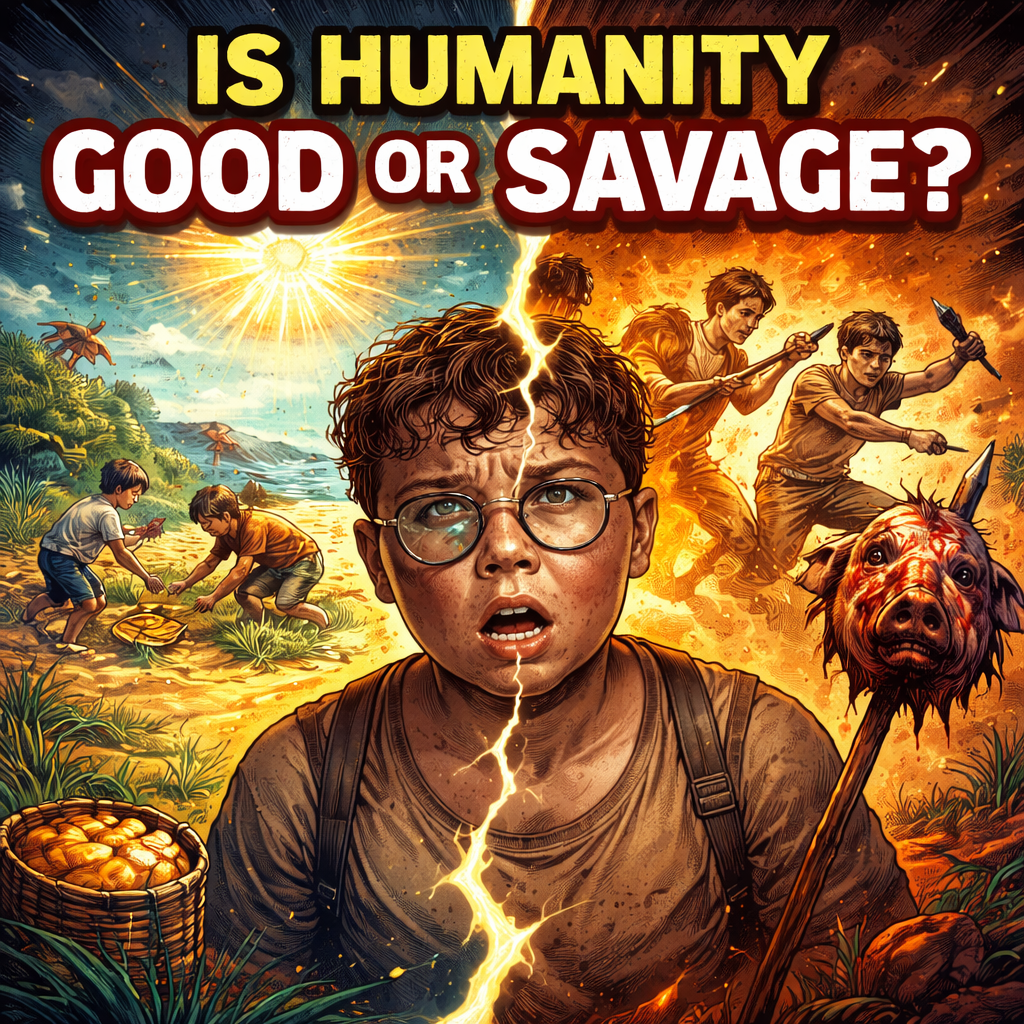
A real-world Lord of the Flies event and modern science both suggest that Golding’s darkest assumption about us may have been profoundly mistaken
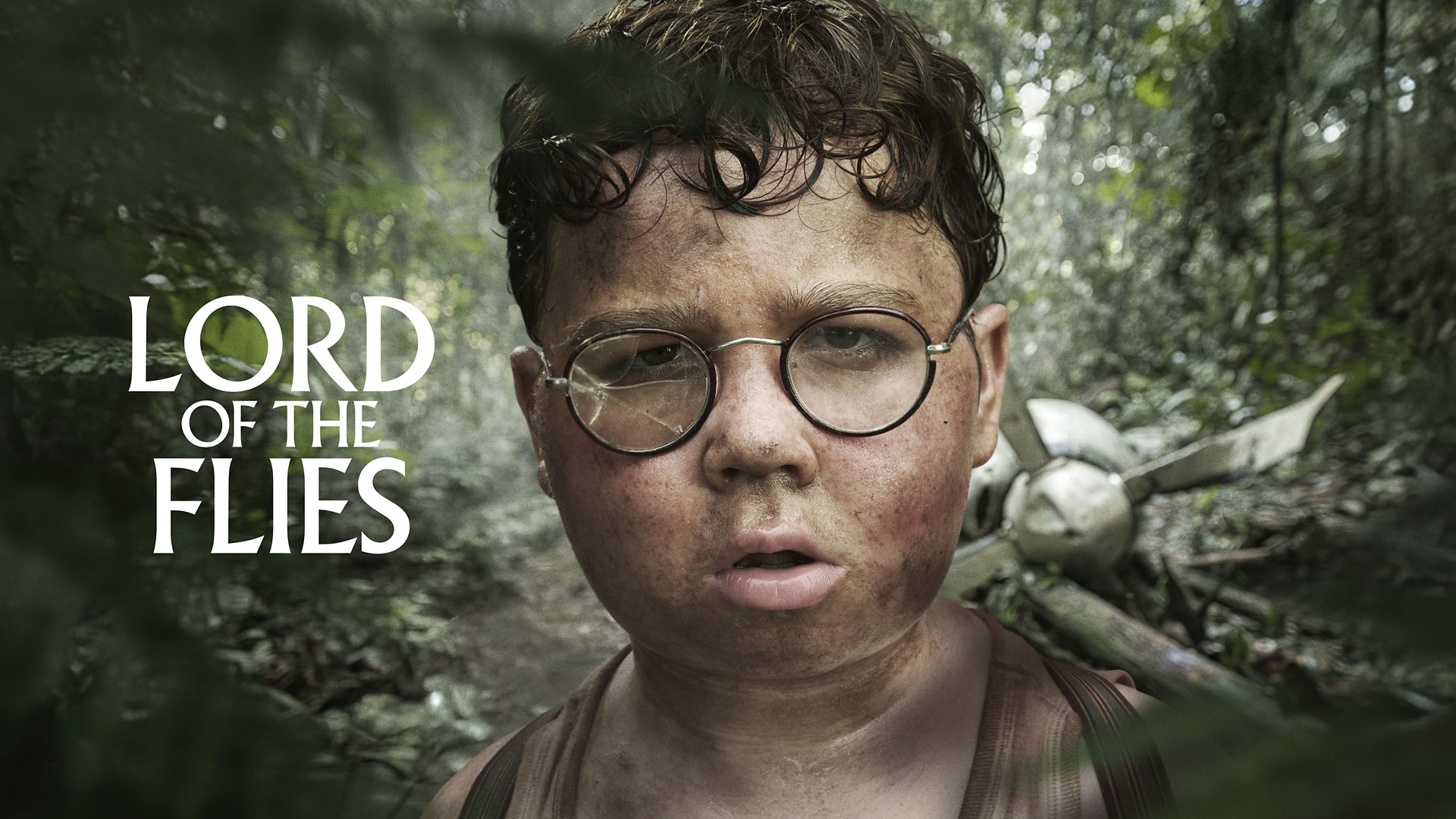
Whenever Lord of the Flies resurfaces, as it now has with a dramatic new television serialisation, we are invited to revisit the same bleak conclusion: scratch the surface of civilisation and out spills the savage. Remove teachers, police, governments, parents, and apparently we revert to painted faces, sharpened sticks, and ritual murder before it’s coconut milk time.
I read Golding’s novel years ago and remember feeling not enlightened but very depressed by it. The idea that a group of reasonably well-brought-up schoolboys could descend so quickly into tribal brutality felt less like insight and more like an indictment of humanity itself. It suggested that beneath the blazer and the hymn book lurks a creature barely restrained by rules.
Golding’s thesis, often referred to as “Veneer Theory,” proposes that civilisation is a thin cosmetic layer over our true barbaric nature. Peel it away and the beast (literally) emerges. It is a powerful narrative. It is dramatically satisfying, of course. But it is also, when examined against real evidence, rather misleading.
Because when reality staged its own Lord of the Flies experiment, it did not end in blood.
The Real Shipwreck
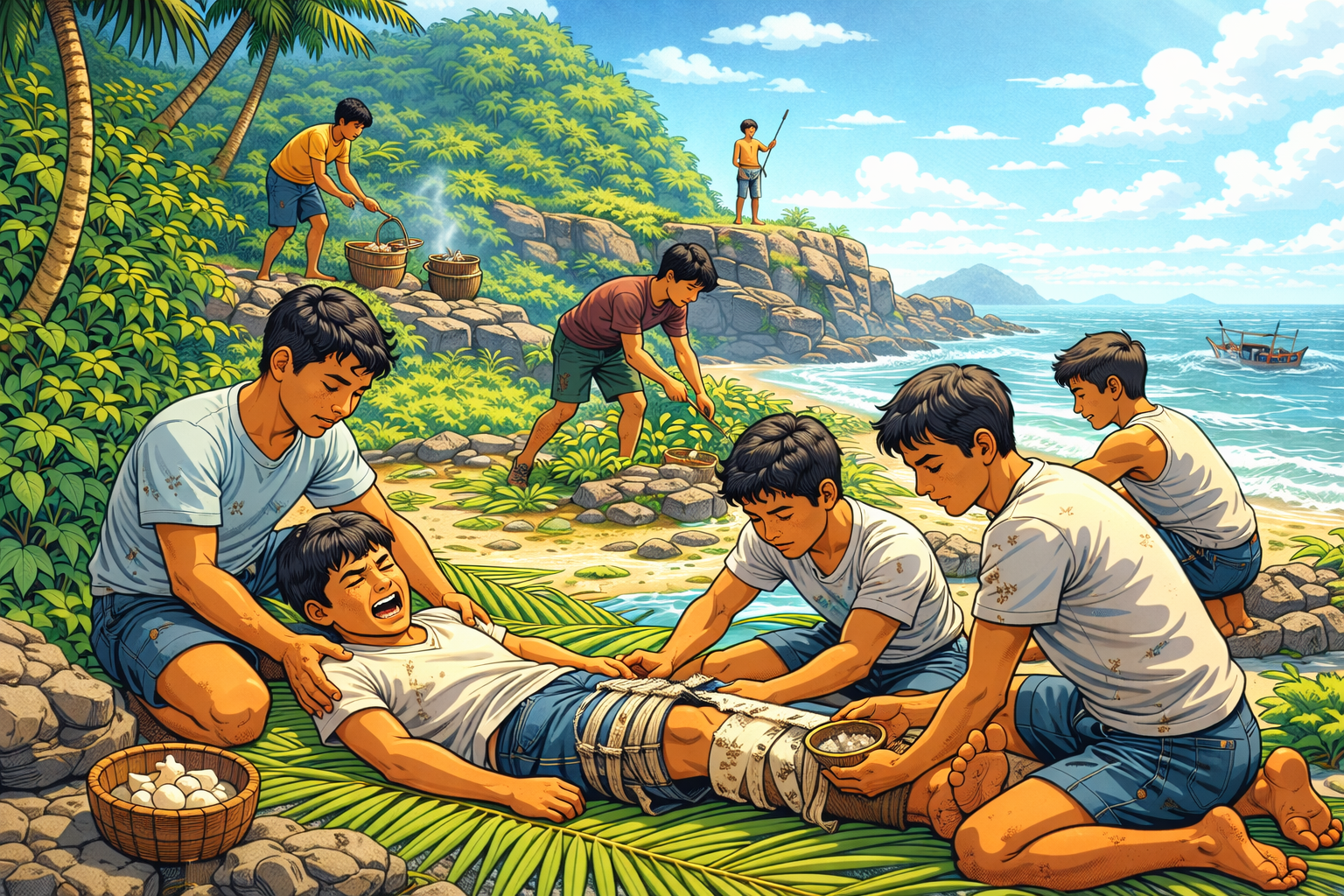
In 1965, six teenage boys from Tonga, bored with boarding school discipline, “borrowed” a fishing boat and promptly sailed into a storm. They drifted for days before being marooned on the remote island of ’Ata, where they survived for fifteen months. If Golding had been correct, this should have spiralled into paranoia, dominance struggles, and violence within weeks.
Instead, the boys organised themselves. They established rosters for gardening, cooking, lookout duty. They settled disputes by separating to cool off rather than escalating. They sang together to maintain morale. When one boy broke his leg, the others splinted it with sticks and cared for him until it healed.
When finally rescued by an Australian fisherman, they were not feral. They were healthy, disciplined, cooperative. Faced with crisis, their instinct was not savagery. It was solidarity. That is what really happened, and that is more hopeful, inspiring and thankfully, real.
So Where Do the Jacks Come From?
If we are wired for cooperation, how do we explain the tyrants, the bullies, the corporate predators, the political opportunists? Where do we find Golding’s Jack in the real world?
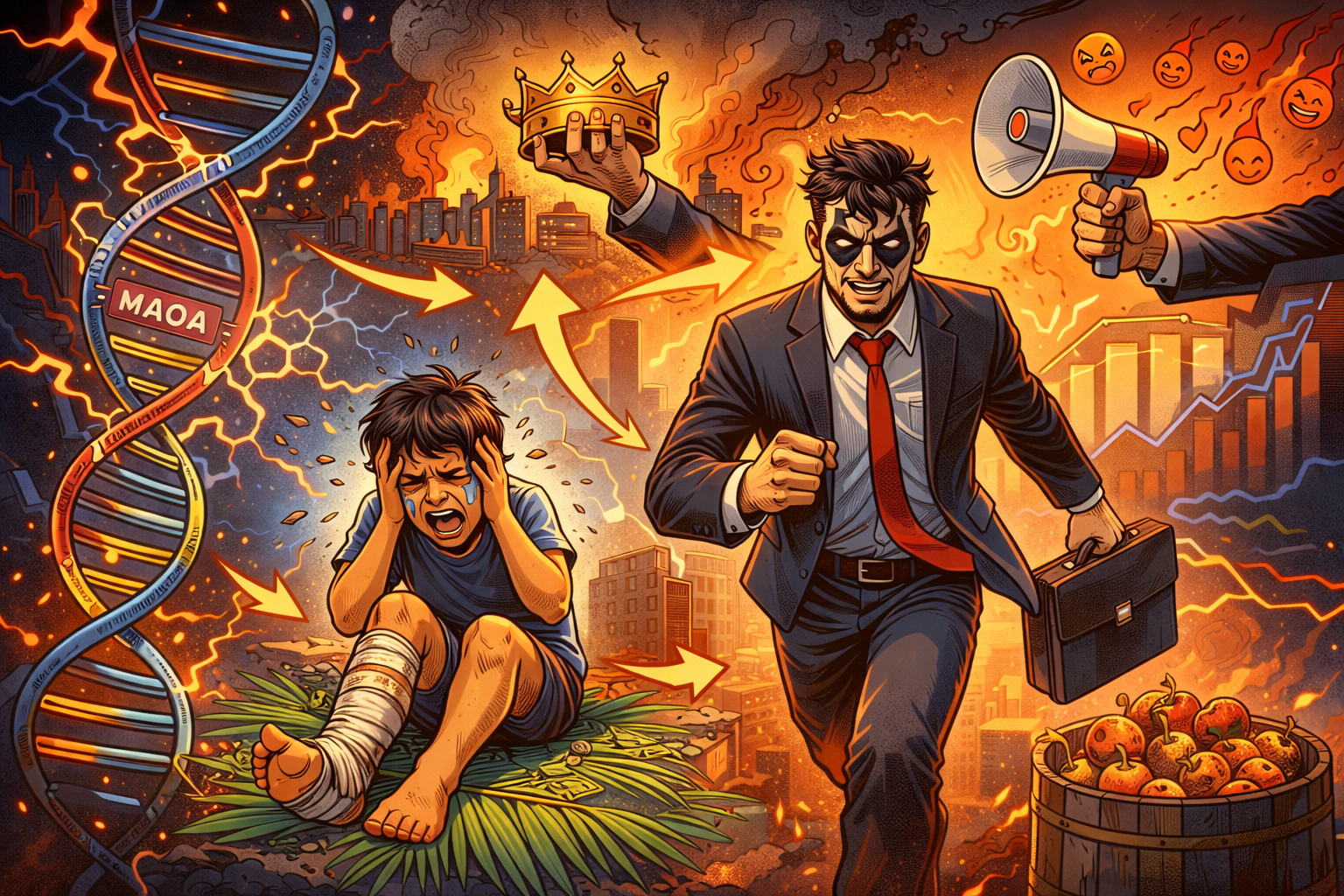
Modern psychology does not lean on “evil” as an explanation. It points instead to biological variation. A small minority of people exhibit traits associated with psychopathy: lower baseline empathy, higher risk tolerance, reduced fear response. That does not automatically produce violence or evil. Context matters enormously.
Take the much-discussed MAOA gene, once sensationally labelled the “warrior gene.” It correlates with aggression primarily when combined with severe childhood trauma. Genetics loads the gun; environment pulls the trigger.
On the other hand, put someone with the same cold emotional traits into a structured, accountable system and they may become a calm surgeon, an unflappable emergency responder, a decisive leader in crisis. Place the same traits in a chaotic environment of scarcity and unchecked power, and you may well manufacture a Jack.
The problem is rarely the apple alone. It is usually the barrel (as in the old idea that a bad barrel spoils the apples inside it).
Why It Feels Like Golding Was Right
If humans are fundamentally cooperative, why does the modern world often feel like a dystopian audition tape? Because while our evolutionary hardware was built for small-group collaboration, our current operating system runs on competition, hierarchy, and artificial scarcity. We reward the ruthless disproportionately. We monetise outrage. We amplify tribal identity.
The internet, for all its brilliance, functions rather like Jack’s face paint. Anonymity erodes accountability. Social shame, which evolved to regulate behaviour in small communities, loses its grip when you are hidden behind a username and a Wi-Fi signal.
We are not inherently savage creatures struggling to behave. We are cooperative beings placed inside systems that incentivise conflict. It is that tension that creates the chaos, not the beast within – which arguably doesn’t really exist at all.
The Star Trek Temptation
Some look to science fiction for an escape hatch – as I frequently do, and in particular, Star Trek. In the Gene Roddenberry-inspired universe, humanity transcends greed through post-scarcity technology. Replicators eliminate material want. Money becomes obsolete. People pursue meaning, reputation, curiosity, and service.
It sounds utopian. It also highlights a critical insight. Much of human conflict is driven not by innate brutality but by perceived lack of stuff they need and want. When survival feels threatened, tribal instincts sharpen.
We do not yet have replicators. We barely manage an equitable benefits system. Until basic needs are consistently secured, whether through economic reform, social policy, or something like universal basic income, our cooperative wiring will continue to clash with competitive structures.
We are in transition. And transitions are unstable. They either refine a civilisation or expose its cracks. If we continue to reward the most ruthless, we will not be overrun by savages emerging from the jungle. We will manufacture our own Jacks in boardrooms, parliaments, and algorithms.
We are NOT Savages, We Are Humans
Enjoy the new adaptation of Lord of the Flies. It is compelling drama. It taps into something primal and theatrical. But do not swallow it as anthropology.
Golding’s war trauma understandably coloured his worldview. He saw civilisation collapse in Europe and extrapolated downward into the depths of human despair and desperation. The narrative resonates because it mirrors our own fears – even today.
Yet the evidence suggests something more hopeful and arguably more complex. Across evolutionary history, we survived not because we were the most violent primates, but because we were the most collaborative and communicative. We share food. We coordinate. We nurture. We build.
The darkness we witness today is often structural rather than biological. Systems can be badly designed. Incentives can distort behaviour. Power can corrupt when unchecked.
But that is not the same as saying we are monsters in waiting. When the grown-ups leave the island, we do not automatically become savages. More often, we step up to become organisers, carers, problem-solvers. We create rosters. We build shelters. We sing.
The savage is not our default setting. It is a narrative we were told. A dramatic one. A memorable one. But not, it seems, a particularly accurate one.

If you found this useful, interesting or fun, consider supporting me via Patreon, Ko-Fi, or even grabbing a copy of one of my books on Amazon. Every bit helps me keep creating independent automotive content that actually helps people.
Support independent car journalism 🙏🏽☺️ grab my books on Amazon, take up membership to BrownCarGuy on YouTube, or join me on Ko-Fi or Patreon.

👉🏽 Channel membership: https://www.youtube.com/browncarguy/join
👉🏽 Buy me a Coffee! https://ko-fi.com/browncarguy
👉🏽 Patreon – https://www.patreon.com/BrownCarGuy

MY BOOKS ON AMAZON!
📖 Want to become an automotive journalist, content creator, or car influencer? Check out my book: How to be an Automotive Content Creator 👉🏽 https://amzn.eu/d/7VTs0ii
📖 Quantum Races – A collection of my best automotive sci-fi short stories! 👉🏽 https://amzn.eu/d/0Y93s9g
📖 The ULEZ Files – Debut novel – all-action thriller! 👉🏽 https://amzn.eu/d/d1GXZkO
Discover more from Brown Car Guy
Subscribe to get the latest posts sent to your email.
