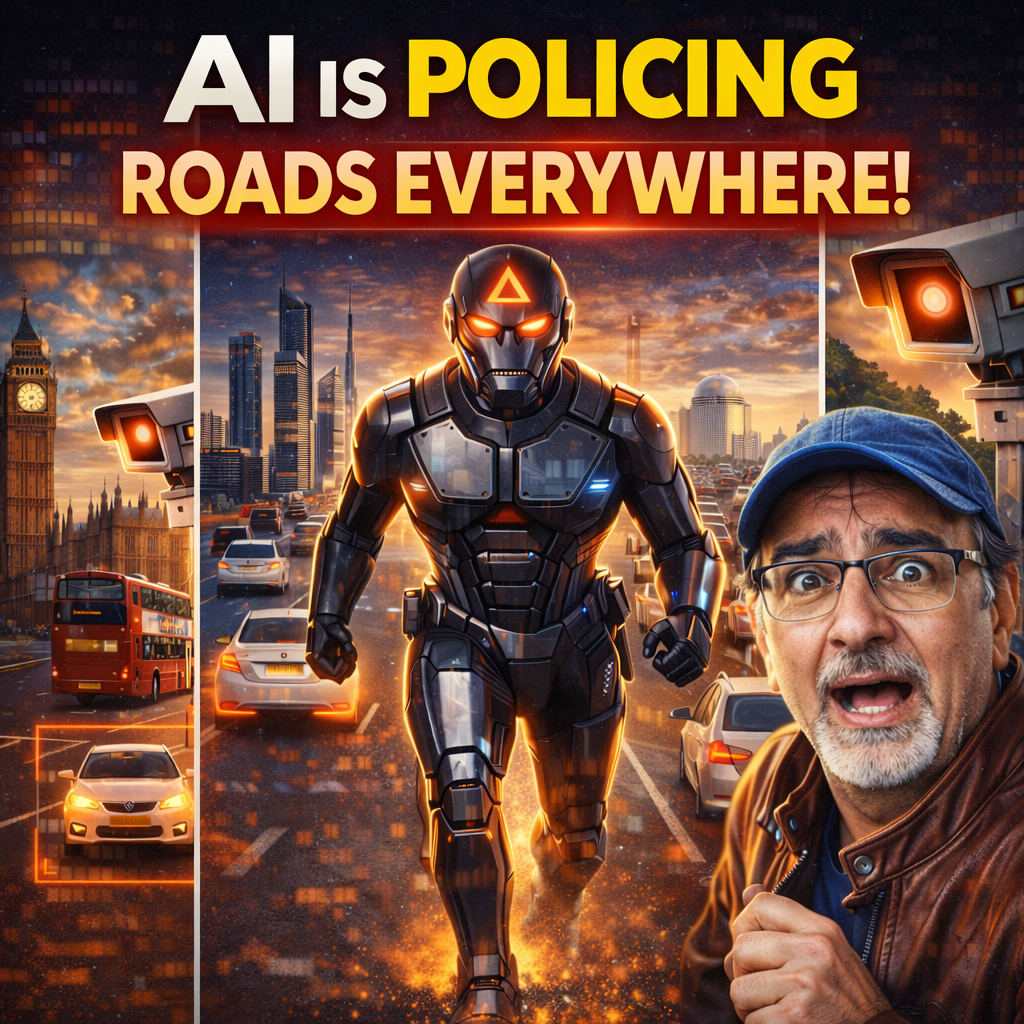
AI traffic cameras were just the beginning. Around the world, machines are now judging how you drive – and once the system decides, there’s no arguing back
Remember when getting pulled over went a bit like this… You’d clock the flashing lights, feel your stomach drop, rehearse your apology, and then hope – just hope – that the officer was having a good day. Maybe you’d get a telling-off. Maybe a warning. Maybe, if the stars aligned and Mercury was in retrograde, you’d get sent on your way with a “take it easy, mate”. Yeah, about that…
Those days are long gone I’m afraid. They didn’t die with a bang or some dystopian announcement blasted across the evening news, but with a soft electronic hum, a firmware update here, a pilot programme there, and the steady, almost imperceptible spread of cameras, sensors and algorithms that don’t shout their presence, don’t need to, and don’t particularly care whether you’ve noticed them or not.
“Driving enforcement no longer reacts to what you did. It quietly predicts what you might do next.”
Because while most of us have been busy arguing about speed limits, low-traffic neighbourhoods, potholes, touchscreen dashboards and whether anyone genuinely asked for subscription heated seats, the very nature of driving enforcement has been evolving beneath our wheels. Not reacting anymore, not waiting for a single moment of indiscretion, but watching continuously, patiently, building a picture of who you are behind the wheel, how you behave when you think no one’s looking, and what your driving says about you over time.
And that, really, is the crucial shift.

From Momentary Mistakes to Behavioural Patterns
Traditional enforcement was episodic. A snapshot. A moment in isolation. You were either speeding at that precise instant or you weren’t. You crossed the line or you didn’t. You got caught on a bad day, or you didn’t. AI-driven enforcement, by contrast, is cumulative. It doesn’t care about one naughty flick of the throttle or a single lapse in concentration. It cares about patterns, tendencies, habits. It notices whether you drift in your lane, whether you tailgate just a little too often, whether your hand finds your phone more frequently than it should, whether your driving feels distracted, impatient, hurried, or – and this is the key word – risky.
“Once enforcement loses its human face, it also loses its capacity for forgiveness, discretion, and nuance.”
Which means that even if you obey every posted speed limit, even if you never technically “break” a rule in the old-fashioned sense, you can still find yourself quietly categorised, algorithmically assessed, and statistically nudged into a box marked something along the lines of: driver behaviour suggests elevated risk. No flashing lights. No siren. No conversation at the roadside. Just a system somewhere, crunching numbers, correlating behaviours, and drawing conclusions without ever needing to look you in the eye.

The Rise of the Invisible Traffic System
This is where the popular understanding of AI traffic cameras falls short. They are no longer just automated replacements for speed traps or red-light cameras. They are components in a much broader ecosystem of surveillance-led traffic management, one that blends roadside AI enforcement with in-car telematics, insurance risk scoring, and interconnected databases that talk to one another far more fluently than most drivers realise. Your car, your phone, the road infrastructure and your insurer increasingly exist in the same digital conversation, even if you’re not invited to it.
And the unsettling part is not that these systems exist – safety, after all, is a perfectly reasonable objective – but that their logic is probabilistic rather than moral. They don’t ask why you did something. They don’t care if you were tired, stressed, late, distracted by life rather than TikTok. They don’t weigh context or contrition. They simply measure inputs, identify correlations, and output consequences. A fine. A score. A premium increase. A nudge towards behavioural compliance, delivered not with authority or anger, but with administrative indifference.

Life Under Continuous Assessment
Once enforcement loses its human face, it also loses its capacity for forgiveness, discretion, and nuance. You can’t charm an algorithm. You can’t apologise to a database. You can’t appeal to a neural network’s better nature, because it doesn’t have one. There is only compliance, deviation, and the statistical space in between, and as these systems spread from pilot projects to permanent infrastructure – in the UK, in Dubai, in India, in Pakistan, and increasingly across Europe – that space is shrinking fast.
“You can’t charm an algorithm, apologise to a database, or appeal to a system that doesn’t recognise regret.”
Which raises an uncomfortable question that goes well beyond speed limits or mobile phones at the wheel. If driving is no longer judged moment by moment, but instead assessed as a rolling behavioural profile, then at what point does the simple act of getting behind the wheel stop being a freedom, and start feeling like a permanent exam you never quite finish sitting?
And perhaps more importantly: who, exactly, is marking the paper?

If you found this useful, interesting or fun, consider supporting me via Patreon, Ko-Fi, or even grabbing a copy of one of my books on Amazon. Every bit helps me keep creating independent automotive content that actually helps people.
Support independent car journalism 🙏🏽☺️ grab my books on Amazon, take up membership to BrownCarGuy on YouTube, or join me on Ko-Fi or Patreon.

👉🏽 Channel membership: https://www.youtube.com/browncarguy/join
👉🏽 Buy me a Coffee! https://ko-fi.com/browncarguy
👉🏽 Patreon – https://www.patreon.com/BrownCarGuy

MY BOOKS ON AMAZON!
📖 Want to become an automotive journalist, content creator, or car influencer? Check out my book: How to be an Automotive Content Creator 👉🏽 https://amzn.eu/d/7VTs0ii
📖 Quantum Races – A collection of my best automotive sci-fi short stories! 👉🏽 https://amzn.eu/d/0Y93s9g
📖 The ULEZ Files – Debut novel – all-action thriller! 👉🏽 https://amzn.eu/d/d1GXZkO
Discover more from Brown Car Guy
Subscribe to get the latest posts sent to your email.
