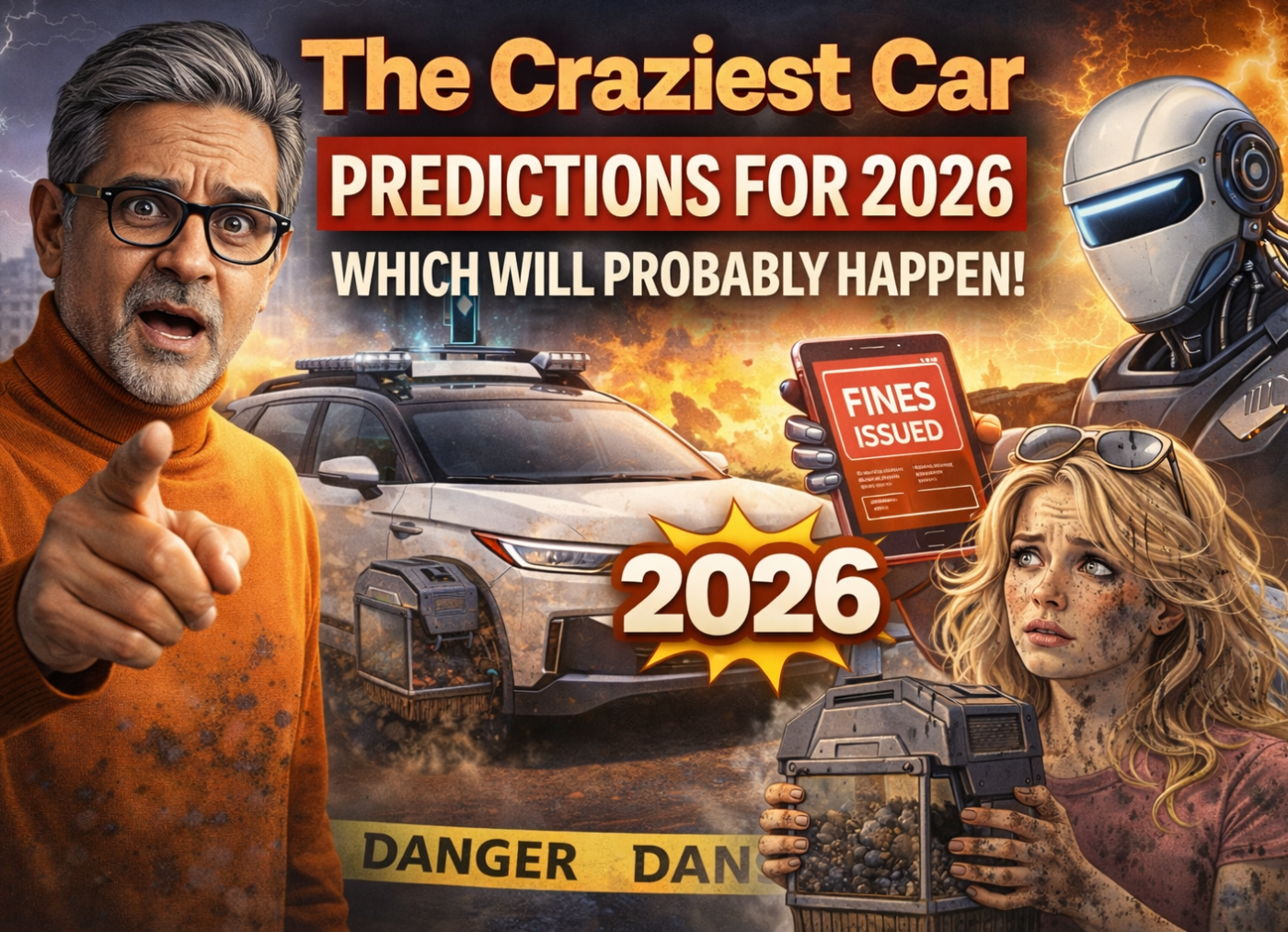
Cars that drive themselves, insurance that costs more than the car, and progress that appears to have misplaced the steering wheel – welcome to 2026
The future has arrived. Not with a heroic fanfare or a cinematic fly-through of a gleaming metropolis, but more like a confused relative turning up late to Christmas dinner wearing mismatched socks and asking if anyone’s got the Wi-Fi password. Because the trouble with the future is this: it never arrives the way the sci-fi promised. There are no flying cars. No elegant solutions. No perfectly optimised utopia. Instead, we’ve been handed a series of half-finished ideas, each more complicated than the last, and told they’re all part of a journey.
And as we edge into 2026, the motoring world doesn’t feel like it’s confidently accelerating towards progress. It feels more like we’re hurtling enthusiastically towards a brick wall… while holding a committee meeting about the wall’s colour, texture, sustainability rating and emotional wellbeing.
So what follows is not a list of certainties or prophecies. There are no crystal balls involved. This is simply an attempt to look at the direction of travel, squint slightly, tilt your head… and say: “That… that doesn’t quite seem right. But I guess we’re doing it anyway.”
Settle in. Pour yourself something festive. Here are my predictions for the car world in 2026 – some sensible, some concerning, and several suggesting that, as a species, we may have mistaken complexity for intelligence.
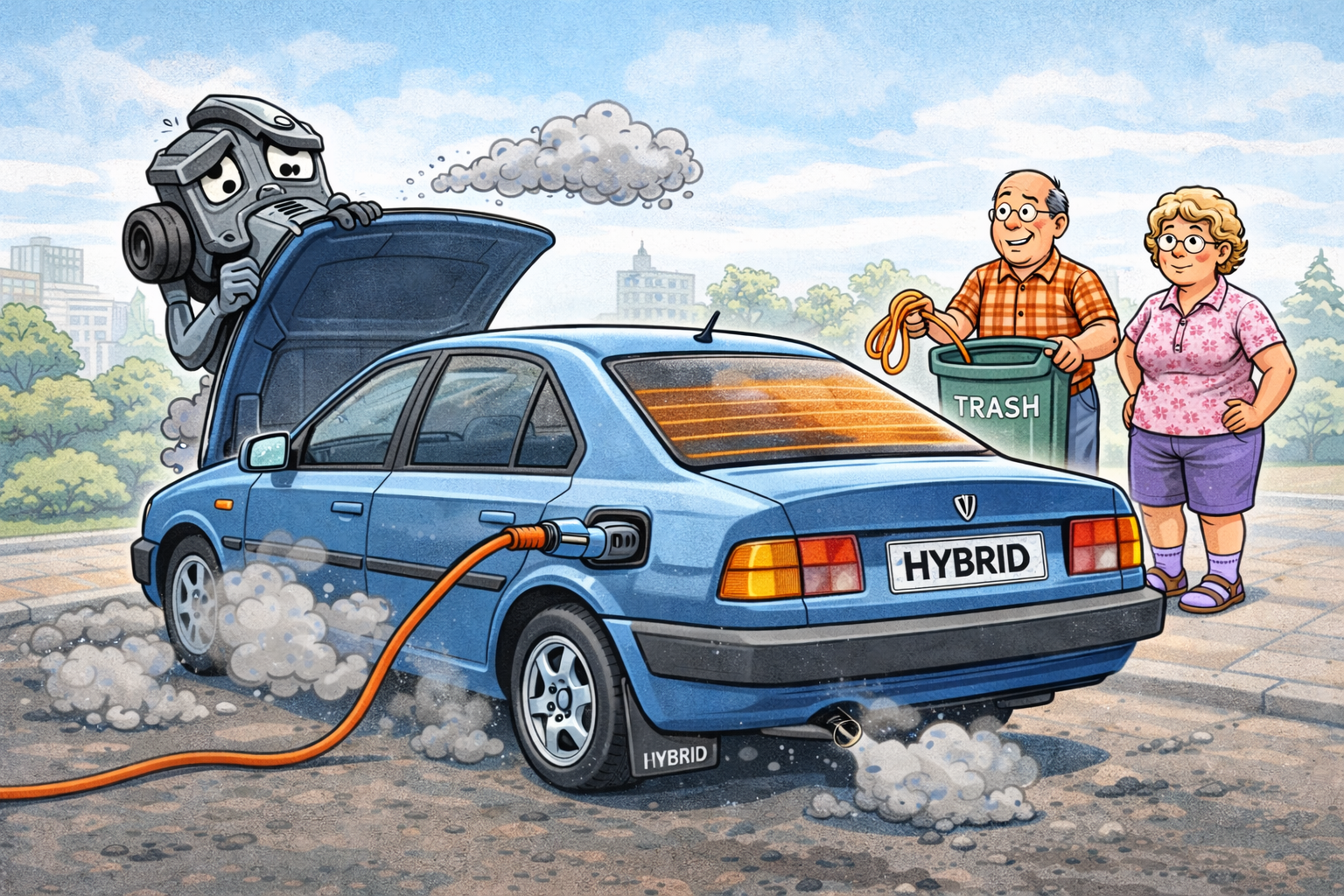
10. Hybrids Become the New Skoda
Once upon a time, Skoda was the punchline of every decent car joke. You remember them.
Why does a Skoda have a heated rear window? So your hands don’t get cold when you’re pushing it.
And then, while everyone was distracted by traction control systems and corporate rebrands, something deeply inconvenient happened. Skoda became… good. Solid. Sensible. Cleverly engineered. Slightly smug.
And in 2026, hybrids complete the same journey. They were once mocked as half-hearted fence-sitters. A petrol car with a guilty conscience. Something for people who don’t trust extension leads. The automotive equivalent of wearing socks with sandals.
And yet here we are. As full EV adoption stalls and regulations tighten like an over-zealous seatbelt, hybrids have quietly become the unlikely saviours of the internal combustion engine. They keep the noise, dodge the rules, and allow politicians to say “transition technology” while sounding like they understand what’s going on. Which they don’t. Obviously.
Is this irony? Or some vast cosmic joke designed to teach petrolheads humility… and the flavour profile of humble pie?
9. Driver Engagement Becomes an Endangered Species
There was a time when car launches talked about steering feedback. Seat-of-the-pants feel. Visceral engagement. In 2026, “driver engagement” is quietly ushered into the same museum as choke cables and cassette adapters. Because it reminds people that driving used to be something you did. Not something that happened to you while you checked emails.
Somewhere in a glass meeting room, a brave junior engineer will suggest hydraulic steering and a manual gearbox. He won’t finish the sentence. The accountants will shake their heads. The engineers will go apoplectic. The marketing team will film the whole thing for TikTok. And a new edict will be scrawled on the wall:
Fun is difficult to homologate. Fun will not be allowed.
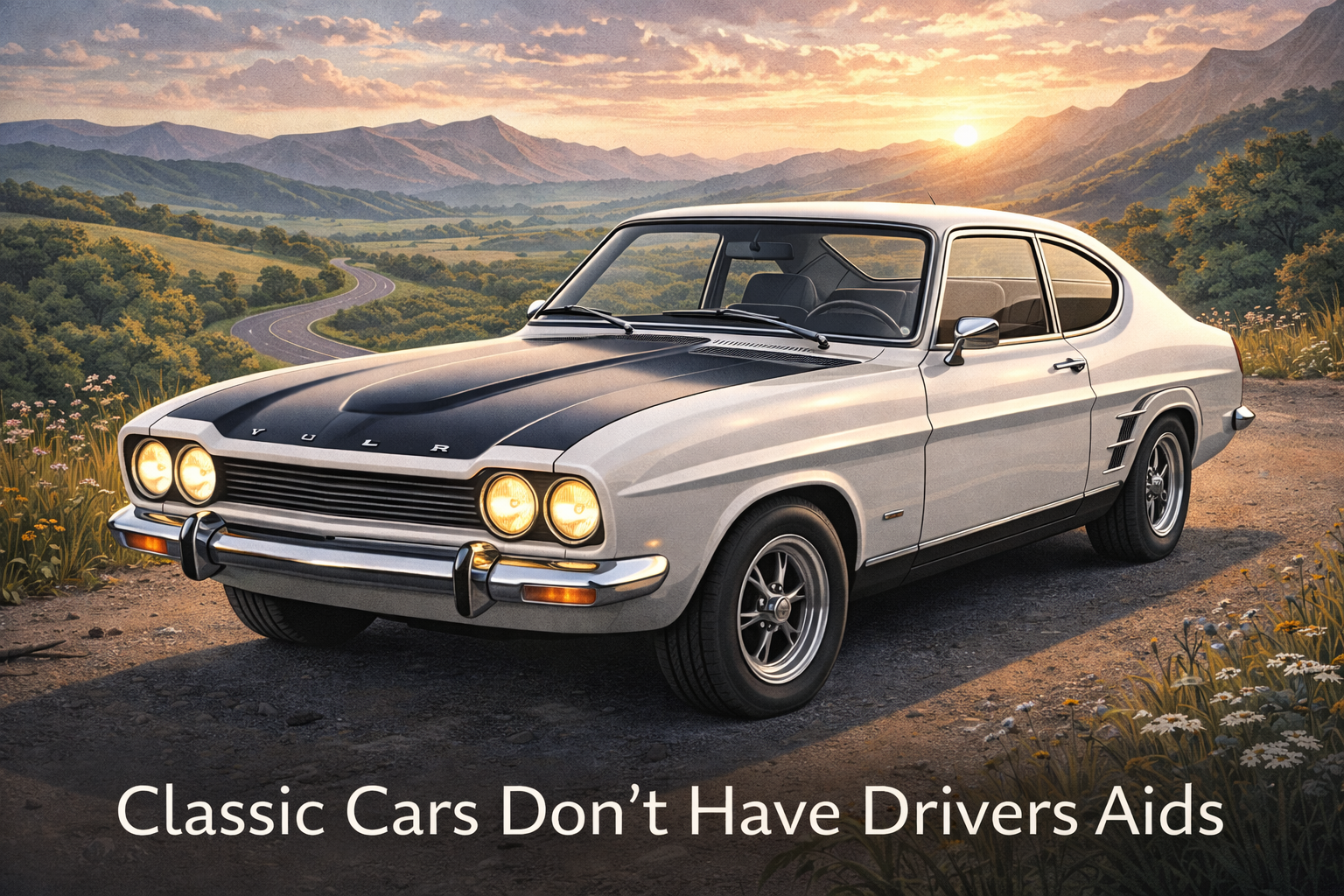
8. Classic Cars Start to Feel Emotionally Safer Than Modern Ones
Not safer in a Euro NCAP sense. Emotionally safer. Classic cars don’t phone home. They don’t wake up sulking after a software update. They don’t disable features you already paid for because a subscription expired. They have keys you can fiddle with in your pocket. Engines that make rude noises. And occasionally, they have a basic, old-fashioned disagreement with you. This may involve strong language, a hammer, and reminding the car who’s boss.
Crucially, they don’t lull you into a false sense of automotive divinity. Fear remains part of the driving experience – and that’s no bad thing. Fear keeps you sharp. Fear keeps you focused. Fear keeps you alive.
In 2026, that sort of mechanical honesty starts to feel… well… quite radical.

7. A Software Update Brings the World to a Halt
Mark my words. This will be a headline at some point in 2026. A routine over-the-air update. A reassuring message. A little spinning icon. And then… nothing.
Cars immobilised where they stand. Unable to select neutral. Too heavy to push. Steering locked. Motorways transformed into very expensive car parks while someone on breakfast television explains “the cloud” – a concept which, in 2026, nobody has still managed to properly define. This will be the moment many people realise they don’t actually own their car. They are merely guests in it.
We will rage online. Vow never to buy a connected car again. And then carry on as normal once everything reboots. We will experience it. We will talk about it. And we will learn absolutely nothing.
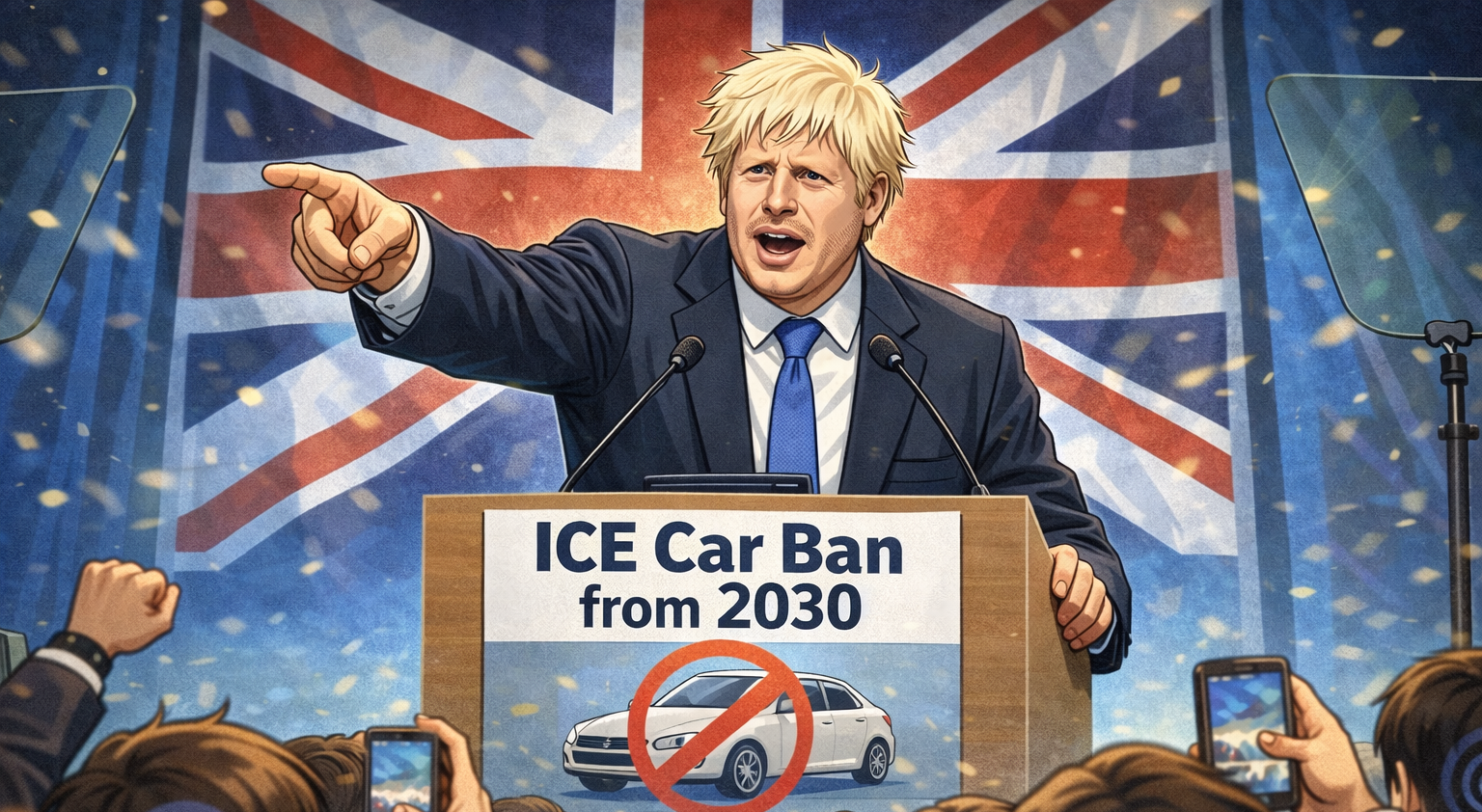
6. The 2030 Petrol Ban Drifts Gently into Myth
The government will remain absolutely committed to net zero. This will be repeated often. Firmly. Sincerely.
But as Europe softens its stance and reality intrudes, the UK’s 2030 ban will quietly transform from firm… to flexible… to aspirational… and finally to that most comforting of phrases: “Under review.” No announcement. No apology. Just a slow bureaucratic fade-out, like a radio station losing signal as you drive into the countryside.
The policy won’t be cancelled. It will simply stop being enforced.
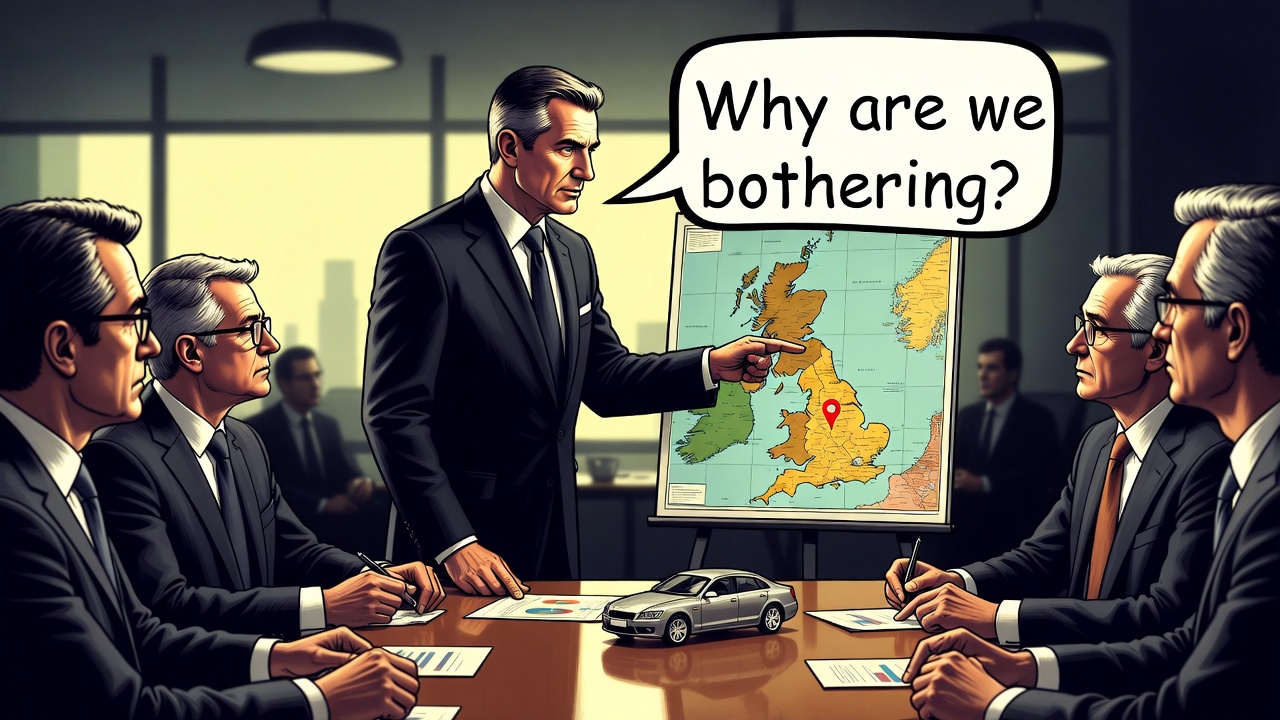
5. German Premium Carmakers Quietly Pull Back from the UK
This will not happen with a bang. There will be no dramatic exit. No angry press releases. No farewell special editions with commemorative plaques and misty-eyed videos. Instead, it will happen the German way. Politely. Rationally. With spreadsheets.
Because when you look at the UK market through the eyes of a premium German carmaker, the numbers are starting to look… awkward. High taxes. Constant regulatory uncertainty. Ever-tightening emissions rules. Hostile urban policy. And a customer base that is being gently but persistently trained to feel guilty about enjoying driving – or, increasingly, enjoying anything at all.
At some point, someone in Ingolstadt, Munich or Stuttgart will stare at a screen and ask a very calm, very German question: “Why are we still bothering?” Why homologate a high-performance petrol model for a shrinking market that increasingly doesn’t want it? Why engineer compliance solutions for a country that keeps changing the rules mid-game? Why go to the effort of producing right-hand-drive versions for cars that arrive already taxed, restricted, penalised and side-eyed?
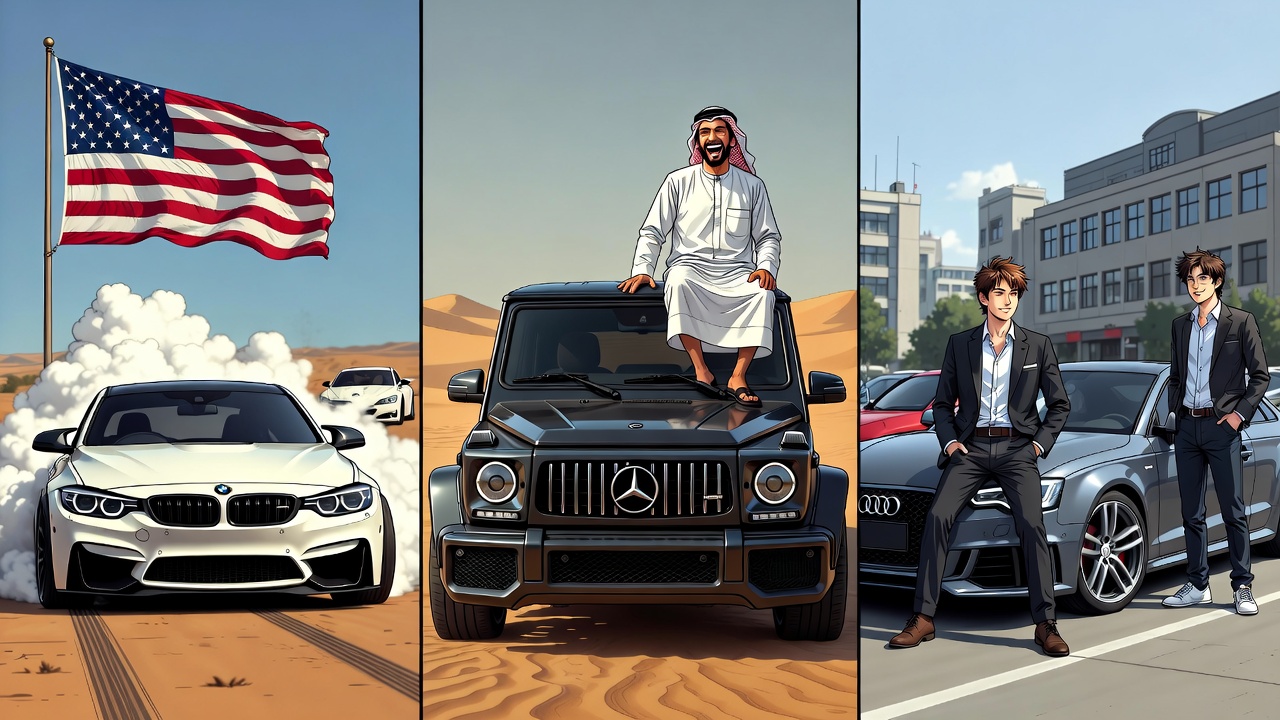
And so it won’t be that RS, AMG and M cars disappear overnight. They’ll just… thin out. Fewer engines. Fewer variants. Fewer allocations. Longer waiting lists. More excuses. Not cancelled. Just quietly deprioritised.
And when the inevitable question is asked – where will they go instead? – the answer will be obvious. The US. The Middle East. And of course, China. Markets where performance cars are still allowed to exist without apology.
At some point, a senior German car boss will shrug faintly and mutter, with polite finality: “Ah… let the Chinese brands have the UK.” Not an insult. Just a conclusion.
For enthusiasts, this will be the unsettling realisation that the golden era of walking into a UK showroom and ordering a snarling, petrol-fuelled RS, AMG or M car to your exact specification is quietly ending. Not because the UK stopped loving them. But because Germany gave up on us.
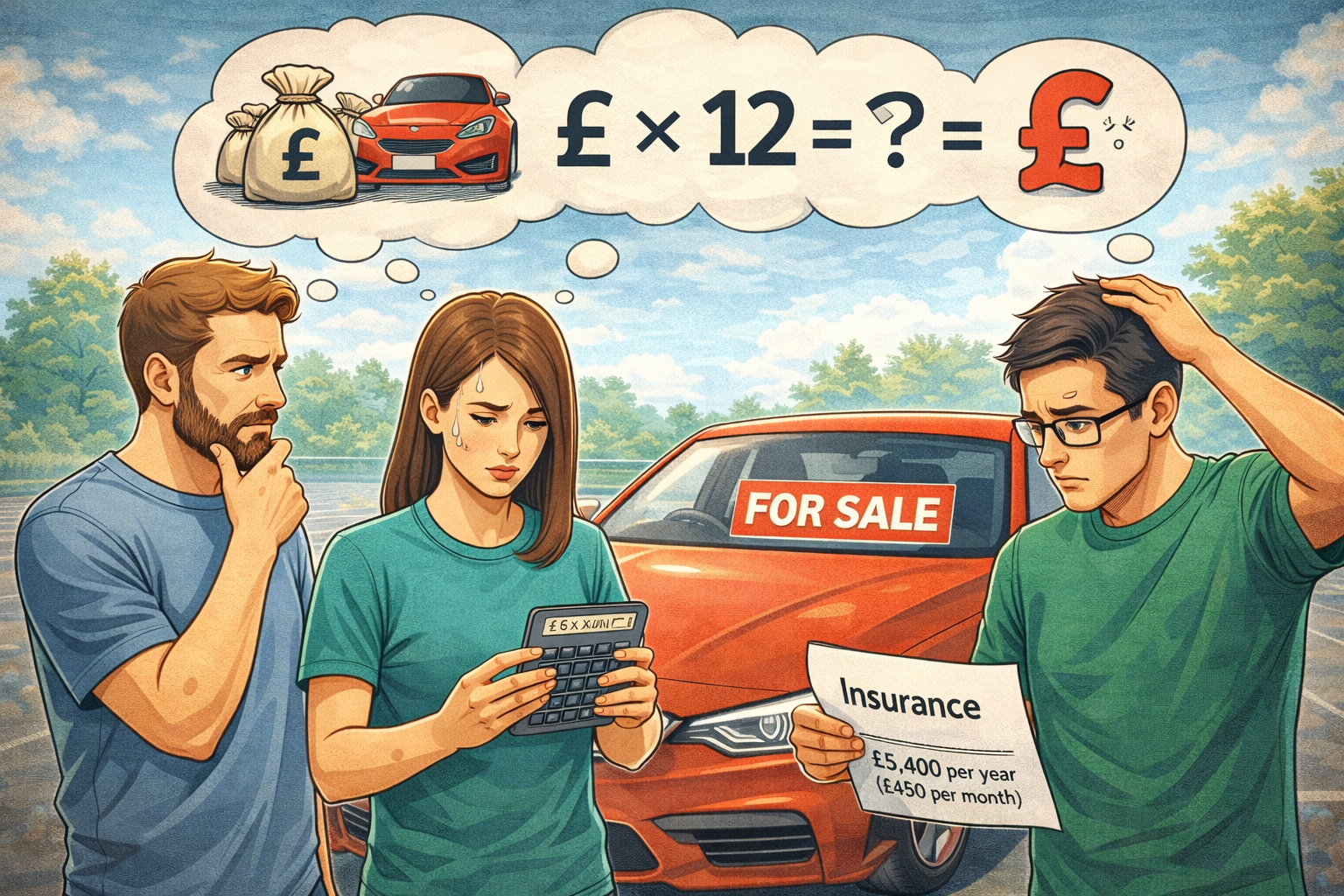
4. Insurance becomes the most expensive part of owning a car
In 2026, many motorists will make a startling discovery. The most expensive part of owning a car is no longer the car. It’s not the purchase price. Not the finance. Not the servicing. It is, of course, the insurance.
You’ll receive a renewal email with a subject line like “Good news about your policy!” You’ll open it. You’ll blink. You’ll sit down. You’ll read it again to check that this is just the monthly payment… not the annual total.
At this point, some people will do the maths and reach an extraordinary conclusion. They have to sell their car… To pay for the insurance… That they need in order to drive it. The car itself may still be just about affordable. But the permission to use it is not.
Insurance companies will explain this patiently. It’s risk. It’s data. It’s sensors. It’s calibration. It’s inflation. It’s geopolitics. It’s the moon being in the wrong phase. All technically true. None of it remotely helpful.
A minor bump that once required a new bumper will now require a technician, a laptop, a calibration rig, three updates, an alchemist, and a small ceremony in which several Hot Wheels models are sacrificed. Your premium has to reflect this.
By late 2026, comparison websites will start adding new filters:
“Exclude cars with radar.”
“Exclude cars with cameras.”
“Exclude cars with feelings.”
Actually… just exclude bloody cars altogether, innit?
By the end of the year, you won’t impress anyone with horsepower figures or prestige badges. To really show off, you’ll casually mention your insurance policy.
And when someone finally asks how it came to this, the answer will be simple. We made cars so clever, so expensive, and so fragile… that they cost more to repair than they do to build.
Also – let’s be honest – insurance companies are absolutely having a laugh.
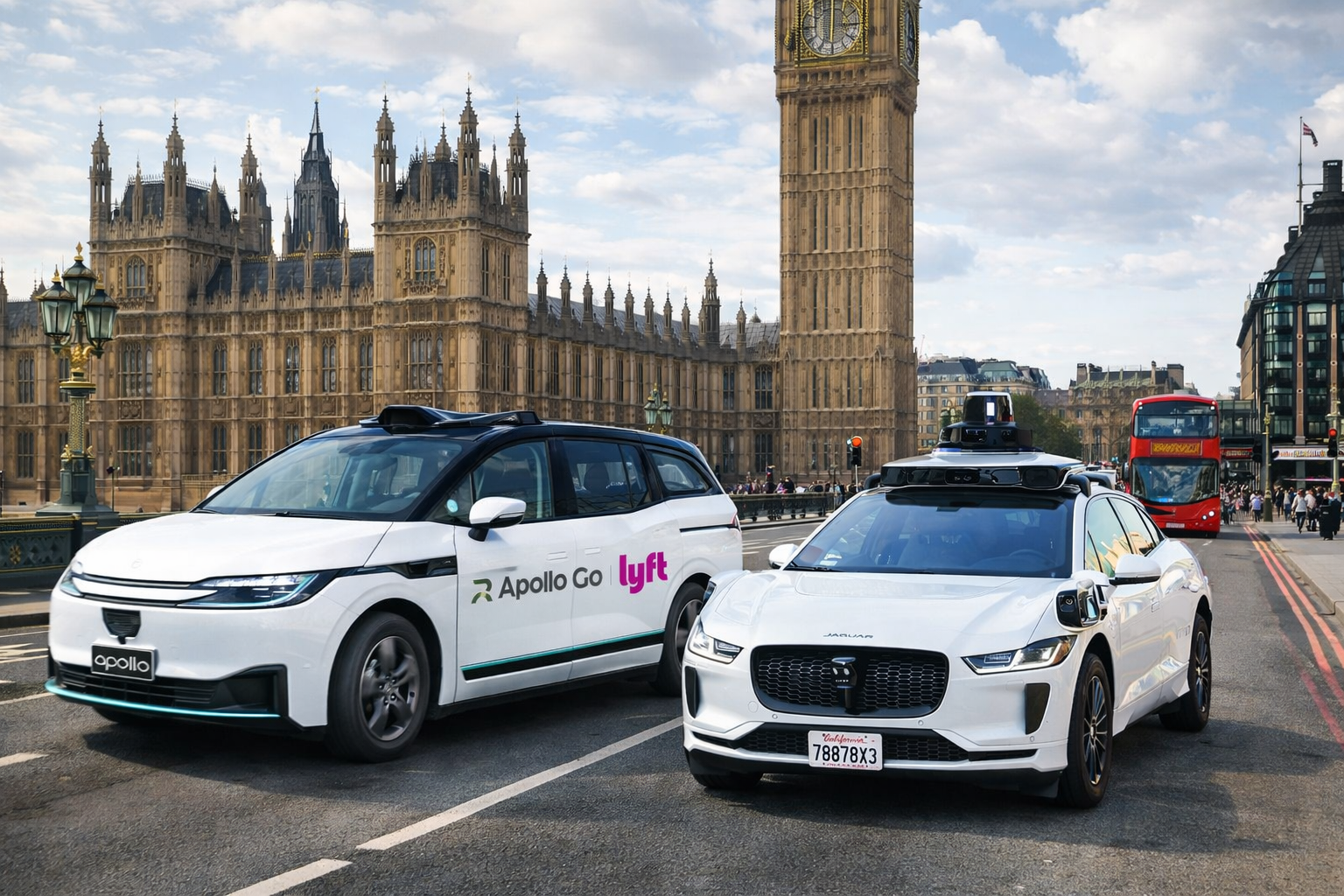
3. Driverless taxis go viral in London
In 2026, driverless taxis will finally arrive on the streets of London. This is not speculation. They are now legal. This will be heralded as a triumph of technology. A milestone. A glimpse of the future.
And within approximately forty-five minutes, someone will film one doing something profoundly stupid.
Because London is not a test environment. It is not a grid. It is not logical. It is a thousand years of compromise, Victorian street furniture, faded road markings, and decisions made either during the Blitz… or at council road-planning meetings in the 1960s when everyone appeared to be extremely, enthusiastically high.
And into this… we will drop an algorithm.
At first, the cars will be polite. Painfully polite. They will hesitate at everything. They will avoid eye contact with cyclists. They will be utterly baffled by yellow box junctions. The taxi will enter one. Realise it shouldn’t be there. Stop. Apologise to the cloud. No one will know what it’s doing.
Mini-roundabouts will cause existential crises. Roadworks will break it entirely. Especially the cones. Temporary cones. Moved daily. Placed by someone called Stefan. The car will freeze. Attempt to interface with the cone. Fail. Its hazard lights will blink nervously.
TikTok will go feral.
“AI meets Victorian street planning.
“Robot taxi bullied by London.”
“This is why we can’t have nice things.”
To be clear, this will not mean autonomy has failed. It will simply mean that London has defeated it.
Frankly, even as a human driver with forty years of experience, driving in central London leaves me a nervous wreck. How is a poor, fledgling robot supposed to cope?
The future, it turns out, is hilarious. Slightly terrifying. And best enjoyed in fifteen-second vertical videos… with that oh no, oh no soundtrack.
2. Motoring journalists stop driving cars
In 2026, a quiet but deeply strange shift will take place in motoring journalism. We will stop driving the cars. Not overnight. Not officially. Just… gradually.
And I say this as someone who has spent more than thirty-five years driving cars for a living – on tracks, on roads, in deserts, in the rain, in machines that were brilliant, terrible, terrifying, and occasionally all three at once.
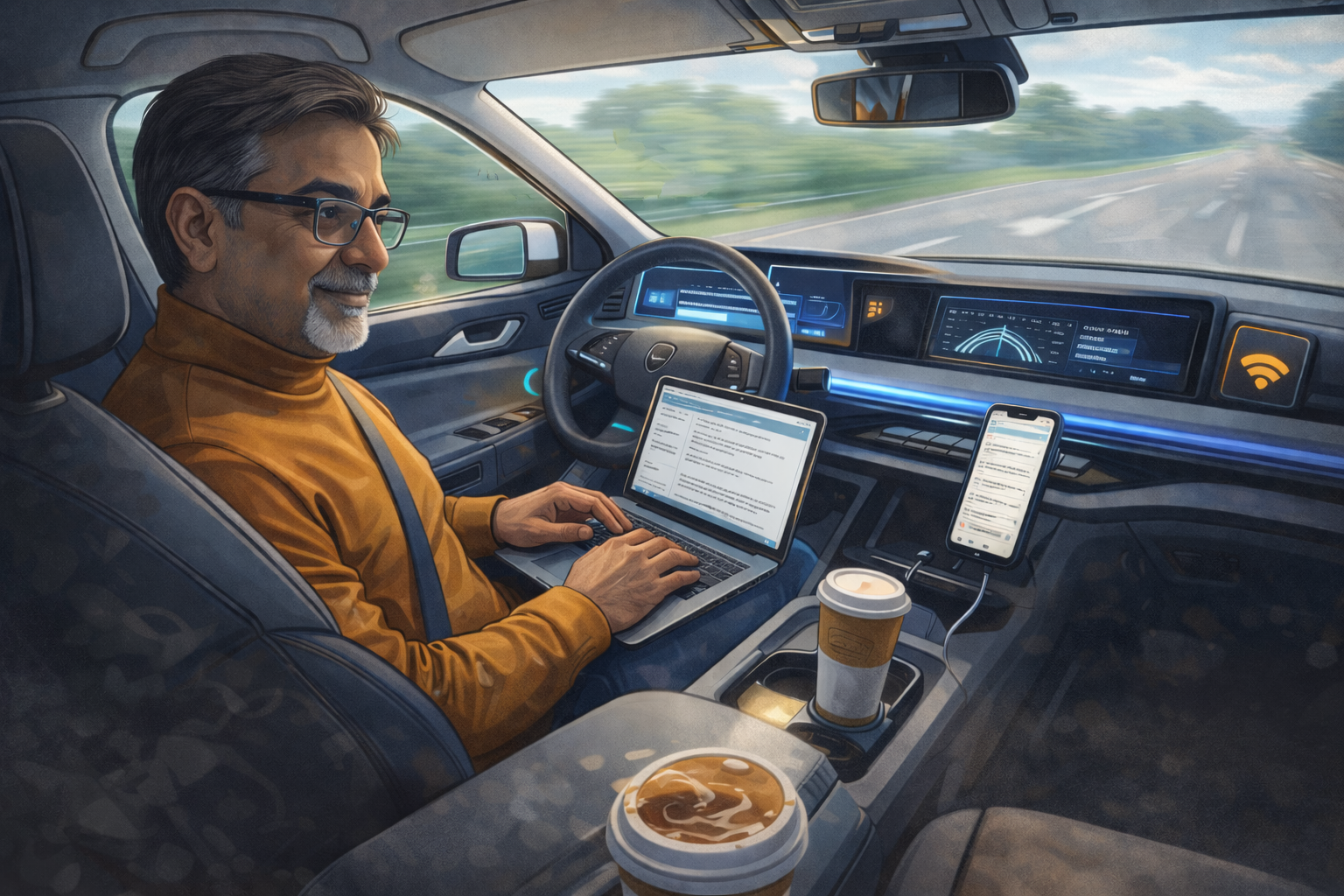
Press launches will still exist. There will still be airports, hotels, lanyards and PowerPoint decks explaining “the messaging”. But the driving bit will become optional. The journalist will climb into the passenger seat. The car will glide off silently. And the review… will begin.
Steering feel becomes a historical concept. Something discussed in the same reverent tones as carburettors and choke cables. Ride quality is assessed by how little coffee spills. Handling is judged by how many emails you managed to reply to. Driver involvement is measured in Wi-Fi strength and Bluetooth stability.
You’ll hear phrases like:
“It was very relaxing.”
“It inspired confidence.”
“I barely noticed the journey.”
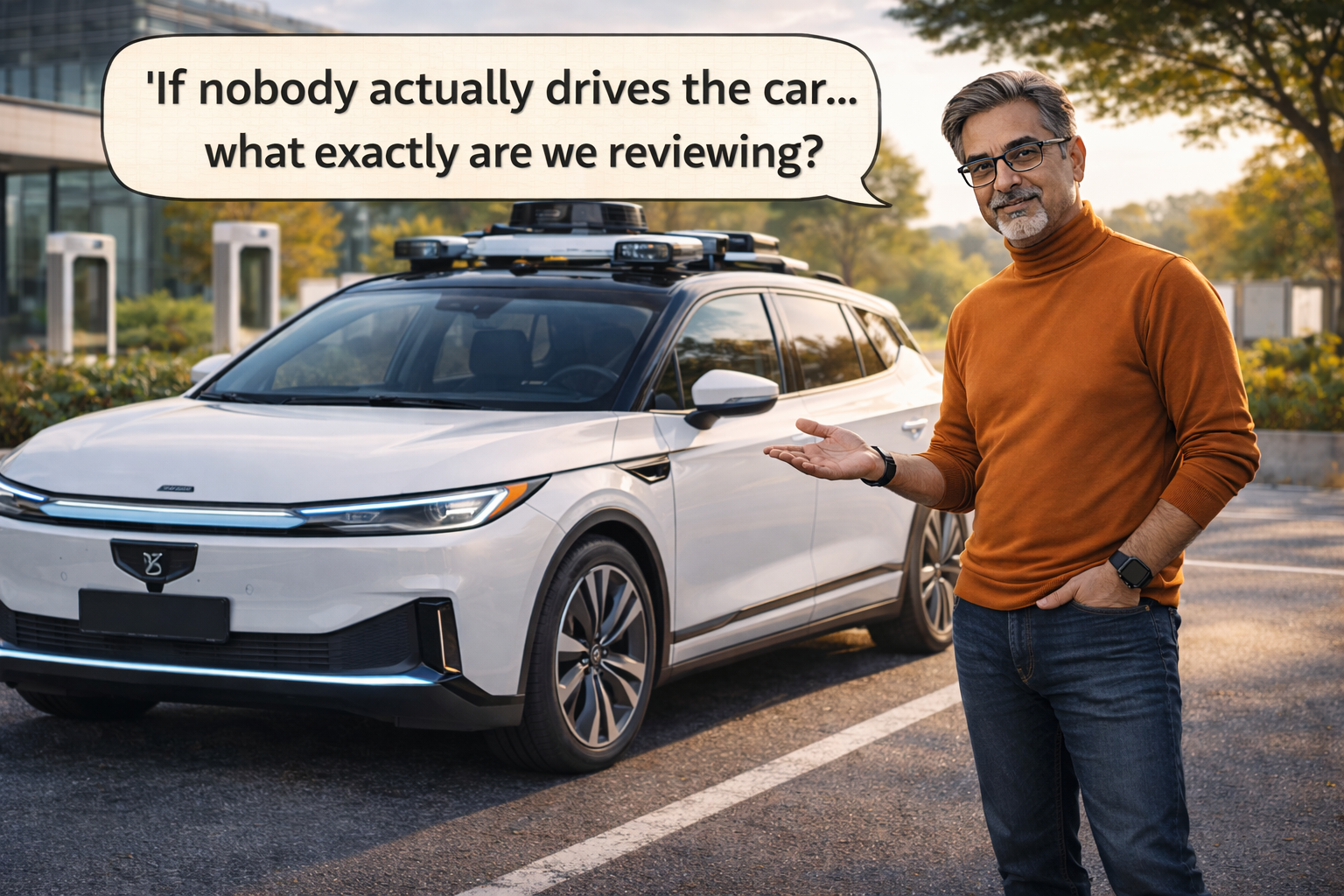
Which is another way of saying… nothing happened. At some point, someone will ask a genuinely dangerous question: “If nobody actually drives the car… what exactly are we reviewing?”
And the answer will be: vibes. User experience. Interface logic. Cupholder placement. The phrase “on the limit” will now refer exclusively to battery percentage.
And when some old hack mentions feedback, balance or throttle response, the room will fall silent. Polite smiles. Gentle nods. A look that says, bless him… he’s ready for the glue factory.
By the end of 2026, the most valuable skill in motoring journalism will not be the ability to assess a car. It will be… the ability to stay awake.
1. Cars sprout pollution collectors – and it becomes your problem
And finally… the future.
In 2026, having failed to stop people driving, failed to stop people buying cars, and failed to persuade anyone to enjoy being told what to do, a solution will emerge. Attach collectors to the cars.
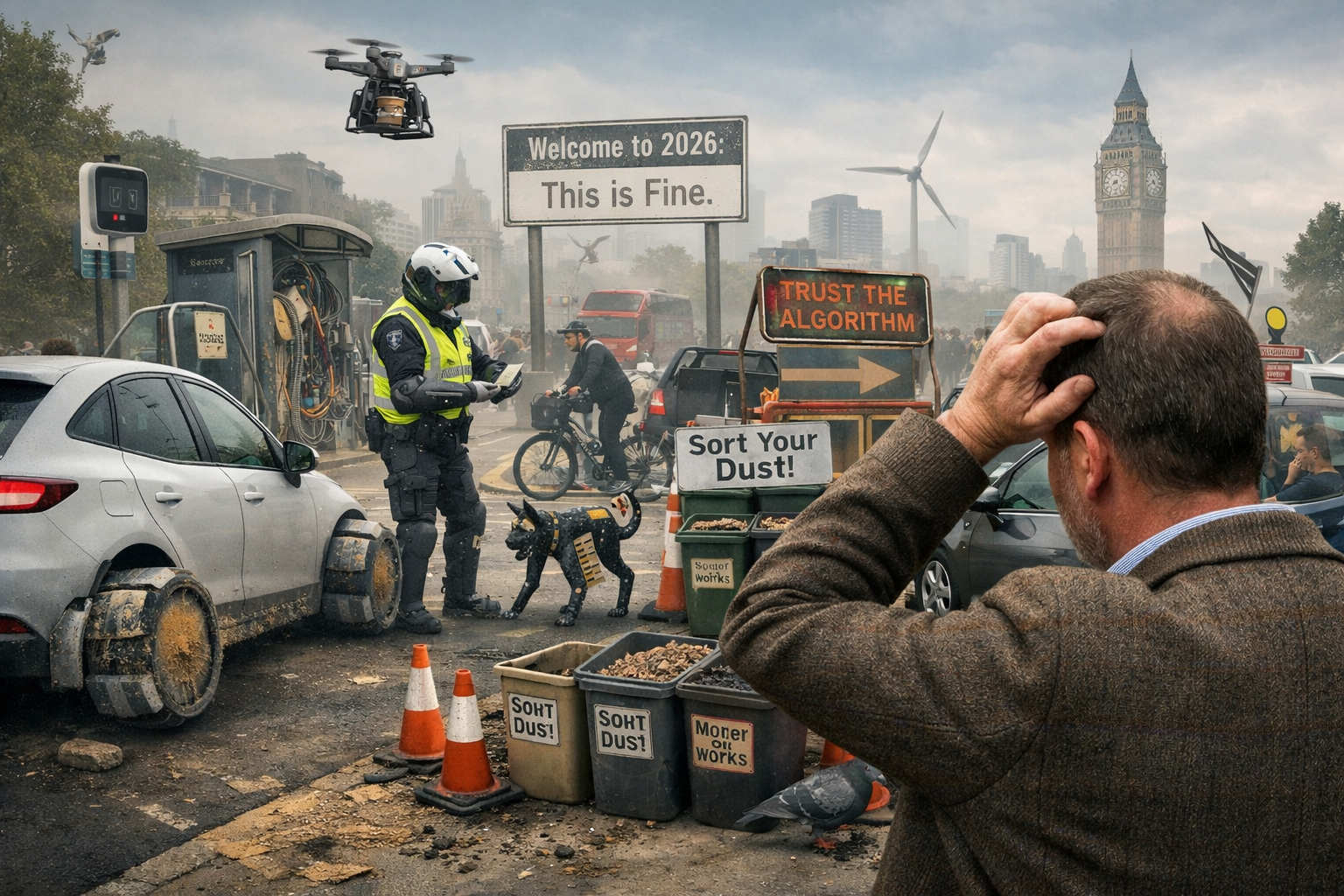
Cars will sprout ungainly collectors behind each wheel, right where mudguards used to be, designed to harvest tyre dust, brake dust, road filth, micro-particles, macro-particles, and whatever else the car sheds as it quietly disintegrates. They will be described as “elegant”. They will look like cybernetic barnacles. They will be described as “unobtrusive”. They will be anything but.
And crucially… they will become your responsibility. Every few weeks, you’ll be expected to remove these canisters, take them home, and separate the contents for recycling. Rubber here. Brake dust there. Road grime in a third container. Possibly your tears in a fourth. This will be described as “empowering consumers”.
As a direct result, fly-tipping will increase overnight. People will start handling toxic dust in their kitchens. Particulate exposure will rise dramatically. Somewhere, a rare sensible individual will point out that this appears to have made things significantly worse than the original problem. They will be ignored.
At this point, having turned every motorist into a part-time hazmat technician, the government will pause… scratch its head… and reach an extraordinary conclusion. Perhaps… just perhaps… we were wrong. And we should all go back to Euro 4 cars. Which won’t happen. Obviously.
But as this is my final, most outlandish prediction, I hope you’ll allow me that small indulgence.
And standing there, covered in brake dust, holding a plastic canister filled with the physical evidence of your own motoring existence, you may find yourself wondering something genuinely dangerous. Not just how did we get here? But why did we think this was a good idea in the first place?
The car won’t disappear in 2026
But in our relentless pursuit of optimisation, regulation and control, we may finally make driving so complicated, so joyless, and so absurd… that we eventually just stop driving them.
Happy New Year. Hold onto your keys. While you still can.
If you found this useful, interesting or fun, consider supporting me via Patreon, Ko-Fi, or even grabbing a copy of one of my books on Amazon. Every bit helps me keep creating independent automotive content that actually helps people.
Support independent car journalism 🙏🏽☺️ grab my books on Amazon, take up membership to BrownCarGuy on YouTube, or join me on Ko-Fi or Patreon.

👉🏽 Channel membership: https://www.youtube.com/browncarguy/join
👉🏽 Buy me a Coffee! https://ko-fi.com/browncarguy
👉🏽 Patreon – https://www.patreon.com/BrownCarGuy

MY BOOKS ON AMAZON!
📖 Want to become an automotive journalist, content creator, or car influencer? Check out my book: How to be an Automotive Content Creator 👉🏽 https://amzn.eu/d/7VTs0ii
📖 Quantum Races – A collection of my best automotive sci-fi short stories! 👉🏽 https://amzn.eu/d/0Y93s9g
📖 The ULEZ Files – Debut novel – all-action thriller! 👉🏽 https://amzn.eu/d/d1GXZkO
Discover more from Brown Car Guy
Subscribe to get the latest posts sent to your email.
