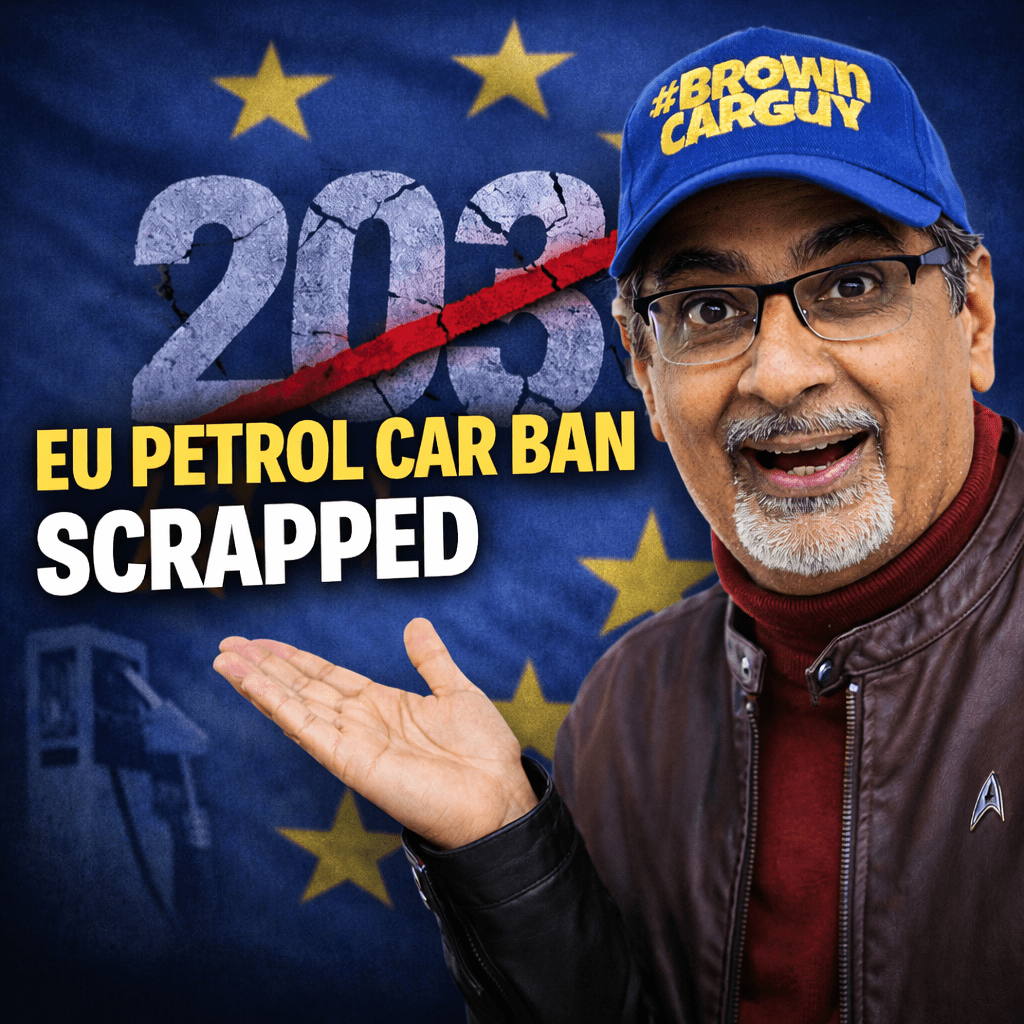
BREAKING: This is big news – EU hasn’t just delayed the petrol car brand, it’s scrapped it, but there are conditions…
For years, we were told the end was nigh for petrol and diesel cars in Europe. 2035 was the date. No debate. No flexibility. No alternatives. Except… that’s just changed. Quietly, but significantly, the European Union has performed a major U-turn on its planned ban on new petrol and diesel car sales from 2035. And while some headlines are still framing this as a “delay” or a “watering down”, the reality is far more profound. In practical terms, the 2035 petrol car ban has been scrapped.
And that raises an awkward, unavoidable question for the UK.
What Has Actually Changed in Europe?
Up until now, the EU’s policy was simple on paper. From 2035, all new cars sold would have to be “zero emission”. That effectively meant electric vehicles only. Petrol, diesel and hybrids would be banned from sale. The European Commission has now changed that. Instead of requiring a 100% reduction in tailpipe CO₂ emissions by 2035, the target has been lowered to 90%. That might sound like a small concession, but it changes everything.
Once the target is no longer 100%, it is no longer a ban.
Under the revised rules, petrol cars, diesel cars and hybrids can continue to be sold after 2035, as long as manufacturers meet overall fleet emissions targets. Crucially, there is now no end date in EU law for the internal combustion engine. This still needs formal approval by the European Parliament, but with the European Commission, Germany, Italy and major car manufacturers all aligned, this is widely seen as a formality rather than a stumbling block.
Why That “10%” Is a Big Deal
Europe sells between 10 and 13 million new cars every year. Ten percent of that is over a million cars annually. So when someone says “it’s only 10%”, what they really mean is that more than a million new petrol, diesel or hybrid cars will continue to be built and sold in Europe every single year, indefinitely.
That is not niche volume. That is not symbolic. That is enough to keep engines, factories, suppliers, skills and research alive for decades.
It also explains why investments like Horse Powertrain, the Renault–Geely joint venture dedicated to developing petrol and hybrid engines, suddenly look very smart indeed.
Why Europe Changed Course
This wasn’t ideological backtracking. It was economic reality catching up with political ambition. Three factors forced Europe’s hand.
1. Demand Hasn’t Matched Targets
Electric car sales have grown, but not at the pace politicians assumed. Governments can mandate production targets, but they cannot force consumers to buy cars that don’t suit their needs, budgets or living situations. The result was looming multi-billion-euro fines for manufacturers, threatening jobs, investment and entire supply chains.
2. Infrastructure Is Lagging Behind
Charging infrastructure, grid capacity, affordability and public confidence have all failed to keep pace with targets. You can mandate vehicles. You cannot mandate reality.
3. Industry Pressure Became Impossible to Ignore
Germany and Italy leaned heavily on the European Commission, backed by some of the biggest names in the industry: Volkswagen, BMW, Mercedes-Benz, Renault and Stellantis. When companies that employ millions and underpin national economies say a policy will break the industry, politicians eventually listen.
Europe hasn’t abandoned decarbonisation. It has abandoned fantasy.
What This Means for Electric Cars
This is not the death of the electric car. Far from it. With 90% of new car sales still needing to be zero-emission, EVs will continue to dominate the new car market. Millions will still be sold every year.
What this change introduces is flexibility. It recognises that electric cars are brilliant for many people, in many use cases, but not yet suitable for everyone. It restores a measure of consumer choice and allows manufacturers to respond to real-world demand rather than political diktats. EVs will continue to improve. Prices will fall. Infrastructure will expand. Adoption will grow naturally.
What has clearly not worked is forcing the transition faster than society and technology can support.
How Manufacturers Will Meet the New Rules
The EU hasn’t simply waved emissions away. Manufacturers will still need to reduce their environmental impact using a mix of measures. These include:
Green steel
Steel produced using low-carbon processes and renewable energy. Carmakers using it will earn emissions credits.
Biofuels
Fuels derived from renewable biological sources, offering lower lifecycle emissions.
E-fuels
Synthetic fuels made using captured CO₂ and renewable energy. Expensive today, but promising, especially for performance and specialist vehicles.
Incentives for small EVs
Extra credits to encourage the production of affordable electric cars.
In other words, Europe is saying: reduce emissions intelligently, not dogmatically.
So Where Does This Leave the UK?
And here’s the uncomfortable bit. The UK still plans to:
- Ban new petrol and diesel cars from 2030
- Ban hybrids from 2035
- Enforce a strict ZEV mandate
- Introduce pay-per-mile style taxation for EVs from 2028
Meanwhile, our biggest trading partner has just removed its hard ban. That leaves the UK asking some very awkward questions.
- Why are we banning something Europe is allowing?
- Why are we making our market uniquely punitive?
- What exactly do we gain by sticking rigidly to deadlines Europe has admitted were unrealistic?
The UK’s Three Realistic Options
There are only three paths forward.
Option one: Go it alone
Stick rigidly to the deadlines, damage the car industry, deter investment and punish drivers for minimal global environmental gain.
Option two: Quietly fudge it
Keep the deadlines on paper, soften enforcement behind the scenes, and hope nobody notices until after the next election.
Option three: Align with reality
Scrap the ZEV mandate, drop the hard bans and align with Europe’s emissions-based approach.
Only one of those options offers long-term credibility.
A Reality Check on Climate Impact
The UK’s contribution to global emissions is small. Even banning every petrol car tomorrow would have a negligible impact on global climate outcomes. The impact on British drivers, British jobs and British manufacturing, however, would be very real. Sticking rigidly to targets while Europe changes course achieves maximum pain for minimal environmental benefit.
Final Thoughts
This isn’t anti-EV. It isn’t anti-climate. It’s pro-reality. Electric cars are part of the future. But petrol, diesel and hybrids will remain necessary for many years yet, until alternative technologies improve dramatically in cost, infrastructure and usability. Europe has accepted that.
It’s good news for motorists because it preserves choice. It’s good news for industry because it restores sanity. And it’s good news for honest policymaking. The UK now needs to decide whether it wants to lead sensibly or simply run off the cliff first.
As ever, I’d love to hear your thoughts.
If you found this useful, interesting or fun, consider supporting me via Patreon, Ko-Fi, or even grabbing a copy of one of my books on Amazon. Every bit helps me keep creating independent automotive content that actually helps people.
Support independent car journalism 🙏🏽☺️ grab my books on Amazon, take up membership to BrownCarGuy on YouTube, or join me on Ko-Fi or Patreon.

👉🏽 Channel membership: https://www.youtube.com/browncarguy/join
👉🏽 Buy me a Coffee! https://ko-fi.com/browncarguy
👉🏽 Patreon – https://www.patreon.com/BrownCarGuy

MY BOOKS ON AMAZON!
📖 Want to become an automotive journalist, content creator, or car influencer? Check out my book: How to be an Automotive Content Creator 👉🏽 https://amzn.eu/d/7VTs0ii
📖 Quantum Races – A collection of my best automotive sci-fi short stories! 👉🏽 https://amzn.eu/d/0Y93s9g
📖 The ULEZ Files – Debut novel – all-action thriller! 👉🏽 https://amzn.eu/d/d1GXZkO
Discover more from Brown Car Guy
Subscribe to get the latest posts sent to your email.
