
The Grim Parallels Between ‘Universe 25’ and Our Own Human Dystopia
Big Brother – you know, the iconic and voyeuristic reality TV experiment – is back this weekend. I won’t be watching. It was fascinating when it first aired 24 years ago, but now it’s just a tired rehash of a formula that’s been worked to death and beyond. What did catch my attention, though, were the hype-building adverts on ITV, featuring mice in a maze – or rather, in a miniaturised version of the Big Brother house.
And that got me thinking about the Rat Race – not just the one we’re all running and losing, but the experimental kind. Numerous social engineering studies have used rodents because, apparently, that’s all we really are – vermin trapped on a giant running wheel (the globe!).
One standout example is John B Calhoun’s Universe 25 experiment from the 1970s. If you’ve never heard of it, it’s an epic analysis of societal breakdown. And I’ll warn you now, his findings are not for the faint-hearted. By the end of this, you might find yourself searching for a quiet corner of the internet to rethink all of existence. But if you’re ready to accept that we’re all just lab mice with credit cards, Instagram accounts, and a mild addiction to Uber Eats – read on.
Welcome to Universe 25: Of Mice, Misery, and Mayhem
Back in the 1970s, a man named John B. Calhoun decided to play god, and in doing so, gave us a glimpse of hell in a designer handbag. He created what he called “Universe 25,” a sort of rodent paradise: a perfectly controlled environment for mice with unlimited food, water, and shelter – basically, all the trappings of luxury life. Think Big Brother house, but for mice. Sounds delightful, doesn’t it? No bills, no mortgage payments, and no need to hunt for the next meal. Just Netflix and chill, right?

Initially, yes. The mice reproduced at a rapid rate, finding little need to do anything but sleep, eat, shit and… well, you know. It was the closest thing to nirvana since the invention of cheese. But then, as their population increased, something dark began to unfold – kind of like Day 2 on Big Brother.
The abundance of resources didn’t result in an eternal mouse utopia. Oh no, quite the opposite. The mice started to display increasingly bizarre behaviours. Groups became aggressive, some withdrew and spent their days obsessively grooming (they were dubbed the “beautiful ones” or, as we’d call them today, “Instagrammers”). Females neglected their offspring, and society as a whole broke down. Eventually, despite no shortage of food or lack of comfort, the population collapsed entirely.
And then, 600 days after the start of the experiment (about a year and seven months) – brace yourself – EVERY SINGLE MOUSE WAS DEAD. Somehow, utopia had swiftly descended into dystopia.

Wait, What Happened?
Now, if you’re still here (and haven’t crawled into a hole to hibernate like those mice probably should have), you’re probably asking: “What the hell happened?!”
Simple: society broke down.
Despite having everything they could ever want, the mice lost the plot. Social roles fell apart, leading to chaos and dysfunction. The once orderly society devolved into aggressive, isolated, and downright bizarre conduct. The “beautiful ones” became so obsessed with themselves that they stopped interacting, while others just gave up on mating altogether.
Parenting collapsed, violence skyrocketed, and without the structure of normal social interaction, the population literally stopped reproducing. In the end, despite the endless buffet of treats, their society couldn’t sustain itself, and it actually resulted in complete extinction. Turns out, being spoon-fed life, kills ya! Who knew?
The Human Parallel
“Okay, that’s bad, sucks for the mice,” you’re probably thinking, “but what on earth does this have to do with me? I’m not a mouse, and I don’t even have a tail! Well… not usually.”
Maybe nothing, but here’s where it gets interesting – Calhoun’s experiment has become an eerie metaphor for the state of modern human society. You what? No, no, hang in there… you’ve come this far after all. Actually, haven’t we all?

There’s a suggestion that humanity itself is right now (as you sit there reading this) slipping into that societal breakdown phase that led to the rodents’ eventual demise. Juxtapose findings with our current reality, and doesn’t it feel like things are slowly falling apart despite the illusion of abundance?
After all, the human equivalent of Calhoun’s “beautiful ones” are everywhere – endlessly posting on social media, beauty filters switched on, carefully curating their online existence to appear glamorous and sensationally wonderful, all while morally bankrupt and seemingly detached from the everyday struggles of the rest of us mere mortals.
Meanwhile, aggression and division are at an all-time high, political polarisation is rampant, and social isolation is growing, even though we’re supposedly more connected than ever. And I know you know that’s true. We have plenty – food, shelter, tech galore – and yet, mental health is at crisis point. Something is clearly going wrong in our highly evolved world, isn’t it?
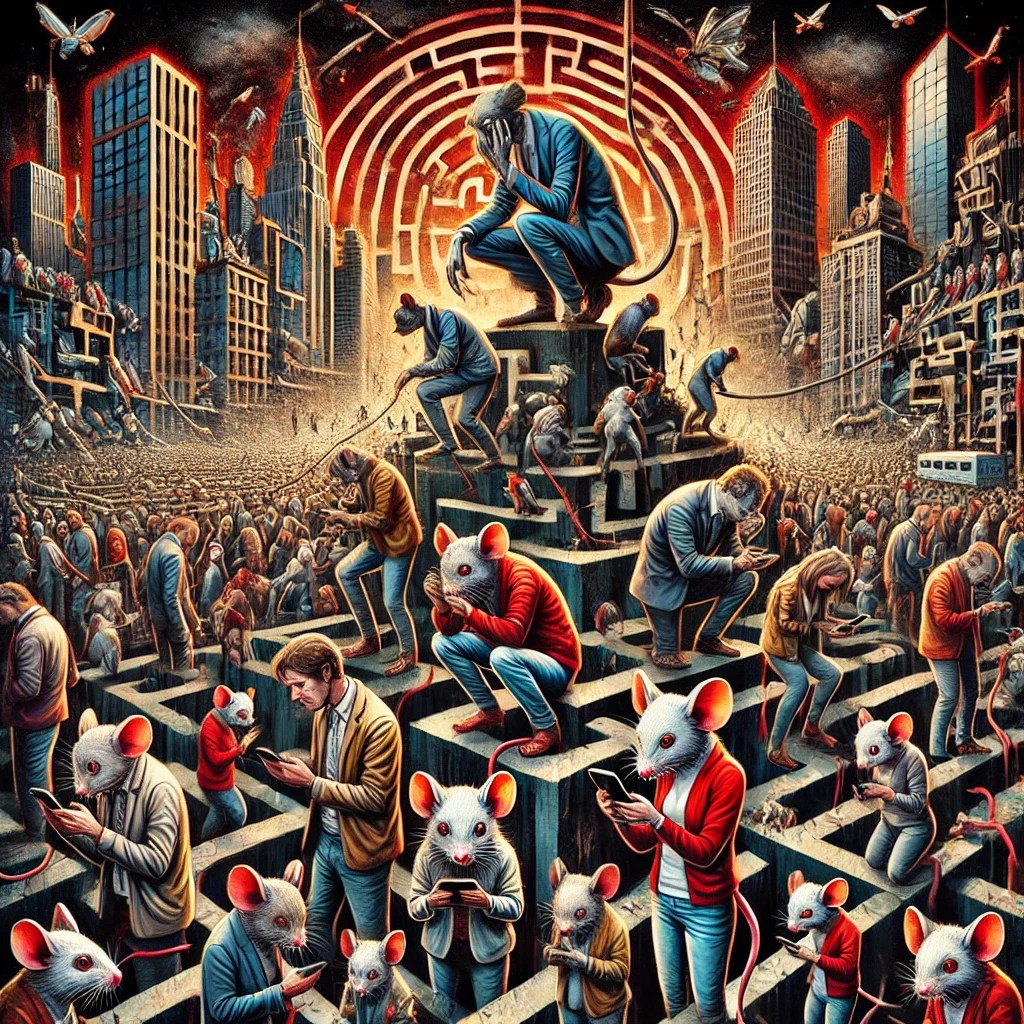
Overpopulation? Check. Hyper-isolation? Check. Obsession with superficiality while the world burns? Oh, very much, check, check, and double check. We’re effectively one step away from forgetting how to raise ourselves and fighting over the last piece of avocado toast.
Is Extinction Inevitable?
So, that’s it then? Are we doomed to follow the same path as the mice in Universe 25? Blindly racing, selfie sticks outstretched, towards a future where our entire socio-economic structure crumbles under its own over-complexity and heaving weight? Is it inevitable that we’ll experience our own extinction – not because of famine, disease, or war, but simply because we… stop functioning properly?
If we keep chasing the cheese with our noses buried in our phones, the answer is probably yes. But wait! Don’t stop reading just yet – there may still be hope.
Calhoun didn’t just leave us with the grim spectre of self-annihilation to haunt our nightmares. His work offers valuable insights that, if we’re smart – and maybe just a little less self-obsessed – we could unravel and use to course-correct before we reach destination destruction.
How We Can Rewrite the Ending?
For starters, one key takeaway from Universe 25 is that overcrowding and social isolation can exist at the same time, and that’s a recipe for disaster. Despite being packed into cities, humans are lonelier than ever.
Social media has a lot to answer for, but it could also serve as part of the solution. Instead of retreating deeper into digital bubbles, raising the virtual drawbridges, boarding up the clickable windows, and firing off verbal volleys of cutting comments – regardless of collateral damage – we could perhaps… not do any of that.

Instead, we could use social media and all our technology to foster genuine human connections. Remember when we used to dial up friends on landlines and cling to extended cables for hours while catching up with them? Despite the disconnect of distance, those calls firmed up our interpersonal connections thanks to more frequent, meaningful conversations. Today, I must confess to sadly and shamefully avoiding the actual act of speaking on the phone, preferring short SMS and WhatsApp messages instead.
The fact is, we should focus on creating communities that offer genuine engagement, not just the superficial kind where you “Like” someone’s post but haven’t spoken to them in years.
Next, urban planning has to do better. The mice had everything they needed, but too much proximity and not enough personal space led to their behavioural sink. We humans, however, have some level of control over our surroundings. We plan and build our cities, and with a bit of thought, we can balance density with well-being – more green spaces, better mental health services, and communal infrastructure that brings people together meaningfully.
We also need to find PURPOSE (actual purpose that is, not just: “to become rich and famous”). In Calhoun’s experiment, once the mice had all their physical needs met, they lost their sense of meaning.
Humans have it tougher – it’s not just about having food and water, it’s about belonging and feeling like we contribute to something larger than ourselves. A society where people only see value in consumption is heading straight for disaster. We need to refocus on meaningful work, creativity, and yes, those tiresome but invaluable “human connections.”
Lastly, equity is crucial. One dark undercurrent of Universe 25 was the emergence of extreme inequality – some mice monopolised resources and spaces, pushing others out. Sound familiar? We need to work harder on creating fairer systems of resource distribution, from wealth to healthcare to education. Otherwise, we’re just following the mice’s paw prints straight to oblivion.

Avoid the Mice-Steps and Build a Better Future
Let’s be clear: this isn’t about doom-mongering for the sake of it. Yes, the parallels between Universe 25 and modern life are unsettling, but the fact that we can recognise, comprehend, and analyse these warning signs gives us an upper hand over our furry friends – and the chance to avoid the same fate.
Humans are far more adaptable than rodents (most of us, anyway), and our track record shows we’ve pulled ourselves back from the brink more than once.
So, if we want to avoid becoming the tragic victims of our own social experiment, we need to start rebuilding a society that values people, purpose, and connection over isolation and consumerism. It’s not an easy path, but the alternative is to sit back and watch as our luxurious little utopia disintegrates, while we sip cinnamon chai lattes and giggle at cute cat videos.

Discover more from Brown Car Guy
Subscribe to get the latest posts sent to your email.

For a parallel look what happened to the Roman empire 2000 years ago…
LikeLiked by 1 person