Oil prices have dropped, there’s a ceasefire… so why are we still paying through the nose at the pumps?
The sun is shining, the birds are chirping, and—somewhat miraculously—the world hasn’t ended. Now, I don’t say that flippantly. Because just 24 hours ago, it genuinely felt like things were teetering on the edge. When world leaders start throwing around phrases like “destroy a civilisation forever,” you do tend to sit up a bit straighter and think, hang on… where exactly is this going? And yet here we are. A ceasefire has been announced. The immediate threat of escalation appears to have eased. On the surface, you might be forgiven for thinking, right then, crisis over… back to normal… fuel prices will drop again. Yeah… about that.
Let’s start with the headline number. Oil prices – yes – have dropped. Quite significantly, in fact. At the peak of the panic, we were looking at around $135 per barrel. As of today, that’s fallen to roughly $108 per barrel. That sounds like good news. And it is… relatively speaking.
But here’s the reality check. Before all this kicked off – before the war, before the chaos, before the markets lost their collective sanity – oil was sitting at about $75 per barrel. So even now, after the “drop,” we’re still over 40% higher than normal levels. That’s not a correction. That’s just less bad.
Why Fuel Prices Don’t Fall as Fast as They Rise
Now here’s the bit that really frustrates people. Fuel prices shoot up like a rocket… but fall like a feather. You’ve probably heard that before. And yes, it sounds like a conspiracy theory. Greedy oil companies, profiteering petrol stations, all that sort of thing. But the truth is a bit more complicated – and frankly, a bit more annoying. Because there are actual reasons for it.
Fuel doesn’t magically appear at your local petrol station the moment oil prices change. There’s a time lag. A big one. Think about it. The oil being refined and sold right now… was bought, shipped, and processed weeks ago, when prices were at their peak.
Tankers that set off during the worst of the crisis are only just arriving now. So even if oil prices drop today, the fuel you’re buying was effectively “priced” weeks back. That delay alone can keep pump prices artificially high for several weeks, even months.
Then There’s the Bigger Problem: Supply Disruption
And this is where things get properly messy. This wasn’t just a price spike driven by speculation. This was a physical disruption to supply. Let’s talk about the Strait of Hormuz. Around 20% of the world’s oil supply passes through that narrow stretch of water. When that gets disrupted—even briefly—it sends shockwaves through the entire global supply chain.
Now factor in:
- Shipping delays and rerouting
- Backlogs at major ports
- Uncertainty in global distribution networks
And suddenly, you’re not just dealing with expensive oil… you’re dealing with delayed oil.
Damage to Infrastructure: The Hidden Impact
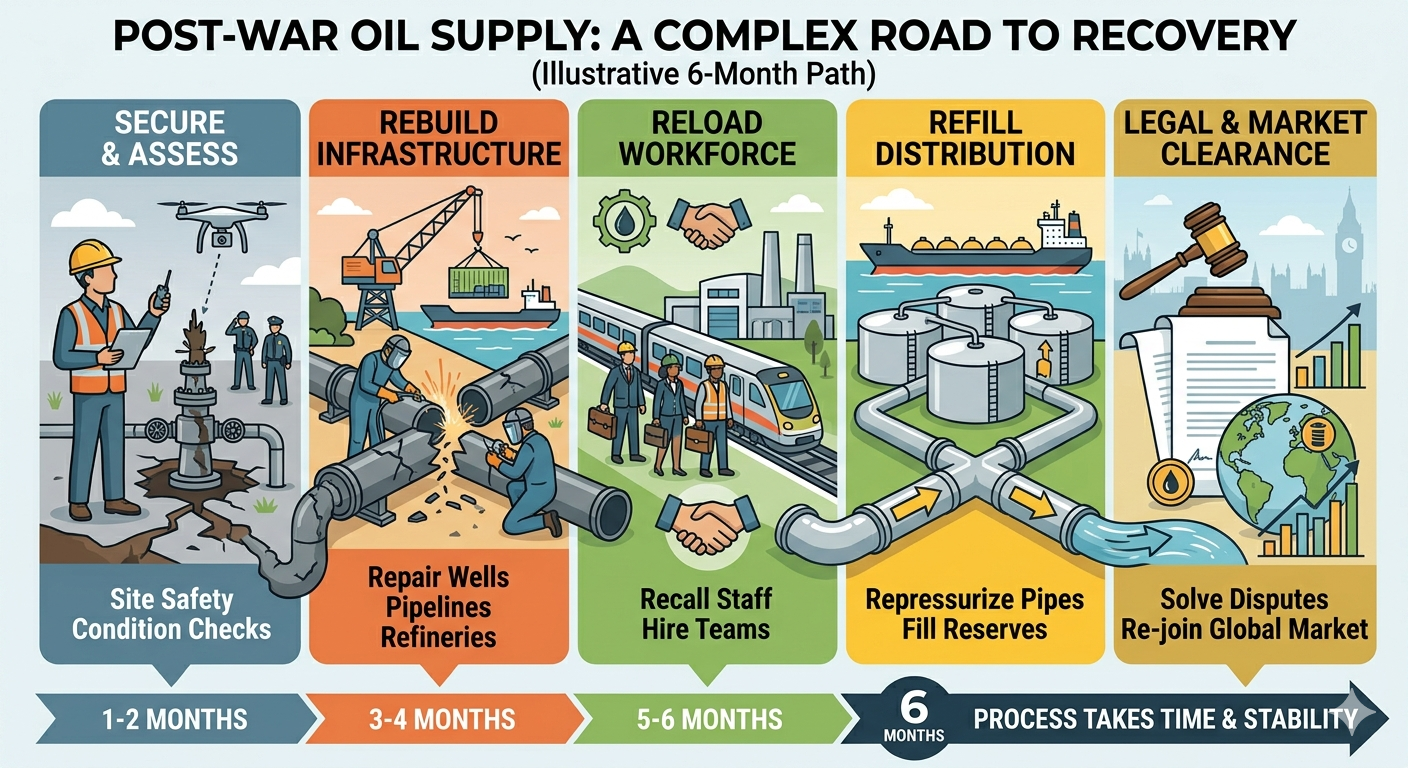
Here’s something that isn’t being talked about enough. During the conflict, refineries and oil facilities were damaged across parts of the Middle East. And that’s not something you fix over a weekend.
Some estimates suggest we could be down millions of barrels per day in output due to this damage. Repairs take time. Restarting production takes time. Stabilising supply takes time. And until that happens, prices stay elevated.
So when people say: “Ah well, ceasefire now, fuel will be cheap again…”
No. Not happening. Even with the current situation calming down, experts are suggesting it could take at least six months before things even begin to resemble normality. And that’s assuming:
- The ceasefire holds
- No further disruptions occur
- Supply chains stabilise smoothly
Which, in today’s world, feels like quite a few big assumptions.
This Isn’t Just About Fuel – It’s Bigger Than That
Here’s where it starts to hit the wider car world. Because this isn’t happening in isolation. The automotive industry is already:
- Recovering from COVID disruptions
- Still feeling the effects of the semiconductor shortage
- Struggling with rising production costs
- Under pressure from the EV transition
- Facing intense competition from Chinese manufacturers
And now this. Another global shock to supply chains, logistics, and pricing. It’s like the industry’s been knocked down… just as it was trying to get back up.
A Real-World Example: Jebel Ali
Let me give you a proper real-world illustration. When I was living in Dubai, there’s a place called Jebel Ali Port. It’s not just a port. It’s basically a global sorting office.
Ships arrive from all over the world, goods get redistributed, and everything moves on to its next destination. Now imagine that system gets disrupted. Ships delayed. Cargo rerouted. Containers stuck.
It’s not just oil that’s affected – it’s:
- Cars
- Parts
- Components
- Entire supply chains
There are even reports of ships ending up in places like Sri Lanka, filled with cars that were never meant to go there… just sitting, waiting for someone to figure out what to do next. That’s the level of disruption we’re talking about.
So What Does This Mean for You?
Simple. Even though oil prices have dropped…
- Fuel prices will stay high for a while yet
- Any reductions will be slow and gradual
- We are not going back to “cheap fuel” anytime soon
And that means your running costs stay elevated.
What You Can Do About It
This is exactly why I made that previous video. Because right now, you’ve got two real options:
1. Drive Smarter Simple changes in driving style can significantly reduce fuel consumption.
2. Drive Something More Efficient Switching to a more economical car could save you: £400 to £800 a year depending on mileage. And suddenly, those “just a few pence per mile” differences don’t look so small anymore.
Final Thought: The Calm After the Storm… Or Just a Pause?
Yes, there’s a ceasefire. Yes, things have cooled down—for now. But let’s be honest. We’re living in unpredictable times. Two weeks from now? Who knows. Six months from now? Even less certain.
So while it’s great that the world didn’t end… The knock-on effects of what just happened are going to stick around for a while.
Are you feeling the impact of fuel prices yet? Have you changed how you drive… or even what you drive? And do you think things will improve… or get worse from here?
Drop your thoughts in the comments, and let’s talk about it.
If you found this useful, interesting or fun, consider supporting me via Patreon, Ko-Fi, or even grabbing a copy of one of my books on Amazon. Every bit helps me keep creating independent automotive content that actually helps people.
Support independent car journalism 🙏🏽☺️ grab my books on Amazon, take up membership to BrownCarGuy on YouTube, or join me on Ko-Fi or Patreon.

👉🏽 Channel membership: https://www.youtube.com/browncarguy/join
👉🏽 Buy me a Coffee! https://ko-fi.com/browncarguy
👉🏽 Patreon – https://www.patreon.com/BrownCarGuy

MY BOOKS ON AMAZON!
📖 Want to become an automotive journalist, content creator, or car influencer? Check out my book: How to be an Automotive Content Creator 👉🏽 https://amzn.eu/d/7VTs0ii
📖 Quantum Races – A collection of my best automotive sci-fi short stories! 👉🏽 https://amzn.eu/d/0Y93s9g
📖 The ULEZ Files – Debut novel – all-action thriller! 👉🏽 https://amzn.eu/d/d1GXZkO
Discover more from Brown Car Guy
Subscribe to get the latest posts sent to your email.

Leave a comment