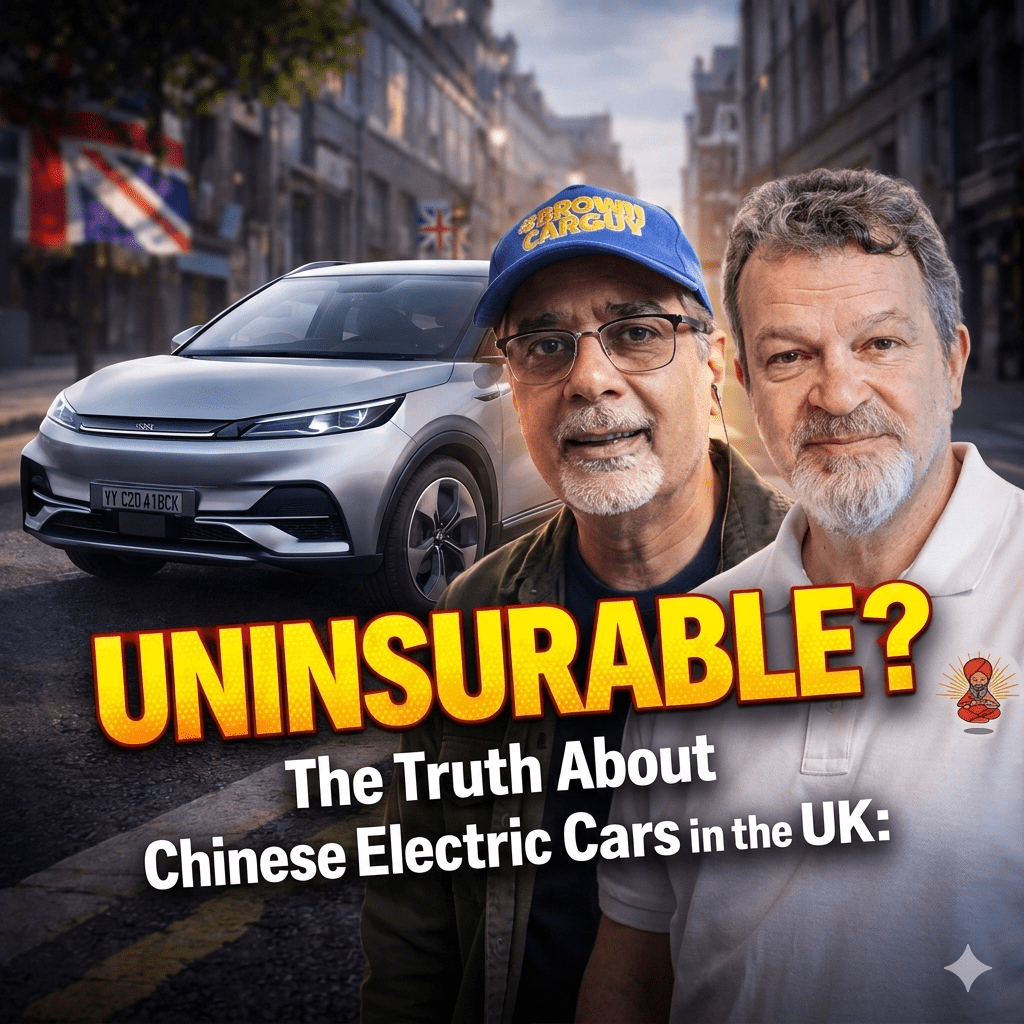
Reports indicate insurers refusing to cover Chinese cars or quoting high premiums – we check in with the Motor Claims Guru
Chinese electric cars are arriving in Britain faster than you can say “range anxiety”. From sleek executive saloons to well-priced family SUVs, brands like BYD, MG, XPeng and GWM Ora are rapidly becoming familiar sights on UK roads. And frankly, it’s not hard to see why. These cars often deliver impressive technology, strong performance and generous equipment for significantly less money than many established rivals. I’ve driven quite a few of them recently and in many cases I’ve been pleasantly surprised. But there’s a growing issue that some buyers are only discovering after they’ve signed on the dotted line. Insurance.
A recent report highlighted the fact that some UK drivers are struggling to get insurance quotes for certain Chinese electric vehicles, while others are facing premiums far higher than expected. It raises an uncomfortable question: are some of these new EVs effectively becoming uninsurable?
To understand what’s really happening, I spoke to insurance expert Tim Kelly, also known as the Motor Claim Guru. The reality, as it turns out, is more complicated than a simple yes or no.
Why insurers are wary of new EV brands
Insurance companies are, by nature, cautious businesses. Their entire model relies on predicting risk as accurately as possible. To do that, they depend heavily on data. Lots of data.
When a new car is launched in the UK, insurers typically analyse extensive information about it long before the first customers take delivery. This includes crash performance, theft resistance, repair procedures and the cost of replacement parts.
Much of this work is coordinated through organisations like Thatcham Research, which helps determine a vehicle’s insurance group rating.
These ratings play a major role in deciding how much you pay for your premium. The problem with many of the new Chinese EVs entering the market is that they are arriving incredibly quickly. In some cases insurers simply do not yet have the depth of data they would normally rely on to price risk accurately.
As Tim Kelly explains, uncertainty is something insurance companies dislike intensely. Without reliable data on repair costs, accident rates and claim patterns, insurers have two basic options. They can either price the risk very conservatively, which means higher premiums, or decline to offer cover altogether. Neither outcome is good news for buyers.
The repair cost question
Another factor influencing insurers is the question of repairability.
Modern electric cars are complex machines packed with sensors, cameras, driver-assistance systems and high-voltage components. Repairing them requires specialised tools, trained technicians and reliable parts supply chains.
For established brands with long-standing dealer networks and parts distribution systems, that infrastructure already exists. For newer manufacturers, particularly those entering the UK market for the first time, the situation can be less mature.
If an insurer suspects that a damaged vehicle might take longer to repair or require expensive specialist parts, the projected cost of claims rises. That inevitably feeds into higher premiums.
It’s not necessarily a criticism of the cars themselves. Rather, it reflects the reality that building a nationwide repair ecosystem takes time.
Déjà vu: Tesla went through this too
Interestingly, this situation is not entirely new. When Tesla first entered the market in significant numbers, insurance pricing went through its own turbulent phase. Early on, premiums were often relatively modest because insurers lacked real-world claims data.
Then accident statistics and repair costs started to emerge. Some insurers discovered that repairs could be expensive, particularly when structural battery components or complex body panels were involved. Premiums rose sharply in response.
Over time, as more data became available and repair networks expanded, insurance pricing gradually stabilised. Tim Kelly believes Chinese EV brands will likely follow a similar trajectory. As more vehicles hit the road, insurers will gain the data they need to model risk more accurately.
Performance may also be a factor
There is another element quietly influencing insurers’ thinking. Performance.
Many modern electric vehicles deliver levels of acceleration that would have been considered supercar territory not long ago. Instant torque and powerful electric motors mean even relatively affordable EVs can reach 60mph in well under six seconds.
While that’s great fun from a driving perspective, insurers are inevitably interested in how that performance translates into real-world accident statistics.
Again, the challenge is that with new brands and models there simply isn’t enough historical data yet. Insurers prefer to work with probabilities rather than guesswork.
Residual values and financial risk
There is also the issue of residual values. When an insurer writes off a vehicle following an accident, it typically pays the market value of the car. For established brands with decades of resale data, predicting those values is relatively straightforward.
For newer manufacturers, the picture can be less clear. How will a particular model depreciate over three or five years? Will demand in the used market remain strong? What happens if spare parts become difficult to obtain?
These uncertainties can affect how insurers calculate financial exposure in the event of a total loss. Again, uncertainty tends to push premiums upwards.
Are Chinese EVs actually uninsurable?
Despite the alarming headlines, the reality is that most Chinese electric cars can be insured in the UK. However, availability and pricing may vary depending on the specific model and the insurer involved.
Some drivers have reported difficulty obtaining quotes through comparison websites, while others have encountered premiums significantly higher than expected.
This is precisely why it is essential to check insurance costs before committing to a purchase.
It sounds obvious, but many buyers still focus primarily on monthly finance payments and overlook insurance until the last minute. That can lead to unpleasant surprises.
Practical advice for buyers
So what should potential EV buyers do? Tim Kelly’s advice is straightforward.
First, obtain insurance quotes before finalising your purchase. This should ideally be done while you are still comparing vehicles.
Second, don’t rely solely on price comparison websites. Some insurers may provide quotes through brokers or directly via their own platforms.
Third, consider speaking to a specialist broker if you are looking at a particularly new or unusual model. And finally, remember that insurance costs can change over time as more data becomes available.
A market still finding its balance
The arrival of Chinese EV brands in the UK is reshaping the automotive landscape. Increased competition is good news for consumers, bringing fresh designs, innovative technology and often very competitive pricing.
However, the wider ecosystem that supports car ownership including insurance, repair networks and parts supply chains inevitably takes time to adapt.
What we are seeing now may simply be the early stages of that adjustment. If history is any guide, insurers will gradually gather the data they need to price risk more confidently. As repair infrastructure expands and more vehicles accumulate real-world mileage, premiums should begin to stabilise.
In the meantime, buyers simply need to do their homework. Because the last thing anyone wants after buying a shiny new electric car is to discover that insuring it is harder, or more expensive, than expected.
If you found this useful, interesting or fun, consider supporting me via Patreon, Ko-Fi, or even grabbing a copy of one of my books on Amazon. Every bit helps me keep creating independent automotive content that actually helps people.
Support independent car journalism 🙏🏽☺️ grab my books on Amazon, take up membership to BrownCarGuy on YouTube, or join me on Ko-Fi or Patreon.

👉🏽 Channel membership: https://www.youtube.com/browncarguy/join
👉🏽 Buy me a Coffee! https://ko-fi.com/browncarguy
👉🏽 Patreon – https://www.patreon.com/BrownCarGuy

MY BOOKS ON AMAZON!
📖 Want to become an automotive journalist, content creator, or car influencer? Check out my book: How to be an Automotive Content Creator 👉🏽 https://amzn.eu/d/7VTs0ii
📖 Quantum Races – A collection of my best automotive sci-fi short stories! 👉🏽 https://amzn.eu/d/0Y93s9g
📖 The ULEZ Files – Debut novel – all-action thriller! 👉🏽 https://amzn.eu/d/d1GXZkO
Discover more from Brown Car Guy
Subscribe to get the latest posts sent to your email.

Leave a comment