How China Conquered the Car World – and they’re not done yet, they’re getting more ships!
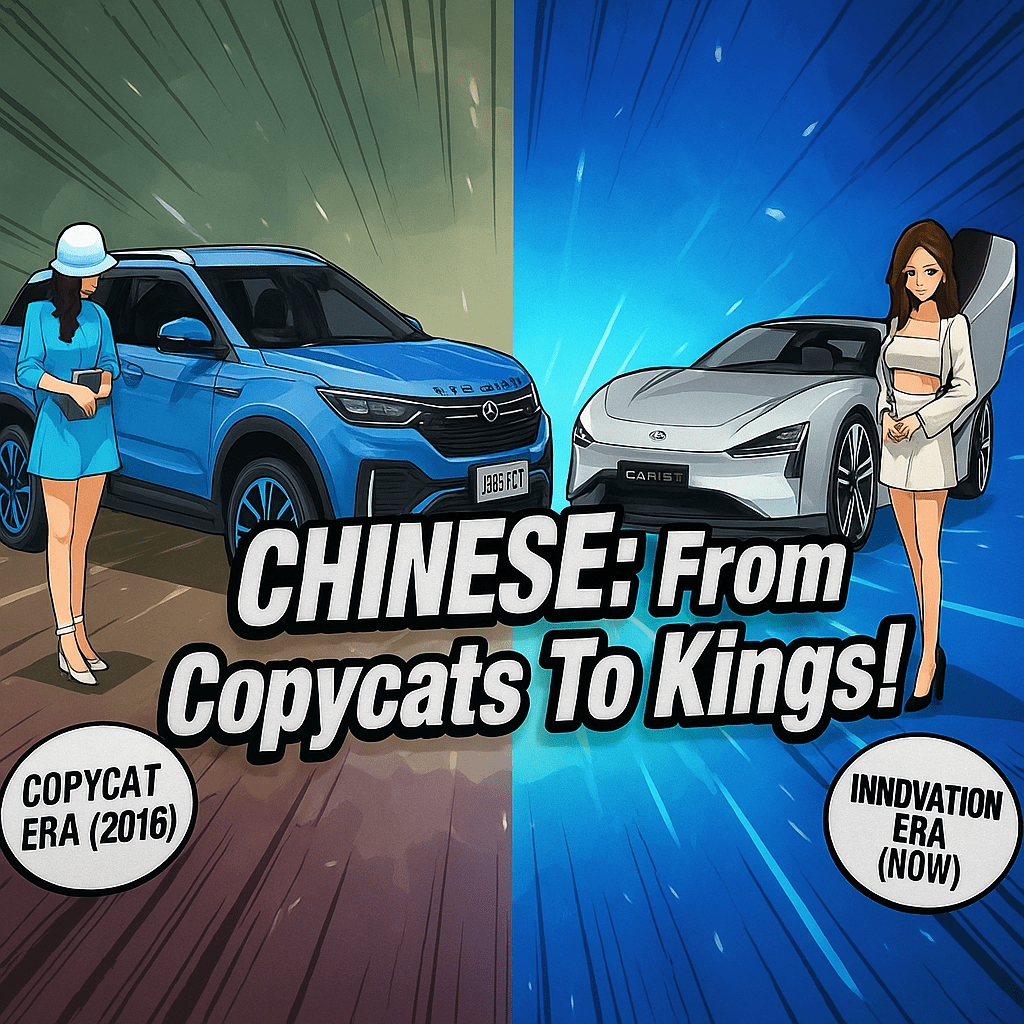
Somewhere between the mockery and the memes, between jokes about “Range Rover rip-offs” and “plastic dashboards”, something rather extraordinary happened. The Chinese car industry grew up – fast. And now, while the West was busy sniggering, Beijing’s automakers quietly built an empire. An empire of design studios, R&D centres, global shipping fleets, and production hubs from Brazil to Budapest. Once dismissed as cheap copycats, China’s carmakers have now become the innovators – the disruptors – the ones pushing the boundaries of electric mobility, tech integration, and even automotive engineering itself.
I Wasn’t Wrong – The Shift Is Real
A few months ago, I did a video called “Car Brands That Will Be Dead Within 12 Months.” It ruffled a few feathers — fair enough. But it wasn’t doom-mongering; it was foresight.
Because here we are now, with the Financial Times confirming what was once dismissed as exaggeration: “European carmakers are rapidly losing market share globally as Chinese rivals enter a new phase of expansion and innovation.”
Wallenius Wilhelmsen – the world’s largest car-shipping operator – has reported “massive growth” in shipments from China to Europe, Latin America, Africa and beyond. In other words: China isn’t just exporting cars anymore – it’s taking over the industry.
The Numbers Don’t Lie
Chinese passenger car exports jumped by 23% last year to 6.4 million units – that’s more than 50% higher than Japan. Consultancy AlixPartners expects Chinese manufacturers to grab 30% of the global automotive market by 2030.
To put that in perspective:
- That’s up from 21% in 2024.
- In Europe alone, Chinese brands like BYD, Chery, and MG (SAIC) have doubled their share from 3.2% to 5.7%in just a year.
- Their share of Europe’s EV market? Already 10% – and climbing.
And don’t assume this growth is limited to urban London or Berlin. You’ll find Chery’s Jaecoo and Omoda SUVs – which look like baby Range Rovers if you squint – cruising through the streets of northwest London, Manchester, and Birmingham. They’re priced right, look sharp, and they’re everywhere.
From Copycats to Innovators
Fifteen years ago, we had our first Chinese test car in Dubai. It was so bad I refused to drive it. Tinny doors, shiny plastic, dodgy build. No way I’m going out in that. Today? I’d recommend most Chinese cars.
The rate of evolution is staggering. What took Japan 30 years, and Korea 20, China has achieved in less than 15. And it’s not just about cheaper labour or state subsidies – it’s about brains. Big ones.
BYD alone employs over 110,000 people in research and development. That’s not production – that’s pure R&D: engineers, scientists, designers, software specialists. For comparison, the Volkswagen Group has around 58,000 spread across VW, Audi, Porsche, Skoda, Bentley, and Bugatti combined.
That’s how you leapfrog an industry.
Tech, Ships, and Supercars
BYD’s sub-brand Yangwang isn’t just building EVs – it’s building monsters. The Yangwang U9 hypercar recently broke the record for the world’s fastest car, and its SUV sibling can literally float on water. Yes, drive it across a flooded road – or a lake if you’re brave – and it’ll power itself along, steering and all.
This is the same company that’s building its own fleet of eight ships to transport cars worldwide. Not hiring, not chartering – building. And if you think that’s overkill, consider this: BYD now has production facilities in Brazil, Hungary, Indonesia, Thailand, Turkey, and Uzbekistan. That’s not an expansion strategy – that’s world domination with logistics included.
Europe on the Back Foot
Meanwhile, Europe’s automotive giants – the same ones that once defined the standard – are struggling.
- Sales are shrinking in China.
- Demand is stagnant at home.
- Tariffs and politics are biting in the US.
It’s the triple whammy – east, west, and home.
And yet, while the EU slaps tariffs on Chinese EVs to “protect” its domestic industry, the Chinese simply pivot – to Africa, Latin America, and Southeast Asia – the very markets that once powered Japan’s rise in the 1980s.
The Inevitable Future
Even when Chinese cars aren’t dominating showrooms, they’re already in your EV – inside your battery, your motor, your software. China doesn’t just build cars anymore; it builds infrastructure.
So, whether you love or hate this shift, one thing’s for sure – the next time you’re sitting in traffic, look around. Within five years, half the cars on that road could have been designed, engineered, or powered by China. From copycats to kings. And this time, the throne will be occupied for a good long while!
If you found this useful, interesting or fun, consider supporting me via Patreon, Ko-Fi, or even grabbing a copy of one of my books on Amazon. Every bit helps me keep creating independent automotive content that actually helps people.
Support independent car journalism 🙏🏽☺️ grab my books on Amazon, take up membership to BrownCarGuy on YouTube, or join me on Ko-Fi or Patreon.

👉🏽 Channel membership: https://www.youtube.com/browncarguy/join
👉🏽 Buy me a Coffee! https://ko-fi.com/browncarguy
👉🏽 Patreon – https://www.patreon.com/BrownCarGuy

MY BOOKS ON AMAZON!
📖 Want to become an automotive journalist, content creator, or car influencer? Check out my book: How to be an Automotive Content Creator 👉🏽 https://amzn.eu/d/7VTs0ii
📖 Quantum Races – A collection of my best automotive sci-fi short stories! 👉🏽 https://amzn.eu/d/0Y93s9g
📖 The ULEZ Files – Debut novel – all-action thriller! 👉🏽 https://amzn.eu/d/d1GXZkO
Discover more from Brown Car Guy
Subscribe to get the latest posts sent to your email.
