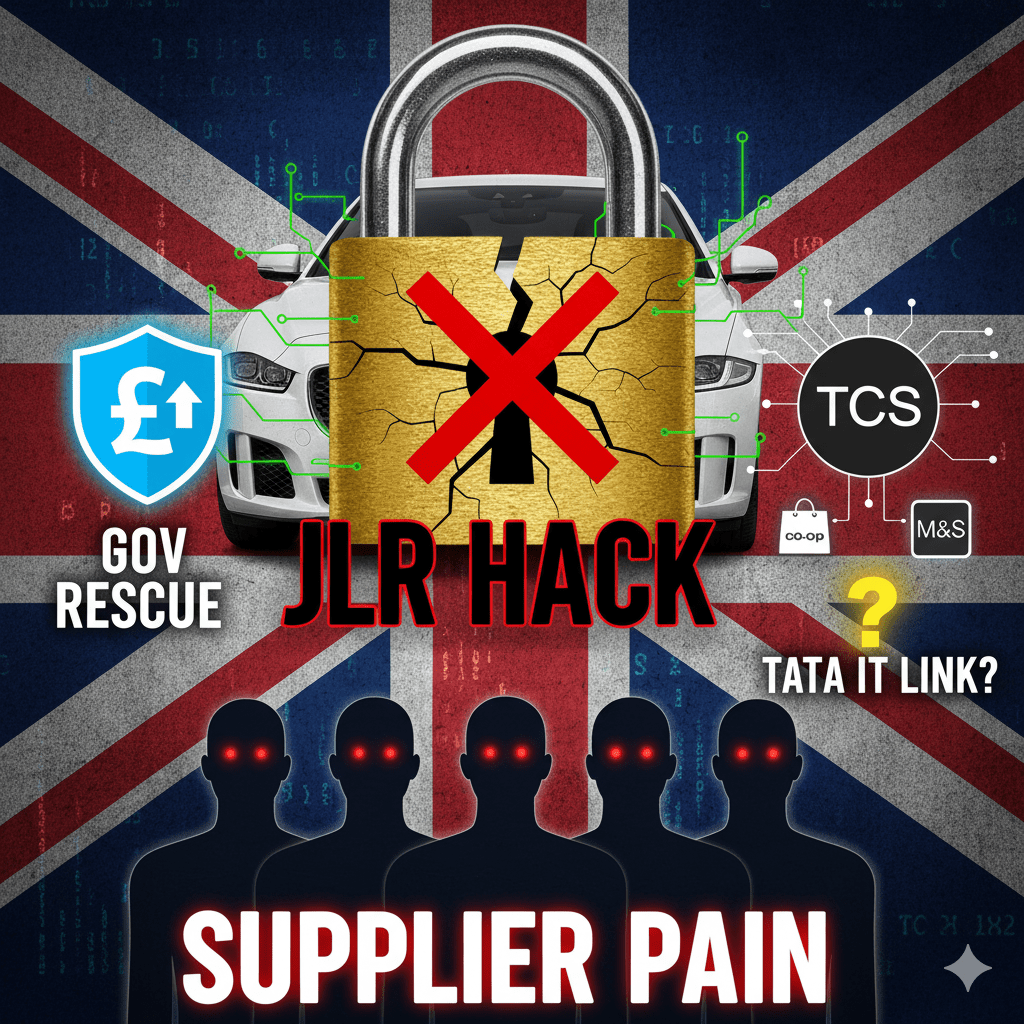
A £1.5bn government rescue may keep Jaguar Land Rover afloat after a crippling cyberattack – but questions linger over a suspected IT weak link connecting JLR, M&S and the Co-op
It sounds like the plot of a cyber-thriller – but it’s happening in real life. Britain’s biggest carmaker, Jaguar Land Rover (JLR), has been brought to its knees by hackers, with production halted for weeks, suppliers on the brink, and billions in lost revenue. Now the UK government has stepped in with a £1.5 billion loan guarantee to keep JLR afloat and protect jobs.
But as the rescue unfolds, a more uncomfortable question is emerging: was this simply bad luck, or could there be a weak link inside JLR’s own technology backbone?
The Government Steps In
On 27 September, ministers confirmed a £1.5bn loan guarantee through UK Export Finance. The package is designed to give JLR liquidity to keep paying suppliers and stabilise operations while systems are rebooted. Government is also exploring direct aid for the supply chain – from buying up unsold parts to easing tax and loan burdens on small firms.
It’s a recognition that JLR is a strategic national asset. Too many jobs, too many communities, and too much prestige are at risk for government to stand by. But it’s also not a blank cheque. Guarantees come with conditions, scrutiny, and awkward questions about how Britain’s automotive crown jewel ended up in this mess.
Supplier Pain, Worker Stress
The impact has been brutal. JLR’s factories have been silent for weeks. Suppliers, many of them small and family-owned, are running out of cash. Some are already cutting jobs or furloughing staff. Even JLR workers have reportedly been told they can sign on for benefits during the downtime.
This isn’t a chip shortage, a strike, or a pandemic. This is hackers pressing pause on an industry worth tens of billions.
The Suspected Weak Link
Here’s where it gets even more intriguing. The Telegraph and other outlets are reporting a common thread between the JLR hack and earlier cyber incidents at Marks & Spencer and the Co-op. The suspected weak link? Tata Consultancy Services (TCS).
TCS is one of the world’s biggest IT providers – and part of the same Tata Group that owns JLR. It also holds long-term contracts with M&S and Co-op. In the M&S breach earlier this year, hackers reportedly used TCS employee credentials to gain access. TCS denied its systems were compromised but admitted accounts were misused.
And now JLR.
Coincidence, Negligence… or Complicity?
Let’s be clear: there is no public forensic evidence that TCS was the entry point for the JLR attack. Neither JLR nor UK authorities have named a vendor.
But with three major UK companies hacked in one year, all with TCS links, the questions practically ask themselves:
- Is this just a coincidence?
- Is it negligence – poor access controls, weak credential hygiene, over-privileged accounts?
- Or is there a darker possibility of complicity?
Complicity would mean someone inside knowingly helped the hackers. There’s no proof of that, but negligence – failing to detect or prevent account abuse – is much harder to dismiss.
Either way, the optics are terrible.
Why It Matters
If a single IT provider is the weak link, dozens of British businesses could be exposed to the same risk. For JLR, the embarrassment is doubled: the company relies on Tata’s IT arm for digital transformation. If Tata’s own systems were involved, even indirectly, it raises questions of corporate oversight and accountability inside the group itself.
For government, too, it’s uncomfortable. Ministers are funnelling billions in guarantees to save JLR, but if the wider Tata organisation failed to secure Britain’s automotive crown jewel, taxpayers will demand answers.
Final Thought
So here we are. A £1.5bn government rescue, suppliers in pain, workers on edge – and a suspected weak link that could connect JLR, M&S and the Co-op.
Coincidence? Negligence? Or complicity? It’s impossible to say, but the questions won’t go away.
One thing seems apparent: the automotive industry’s real battle for survival may not be on the factory floors, it could be in the servers that run their IT systems.
If you found this useful, interesting or fun, consider supporting me via Patreon, Ko-Fi, or even grabbing a copy of one of my books on Amazon. Every bit helps me keep creating independent automotive content that actually helps people.
Support independent car journalism 🙏🏽☺️ grab my books on Amazon, take up membership to BrownCarGuy on YouTube, or join me on Ko-Fi or Patreon.

👉🏽 Channel membership: https://www.youtube.com/browncarguy/join
👉🏽 Buy me a Coffee! https://ko-fi.com/browncarguy
👉🏽 Patreon – https://www.patreon.com/BrownCarGuy

MY BOOKS ON AMAZON!
📖 Want to become an automotive journalist, content creator, or car influencer? Check out my book: How to be an Automotive Content Creator 👉🏽 https://amzn.eu/d/7VTs0ii
📖 Quantum Races – A collection of my best automotive sci-fi short stories! 👉🏽 https://amzn.eu/d/0Y93s9g
📖 The ULEZ Files – Debut novel – all-action thriller! 👉🏽 https://amzn.eu/d/d1GXZkO
Discover more from Brown Car Guy
Subscribe to get the latest posts sent to your email.
