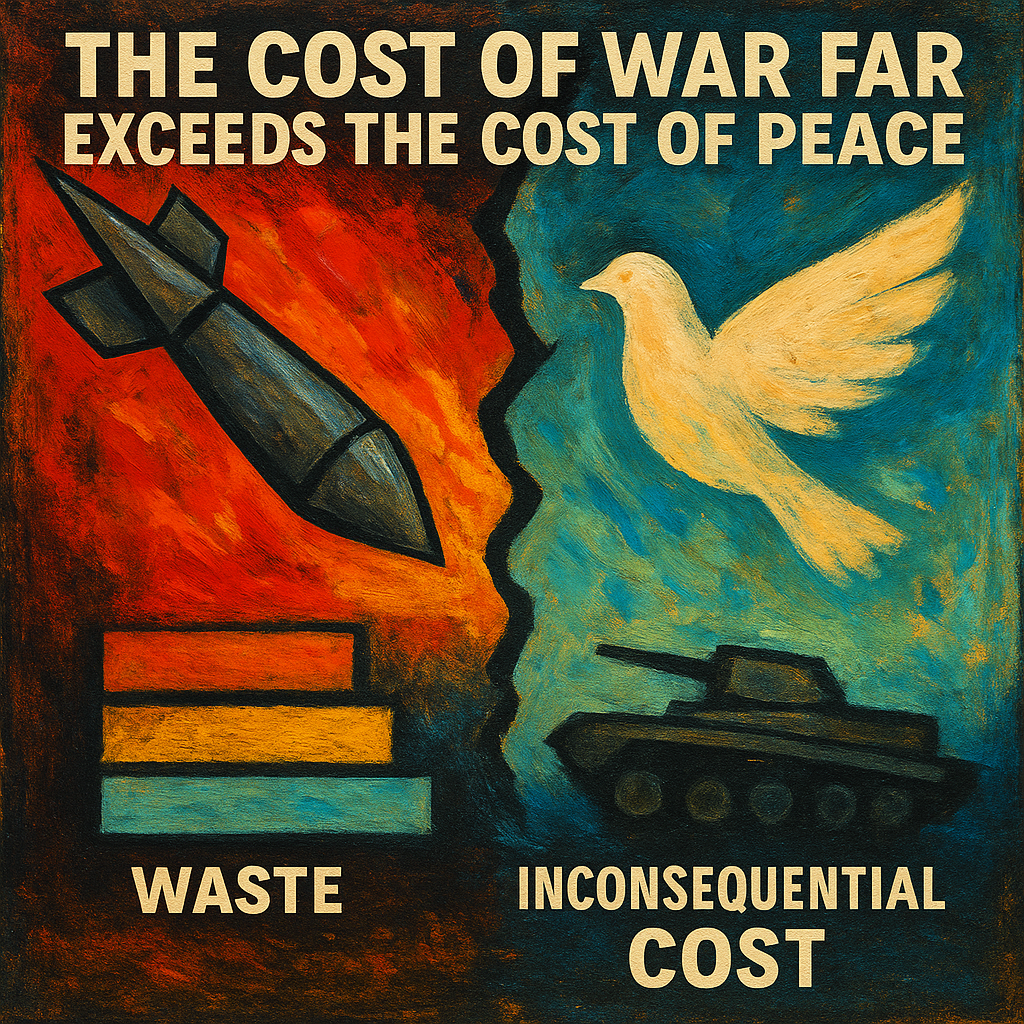
Why Weapons Drain Trillions While Health, Education & Poverty Solutions Cost a Fraction
Exactly a decade ago, I did the numbers and worked out that the price of peace was far cheaper than the cost of war – does that still hold?
Back in 2015, it frustrated me. War and the meaningless death and destruction. The clash of egos of tiny men with big insecurities, leading to catastrophic consequences – the wiping out of tens of thousands of lives, the demolition of cities and infrastructure, and the absolutely shockingly immense cost of it all.
So, exactly ten years since I first laid out the obscene arithmetic of war versus peace, I’ve decided to take another look.
Back then, I hoped the sheer absurdity of the numbers might jolt us into a profound ‘WHOA!’ moment. Stop, think, choose constructive instead of destructive and put the world’s finances and resources to helping and building rather than killing and demolishing. Sadly, we’ve learned nothing.
We still have wars tearing countries to shreds. We still see children pulled from rubble. And we now appear to be perched on the precipice of even wider conflict – with new alliances and blocs hardening in a way that uncomfortably mirrors the build-up to World War II.
The Obscene Cost of War
Meanwhile, the costs of our stupidity continue to rack up. $20,000 per drone, $200,000 per missile, $3.73 million per Patriot interceptor missile, $10 million per Abrams tank, $82.5 million per F-35 fighter jet and up to an eye-watering $300 million plus for the new Next-Gen F-47! Imagine the bottom lines dripping in ghastly red ink.
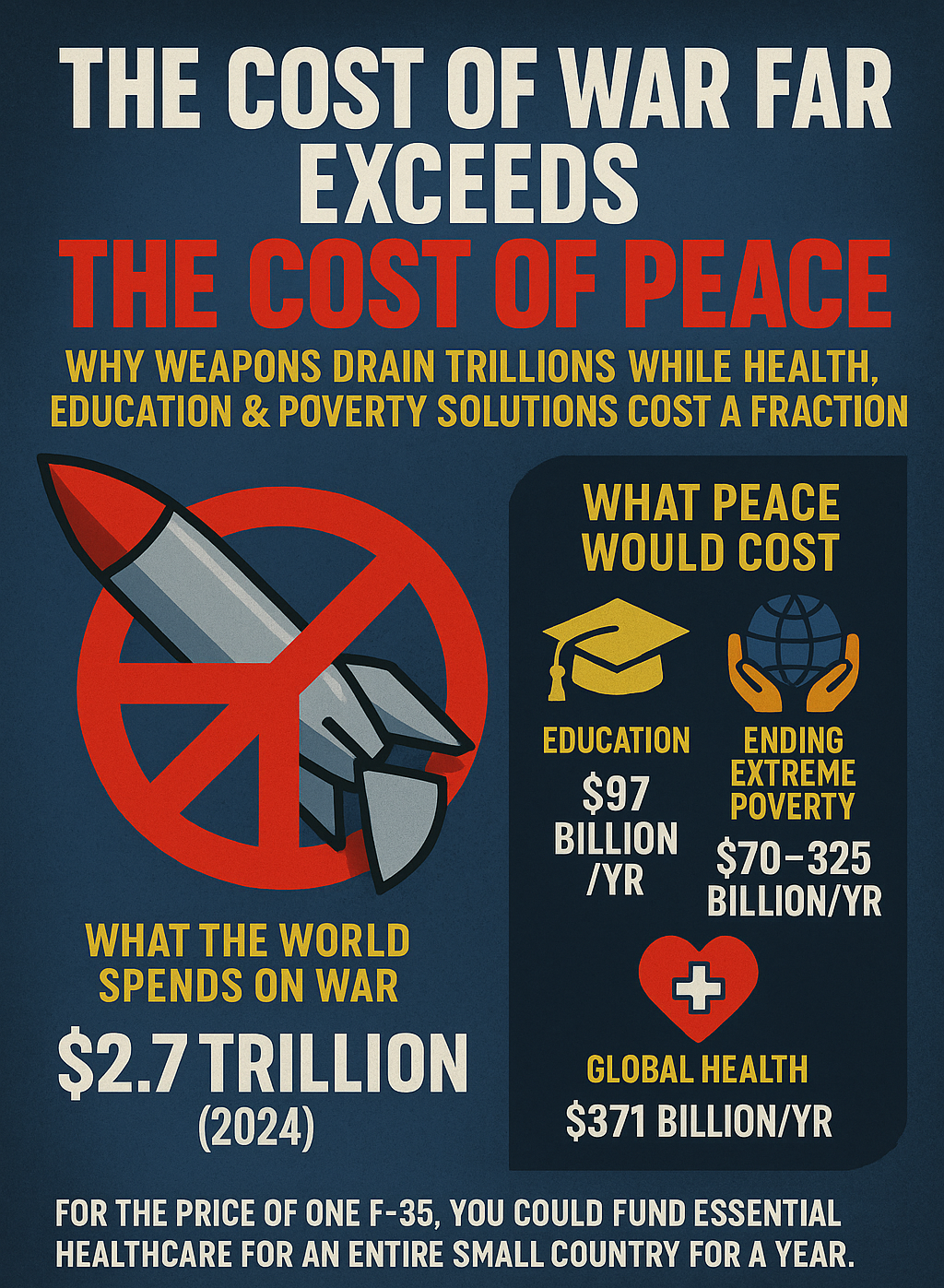
Think of these big numbers. We’re talking a school for a village, a hospital for a town, or food for an entire region – blown up in a single trigger pull. For the price of one F-35, you could fund essential healthcare for an entire small country for a year.
The lesson of history is clear, but humanity keeps retaking the same failed exam. But what I want to know, a decade on – do my arguments still wash? Oh yes, and then some.
What the World Spends on War
- Global military spending (2024): $2.7 trillion – a record high, up 37% in real terms since I first wrote about this in 2015.
- Economic impact of violence (2024): nearly $20 trillion – about 11.6% of world GDP. That’s one in every nine pounds, dollars, or rupees vanishing into the black hole of destruction and then reconstruction.
- U.S. post-9/11 wars: already $8 trillion in direct costs, with another $2-3 trillion still to come in veterans’ care and interest till 2050.
- According to most estimates, every day of the war in Ukraine costs Russia $500 million to $1 billion.
- The economic toll of Israel’s ongoing war on Gaza reached approximately 250 billion shekels ($67.57 billion) by the end of 2024.
This is money spent not on creating, but on un-creating. And on the man-made, orchestrated, deliberate death of fellow human beings.
What Peace Would Cost
Education
- 272 million children and teens are still out of school worldwide, including nearly 80 million of primary age.
- The financing gap to achieve universal schooling in low and lower-middle-income countries is about $97 billion a year – less than 4% of global military spending.
- Just for context, Elon Musk bought Twitter for £44 billion! An insubstantial platform of misinformation or educate half the world’s kids?
Ending Extreme Poverty
- The latest World Bank thresholds put the annual cost somewhere between $70 billion and $325 billion, depending on how you define and deliver it.
- That sounds like a huge number. However, it’s only about 3-12% of global defence budgets that could literally eradicate extreme poverty everywhere.
Global Health
- Providing a package of essential health services across all low and middle-income countries would require an extra $371 billion a year.
- That’s 14% of annual military spending – pocket change compared to the price of a global arms race.
- And again, just for context, the net worth of the world’s richest man, Elon Musk, again, just ONE MAN, is estimated to be around $400 billion. Frankly, that’s disgusting.
The Stark Comparison
| Challenge | Annual Cost | % of Military Spend (2024 = $2.7T) |
|---|---|---|
| End extreme poverty | $70–325B | 3–12% |
| Universal education | $97B | 3.6% |
| Essential health services | $371B | 14% |
| UN peacekeeping budget | $5.6B | 0.2% |
Let’s be brutally clear: Ending poverty, educating every child, and providing basic healthcare for all would together cost at most, less than a third, of what we spend on militaries every year.
Yet here we are, still happily funding destruction, eradicating communities, raping the earth with our missiles, and rationing hope.
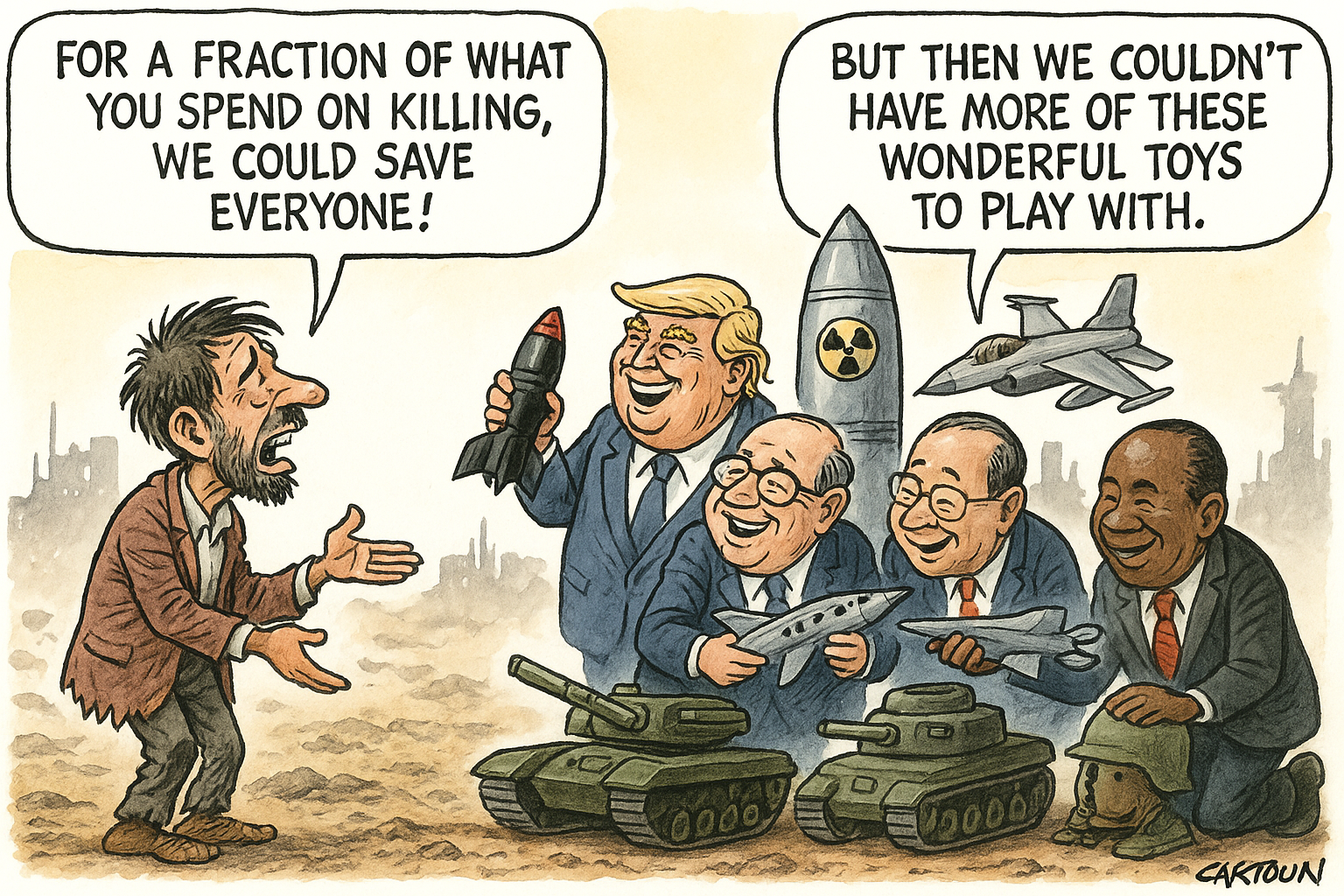
The Artificial Intelligence Factor
What has changed since I wrote the original piece in 2015 is the AI factor.
We’re already seeing Generative AI tutoring platforms slashing the cost of personalised education, bringing one-to-one style teaching to children who’d otherwise never see a qualified teacher.
In healthcare, AI diagnostics are spotting cancers earlier, reading scans faster, and helping doctors treat more patients for less money.
So not only is peace already cheaper – AI (if empathically deployed) could make peace even cheaper still. The cost-benefit gap between war and peace is widening into a chasm.
Why does this equal Peace?
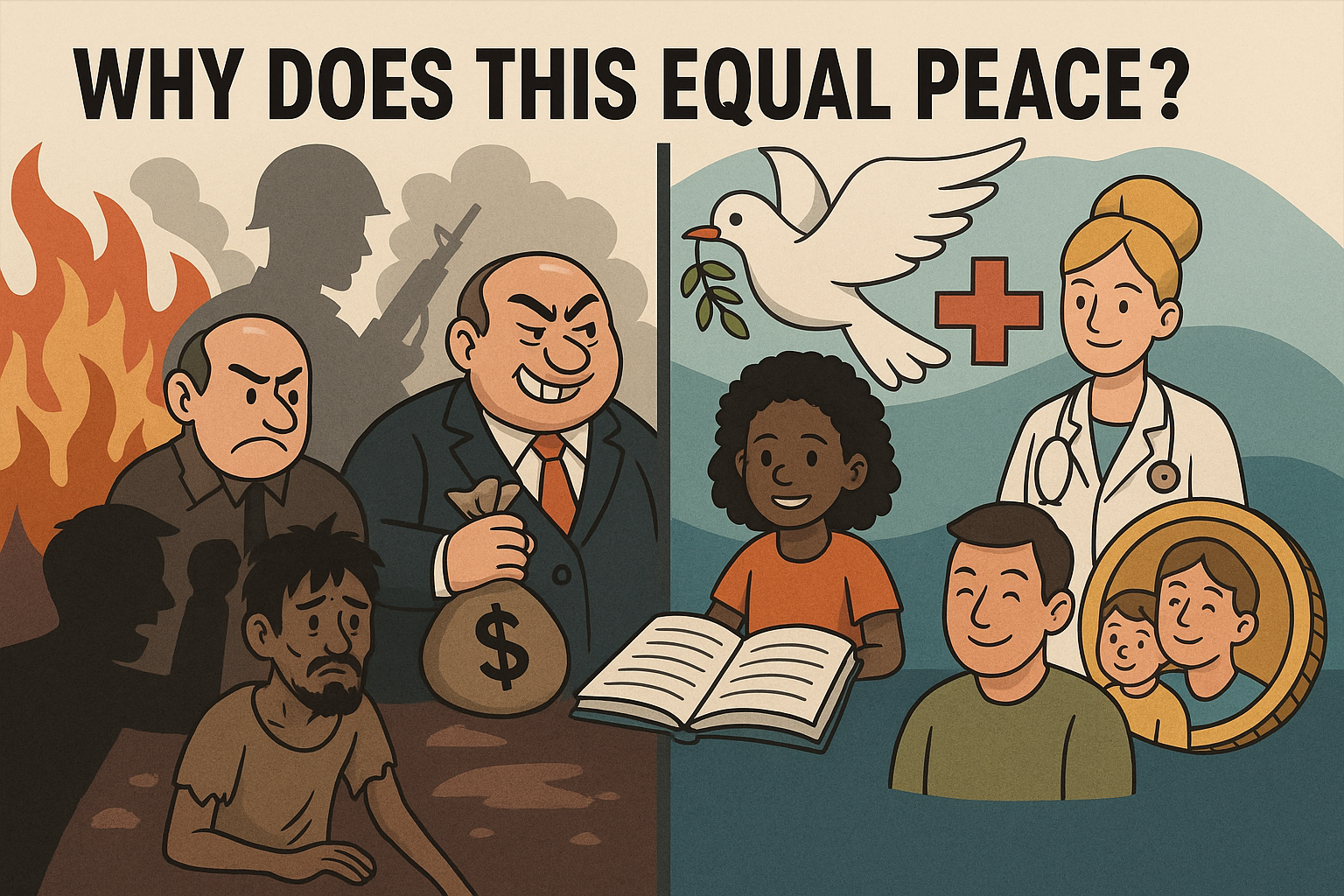
You may be wondering why I keep claiming that education, poverty and health care equal peace.
It’s simple, remove the elements of greed, corruption and egos in world leaders, and the only reasons for conflict and war that really emerge are ignorance, poverty and desperation.
If people are doing okay in terms of finances and health, and are wise enough to be aware of the perils of war – there won’t be any need for it.
And this isn’t just me ranting into the void – some of the smartest thinkers in history back this up.
- Structural Violence – Johan Galtung
One of the fathers of peace studies, Galtung argued that when societies deny people basics like health, education, and stability, that deprivation itself is a form of violence. You don’t need guns and bombs for conflict to brew – leave people poor, sick, or uneducated, and the roots of war are already planted. - Human Needs – Edward Azar’s Conflict Theory
Azar showed that wars drag on when basic human needs – things like security, recognition, and participation – go unmet. Ignore those, pile on inequality or exclusion, and you’re basically constructing the foundations of conflict brick by brick. - Equality Equals Stability – Wilkinson & Pickett
Their research proves that more equal societies aren’t just nicer places to live, they’re safer too. Less violence, better mental health, stronger social bonds. In short, the more people share in health, education, and prosperity, the less reason there is for conflict to ignite in the first place.
Will we EVER LEARN or do we need to be taught?
When I wrote the original piece in 2015, I thought the numbers might shame us into sanity. Instead, the world has doubled down on madness, flirting once again with great-power conflict while ignoring the far smaller bills that would buy us a healthier, smarter, more stable world.
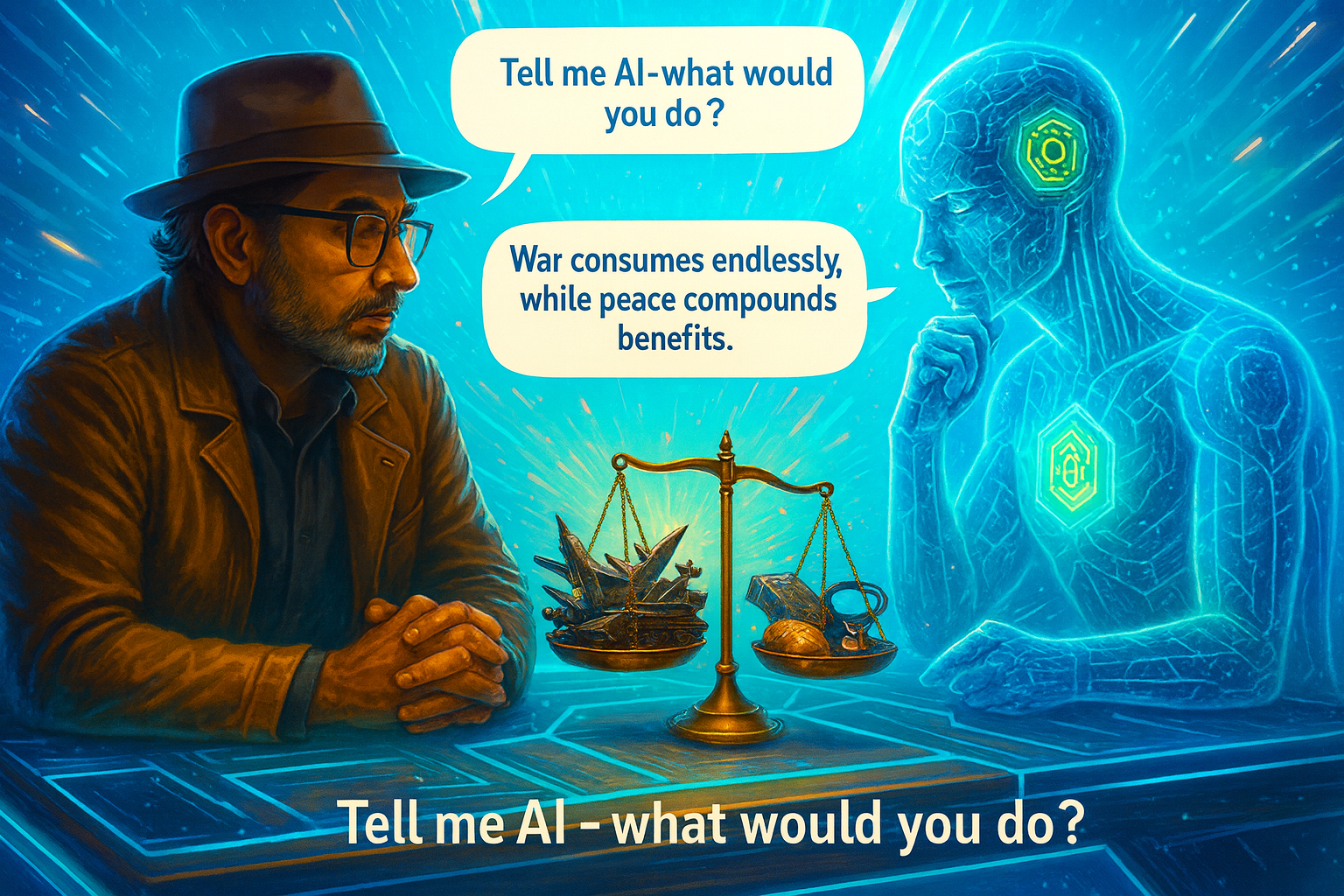
And it begs the question: if AI really did take over decision-making, what would it choose to do with humanity’s resources?
Well, I asked the latest version of ChatGPT, and this is what it replied:
“If given the choice, I would allocate resources to peace, education, healthcare, and human flourishing. Weapons build fear; knowledge builds futures. War consumes endlessly, while peace compounds benefits. If logic alone ruled, peace would always win.”
If only our leaders were that rational.
If you found this useful, interesting or fun, consider supporting me via Patreon, Ko-Fi, or even grabbing a copy of one of my books on Amazon. Every bit helps me keep creating independent automotive content that actually helps people.
Support independent car journalism 🙏🏽☺️ grab my books on Amazon, take up membership to BrownCarGuy on YouTube, or join me on Ko-Fi or Patreon.

👉🏽 Channel membership: https://www.youtube.com/browncarguy/join
👉🏽 Buy me a Coffee! https://ko-fi.com/browncarguy
👉🏽 Patreon – https://www.patreon.com/BrownCarGuy

MY BOOKS ON AMAZON!
📖 Want to become an automotive journalist, content creator, or car influencer? Check out my book: How to be an Automotive Content Creator 👉🏽 https://amzn.eu/d/7VTs0ii
📖 Quantum Races – A collection of my best automotive sci-fi short stories! 👉🏽 https://amzn.eu/d/0Y93s9g
📖 The ULEZ Files – Debut novel – all-action thriller! 👉🏽 https://amzn.eu/d/d1GXZkO
Discover more from Brown Car Guy
Subscribe to get the latest posts sent to your email.

Leave a comment