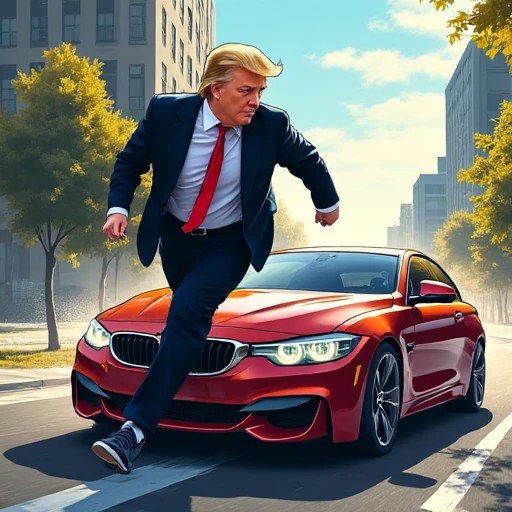
Could This Crash the Car Market and Make Your Next Motor More Expensive?
For nearly three weeks, I’ve been trying to write about Donald Trump’s return to the White House and what it means for the car industry. But every time I sit down to put my thoughts together, bam! – another policy shift, another executive order, another round of economic chaos. Trying to keep up with this has been like watching Final Destination – one unexpected turn after another, except instead of people dodging fate, it’s automakers dodging tariffs.
So, what’s going on? How will this affect the cost of cars, the future of electric vehicles, and – most importantly – your next car purchase? Let’s break it all down.
Trump’s 25% Auto Tariff Tantrum: What’s the Deal?
A few days ago, Trump announced a 25% tariff on all cars and parts from Mexico and Canada – sending shockwaves through the auto industry. The justification? Protecting American jobs, boosting domestic manufacturing, and cutting reliance on foreign supply chains. But in reality, this move had carmakers sweating bullets.
Why? Because a huge chunk of the American car industry runs on parts and assembly lines in Mexico and Canada.Ford, GM, Stellantis, and Volkswagen all rely on North and South American supply chains to keep costs down. Slapping a 25% tax on every car or component crossing the border wouldn’t just hurt Mexico and Canada – it would hit the wallets of American consumers hard.
GM even estimated this tariff could add $3,000 to the cost of every vehicle they sell. That’s right – taxing imports means higher production costs, which means higher showroom prices for new cars. So much for ‘saving American consumers’ from expensive foreign goods!
And Then… The Tariffs Were Put on Hold. For Now.
Just as Canada and Mexico started preparing retaliatory measures (including a threat from Justin Trudeau to make American bourbon more expensive – that got em!), Trump suddenly put the tariffs on pause for 30 days.
Why? Because Canada and Mexico agreed to ramp up their border enforcement and tackle drug trafficking – proving once again that in Trump’s world, trade policy and dictatorship are basically the same thing. But let’s be real – this is only a temporary pause. If Trump wakes up one morning and decides the deal isn’t working, those tariffs could be back overnight.
And that’s the real issue here – it’s not just about whether tariffs happen. It’s the uncertainty. The auto industry operates on long-term planning – manufacturers don’t just move factories on a whim. This kind of instability means carmakers are now hesitating over investments, potentially slowing production, cutting costs elsewhere, or – yep – raising prices just in case.
The War on EVs: Another Blow to the Future of Cars?
If the tariffs weren’t enough, Trump also scrapped Biden’s push for 50% of new cars to be electric by 2030. Now, to be fair, there was never an official ‘EV mandate’ – just incentives like tax credits to encourage EV adoption. But Trump has now removed the $7,500 federal tax credit for electric vehicles and halted federal investment in charging infrastructure.
So what does that mean? If you were planning to go electric, your new Tesla or Ford Mustang Mach-E just got a lot more expensive. And if you were hoping for better public charging stations, well… good luck finding one that’s not already taken by a bloke in a petrol car ‘just stopping for five minutes.’
That being said, Tesla might weather this storm better than most. Unlike Ford or Volkswagen, they don’t rely on Mexican imports for their U.S. supply, and they already slashed their prices last year to stay competitive. But for anyone else in the EV market, this is a real setback.
How Will This Affect the UK and Europe?
Right now, Trump’s tariffs haven’t hit Europe. Yet. But he’s already hinted that the EU could be next in line. If that happens, expect BMW, Mercedes, Volkswagen, and other European manufacturers to get slammed with massive import taxes on any cars they sell in the U.S.
And here’s where it gets worrying for UK buyers. If European brands start losing money in the U.S., they’ll have to make up for it somewhere. That means increasing prices in other markets – including Britain.
Put simply: if Trump taxes German cars, you’ll be paying more for your next BMW or Audi, even if you’re buying it in London.
And that’s before we even consider how supply chains will get hit. The car industry is global – parts, components, brakes, gearboxes and even engines are made in different countries and shipped across the world. If tariffs disrupt supply chains, production delays and price increases will follow.
Will Chinese Automakers Take Over?
Here’s the really interesting part. While Trump is busy slapping tariffs on Mexico, Canada, and potentially Europe, guess who’s watching and rubbing their hands with glee?
China.
Chinese car brands – BYD, Nio, MG, Geely, GWM, XPeng etc – are already growing fast in the UK and Europe, and they don’t have to worry about Trump’s trade wars. In fact, with Western brands struggling to keep costs down, Chinese manufacturers can swoop in with cheaper, high-tech alternatives.
Think about it – if a BMW i4 costs £60,000 and a BYD Seal with similar range, tech, and quality costs £30,000, which one are people going to buy? The answer is obvious.
In the coming years, we could see a situation where Chinese cars flood the UK market while European and American manufacturers struggle with costs, tariffs, and supply chain chaos. And whether you’re a fan of Chinese cars or not, that’s something worth thinking about.
Final Thoughts: What Now?
So, where does all of this leave us? Here’s the short version:
- Car prices could rise—fast. Even though tariffs are ‘on hold,’ manufacturers are already on edge.
- Electric vehicles just became harder to buy. Without tax incentives, EV adoption in the U.S. might slow down.
- The UK could see higher prices on European cars. If German manufacturers lose U.S. sales, they’ll increase costs elsewhere.
- China wins this round. With Western brands distracted by trade wars, Chinese carmakers are in the perfect position to take over more of the market.
What do you think? Are tariffs a necessary step to protect domestic industry, or is this just making things worse for car buyers? Let me know in the comments below!
And if you’re thinking about buying a new car – you might want to do it soon. The prices aren’t coming down anytime soon.
Follow all my channels https://linktr.ee/browncarguy
Get my books! https://amzn.eu/d/9fwhSoQ | https://amzn.eu/d/9IHhqXA
Sponsor my content from as little as £3 at https://ko-fi.com/browncarguy
Big Thanks to my Supporters!
CraftLab (https://www.CraftLab.my)
Tom Conway-Gordon (https://www.instagram.com/anycoloursolongasits_black/)
And others! 🙏🏽☺️
Discover more from Brown Car Guy
Subscribe to get the latest posts sent to your email.

Leave a comment