
Far from being at odds, what the Old and Young Are Really Saying
Things just got weird. I’m not talking about Trump being back in the White House – although that’s certainly part of it – nor am I referring to the world’s richest man doing a Nazi salute on stage and seemingly modelling himself on Moonraker villain Hugo Drax (because let’s face it, that’s exactly who he’s emulating, isn’t he?). No, I’m talking about the phrase “never the twain shall meet” being exposed as a complete falsehood. The twain are meeting, intertwining, and connecting on multiple levels. Let’s take a look at the generational gap that’s apparently no gap at all. Shockingly, the young and old are sharing surprisingly similar frustrations about the politics of the day.
British voters and Generation Z, two groups typically at odds on everything from avocado toast to climate protests, have somehow found themselves on the same platform. Miraculously, they’re not shouting at each other. Instead, they’ve turned their collective frustration on regimes that fail to function effectively. They’re both yearning for something: a strong leader, decisive action, and a break from the perpetual revolving door that is Westminster politics. Two separate surveys – coincidentally released yesterday and both carrying jaw-dropping revelations – have exposed an underlying discontent that bridges generational divides and raises serious questions about the state of Britain today.

Survey Reveals Brits Like Trump Policies
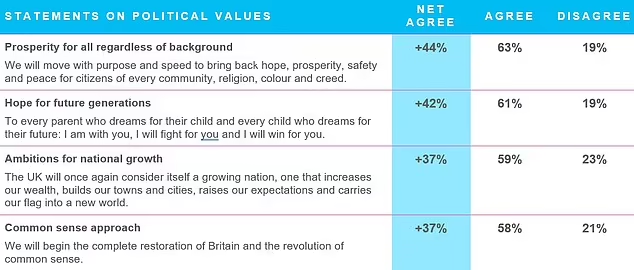
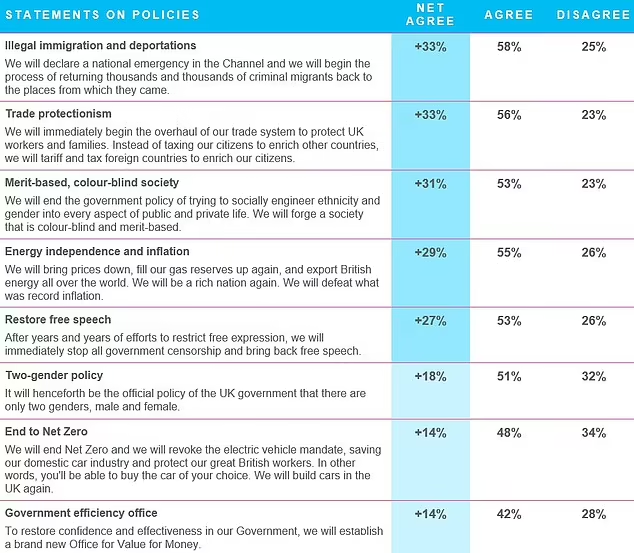
Let’s start with the first survey, the one that asked British voters to judge a raft of policies without revealing their origin. The concept was straightforward yet undeniably clever. Stripped of Donald Trump’s name, excerpts from his inauguration speech were repackaged as potential political policies tailored for the UK. The result? A significant portion of Brits gave their stamp of approval. Astonishing, isn’t it?
How significant? Some 58% supported “declaring a national emergency in the Channel” to tackle illegal immigration, echoing Trump’s declaration of a national emergency at the US-Mexico border.
Meanwhile, 55% backed “filling up our gas reserves and exporting British energy all over the world,” a sentiment reminiscent of Trump’s pro-fossil fuel actions during his presidency.
The idea of “forging a merit-based, colour-blind society” also gained traction, with 53% of respondents supporting it. This phrase, used by Trump in pushing back against diversity, equity, and inclusion (DEI) schemes, resonated with voters across the political spectrum.
Advisory firm Nepean, which commissioned the survey, found that Conservative and Reform voters overwhelmingly supported these policies. Interestingly, there was also significant backing from Labour voters, particularly on policies such as “overhauling our trade system to protect UK workers.” However, proposals like “Ending Net Zero,” “there are only two genders,” and “removing support for electric vehicles” received the least support, reflecting more polarised opinions on these issues.
Now, let me be clear: I am no fan of Trump. His rhetoric, his hubris, his divisiveness, his Twitter meltdowns – he is unsuited to eminence, overrated in competence, and, frankly, the second most dangerous man on the planet right now (Drax being number one, of course). And that’s all without mentioning his propensity for grabbing pussy, as well as scandal, lawsuits, and convictions.
Nonetheless, the policies derived from his ramblings do appear to have struck a chord – not just Stateside, where they secured him a landslide victory, but also here in the UK. That’s despite our general tendency to scoff at the idea of electing such an oaf into office; though let’s not forget we did have Liz Truss, albeit mercifully briefly. Could it be that, stripped of their association with the man himself, these policies aren’t quite so unappetising to the majority after all? Are we, in our disdain for Trump, foolishly discarding ideas that might actually work? We’ll come back to that.

Young Brits Think a Dictator Would Be Better For Us!
Let’s now turn our attention to the second survey, which takes us to the younger end of the spectrum.
Some 52% of Gen Z – people aged between 13 and 27 – said, “the UK would be a better place if a strong leader was in charge who does not have to bother with parliament and elections.” The poll, conducted for Channel 4’s ‘Gen Z: Trends, Truth and Trust’ report, also found that one in three young people want the army in charge of the country. So essentially, we’re talking about a military dictatorship. Meanwhile, 47% agreed that “the entire way our society is organised must be radically changed through revolution.”
Those are big numbers – scarily big. Too big to be casually swept under the carpet of amused apathy. These aren’t fringe opinions; they’re alarm bells ringing loud and clear.
When over half of Gen Z respondents believe Britain would be better off under a strong leader who doesn’t have to bother with the tedious business of elections or parliamentary debates, even one with the authority to deploy the army internally to enforce their will – if that doesn’t make you sit up and take notice, I don’t know what will.
My Experience of Dictatorships
I’ve had some experience with these governance models. I spent part of my formative years in Jeddah, Saudi Arabia during the 1980s. The restrictions were, to put it mildly, suffocating. You couldn’t do much, and whatever you dared to contemplate usually carried unpleasant consequences. So, you ended up spending your time listening to bootleg pop music cassettes on your Sony Walkman, munching on shawarma, and sipping a bottle of Bepzi.
Visiting Karachi, Pakistan in the mid-1980s allowed me to witness the military dictatorship of General Zia-ul-Haq firsthand. And you know what… it wasn’t entirely bad. It’s an unpalatable but honest truth that those couple of visits were the safest and most carefree I’ve ever known the ancestral homeland to be. Families would wander unchaperoned at 2am through deserted residential streets without fear of assault or attack. Today, some people require armed security just to step beyond the polished marble thresholds of their villas. Of course, there was corruption back then, but even that has worsened over time. To be fair, Pakistan is not as dangerous as some might make out, but you still need to stay on your toes most of the time, unlike the casual era of my youth.
And then, of course, I lived in the UAE. It’s a sort of benign dictatorship: behave yourselves, and we’ll keep making things better. Improved infrastructure, more opportunities, unparalleled safety, and security – frankly, it’s a fantastic place to live where everything just works. Roads are built overnight, crime is practically non-existent, and you don’t waste half your life stuck in a queue for a GP appointment.
But let’s not kid ourselves. The history of dictatorship is littered with atrocities, from Pinochet to Pol Pot. The key word here is “benign,” and that’s a rare breed indeed. So, while I understand the appeal of a strongman who can “get things done,” it’s a slippery slope – one we should tread with extreme caution.

Young and Old Alike?
What’s fascinating, though, is the stark similarity between these two groups. The older generation, likely the ones nodding along to Trumpian policies, and the younger generation, disillusioned with democracy itself, are essentially saying the same thing: “Things as they stand just aren’t working anymore.” But how have we reached a point where such vastly different demographics share a common sense of despair? And what can be done about it?
Let’s face it: Britain’s leadership has been uninspiring, to put it mildly. We’ve seen a revolving door of prime ministers, each one promising change and delivering… well, very little, and even that often with disastrous results. From Brexit to the pandemic to the cost-of-living crisis, responses have been wishy-washy, reactive, and devoid of any long-term vision. Is it any wonder people are looking for alternatives, even if those alternatives come with authoritarian undertones?
For the older generation, the appeal of Trump-like policies likely stems from witnessing the decline of British manufacturing, the issues of illegal immigration, crumbling infrastructure, the staggering decline of the NHS, and the erosion of economic opportunities. They now yearn for decisiveness and tangible policy promises.
Meanwhile, the younger generation, bombarded with economic instability, climate anxiety, and a social media-driven culture of instant outrage, sees little hope in the current system. Incredibly, they perceive revolution and radical change as the only way forward. Do we really want to see youths out on the streets, fiercely expressing their anger and frustration in protests against “The Man” live-streamed on TikTok?
What’s the solution? How do we channel this collective discontent into something constructive, rather than letting it spiral into extreme action or simmering apathy?

Step 1: Strong Leadership with Accountability
First and foremost, we need leaders who can inspire trust and respect across the board. This doesn’t mean we need a dictator, but it does mean we need someone who can articulate a clear vision, make tough decisions, and, crucially, stick to them. Accountability must be at the heart of this leadership. Voters need to see that promises made are promises kept. Even if that means reforming political systems to make them more agile and less bogged down by bureaucracy.
Step 2: Reignite Civic Engagement
Both young and old feel disconnected from the democratic process. It’s time to bring people back into the fold. This could mean more direct democracy – think citizen assemblies or referenda on key issues. It could also mean enhanced civic education, ensuring people understand not just how the system works, but how they can influence it effectively. When people feel they have a stake in the process, they’re far less likely to abandon it. Of course, this idea slightly contradicts the appeal of authoritarian leadership, meaning a delicate balance must be struck.
Step 3: Address Economic Inequality
Economic anxiety is a common thread running through both surveys. For older voters, it’s about financial security, preserving a standard of living, and having timely access to GP appointments and medical care. For younger ones, it’s the crushing weight of student debt, unaffordable housing, and a bleak job market. Tackling these issues head-on – through policies that promote fair wages, affordable housing, and robust job creation – is vital for restoring faith in the system.
Step 4: Embrace Pragmatism Over Ideology
One reason Trump’s policies resonate, even in Britain, is that they’re perceived as practical solutions to real problems. Whether it’s energy independence or trade protectionism, these ideas appeal because they address tangible concerns. British politicians might do well to focus less on ideological posturing and more on pragmatic, results-oriented policies.
Step 5: Foster a Unified Vision
Right now, Britain feels fragmented. Whether it’s the divide between Leavers and Remainers, young and old, rich and poor, or black and white, the cracks are painfully evident. We need leaders who can articulate a vision that brings people together rather than driving them further apart – which, unfortunately, seems to be the hallmark of many right-wing campaigns.
This isn’t about eradicating or dismissing diversity. On the contrary, infinite diversity in infinite combinations is something to be celebrated and is uniquely British, a rare positive legacy of the country’s marauding Imperial past. By addressing not just economic divides but cultural and social ones as well, we can create a shared sense of purpose that works wonders for national morale.
Step 6: Leverage Technology Responsibly
Given the younger generation’s reliance on social media for information, there’s a clear need for better digital literacy. At the same time, politicians and policymakers must engage with these platforms to reach younger audiences where they are. This doesn’t mean pandering or gimmicks, but genuine, transparent communication.
A Wake-Up Call
The findings from these two surveys should be a wake-up call for Britain. They reveal a nation deeply dissatisfied with the current status quo. This cannot be ignored, as politicians continuing to stumble along aimlessly, only to hand over to the next hapless hopeful destined to fail, is a recipe for disaster. Such inertia risks an eventual and inevitable societal implosion with catastrophic consequences.
I don’t want a Trump over here – and that includes no cut-price knock-off from the duplicitous far right. The current occupant of Downing Street appears earnestly clueless, while the opposition leader resembles an oblivious eager intern, pandering to the wrong crowd. She needs to be replaced swiftly by a seasoned adult – someone humbled and contrite about the party’s immediate past but armed with solid solutions to reroute and redress their errors. As it stands, none of the alternatives inspire much confidence. Frankly, there doesn’t seem to be anyone capable of stepping forward in the style people so desperately crave.
Nonetheless, we must not lose hope. Whether it’s through stronger leadership, more inclusive governance, or pragmatic policies that address real-world concerns, there is a path forward. However, this path demands courage, vision, and – perhaps most critically – a willingness to truly listen.
If these surveys reveal one thing with absolute clarity, it is that the British people, young and old alike, are crying out for meaningful change. The pressing question is this: will our leaders rise to the challenge, or will they persist in fiddling while Rome burns? For everyone’s sake, let’s hope it’s the former.
Discover more from Brown Car Guy
Subscribe to get the latest posts sent to your email.

Leave a comment